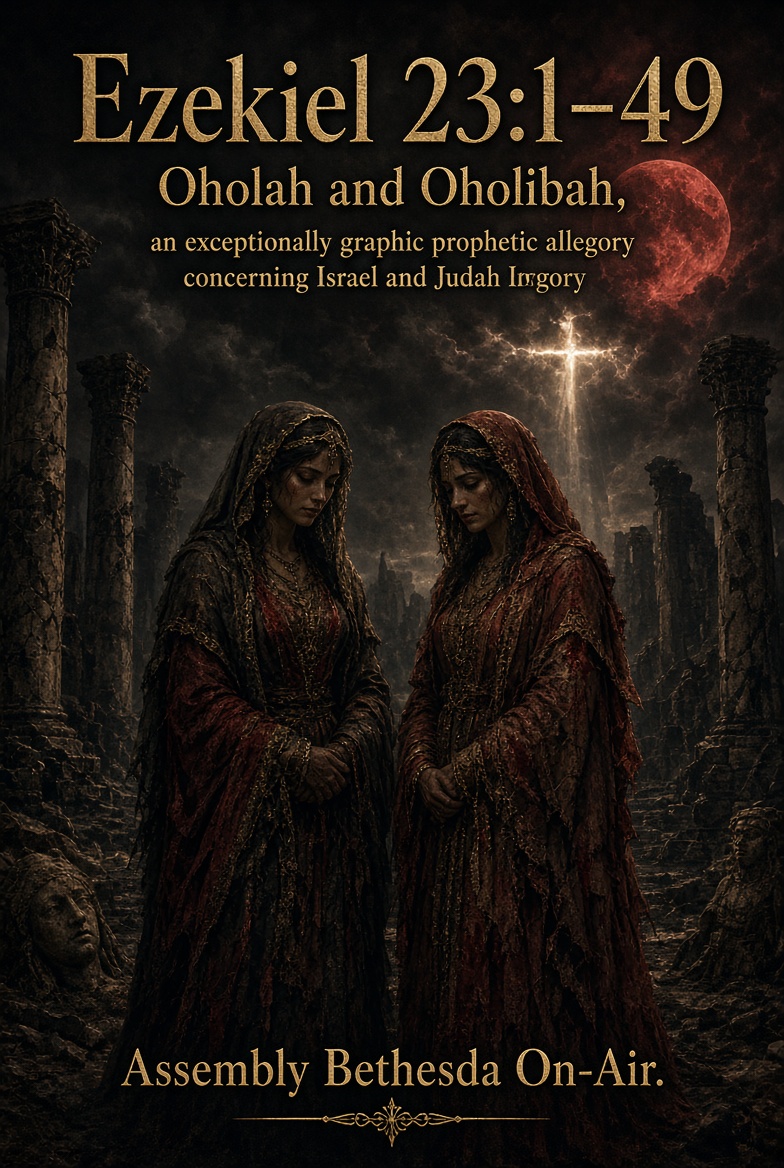
There’s a chapter in Scripture that most people skip over, or read once and never return to. A sealed door in an old cathedral sits in the middle of the prophet’s book, heavy with iron hinges and smelling of old incense mixed with something darker in it. Two sisters, Oholah and Oholibah, tell this story, and the Lord Himself tells it with no softening at all. This isn’t polite religious language. Here’s what happens when people of God chase other lovers and call it freedom.
It’s all in the names. Oholah means “her own tent,” pointing to Samaria, the northern kingdom of Israel. Oholibah means “my tent is in her,” pointing to Jerusalem and Judah. Both of them were born into the Lord’s family. He brought them out of Egypt, and set His name upon them. But as soon as they got the chance, they started imitating the filthy practices of the nations around them.
Oholah, the older sister, runs first. She sees those polished warriors with the blue uniforms and confident stride, and she can’t look away. She invites them in. She gives herself to them. The text doesn’t blush. It describes her lust in plain, almost clinical terms because the Lord wants us to feel the shock of it. Spiritual adultery isn’t pretty when it’s called for what it is. She’s acting like a woman who’s forgotten the One who first loved her, with her alliances, her borrowed gods, her trust in foreign power instead of the living God.
In the end, the same lovers she chased ruin her. Assyrians strip her, take her kids, and leave her exposed. The Lord says He turned away from her on the day of her punishment. You don’t get a soft landing here. Covenant unfaithfulness isn’t easy.
Seeing her sister fall, seeing the wreckage, you’d think Oholibah would learn, but yet she doesn’t. Jerusalem takes the same path and multiplies it. She looks farther, to the Babylonians, those men of rank and high fashion, and her desire burns hotter than Oholah’s ever did. She multiplies her prostitution. And she even remembers Egyptian idols. She’s more corrupt than her sister, more brazen, more determined to chase every new lover she sees.
The language stays graphic because the sin is graphic. Idolatry isn’t mild preference for different religious styles. It’s a deliberate betrayal of a marriage covenant. The people of God act like a spouse who has decided marriage vows don’t apply when they set up high places, burn incense to other gods, and trust in political alliances more than in the Word of God. To make sure no one can say they misunderstood, Ezekiel has to say it out loud.
Even in this dark chapter, you can still see the Lord’s heart. He’s not a distant judge. He’s a wounded husband. The pain in the text is the pain of betrayed love. He remembers the days when these sisters were young and under His care. He remembers how He entered into a covenant with them. The judgments are harsh because love that’s been rejected doesn’t walk away. It confronts. It exposes. Unfaithful parties get the consequences they deserve.
Babylon will do to Oholibah what Assyria did to Oholah. The lovers will turn into executioners. The beauty that once drew the eye will be stripped away. The sons and daughters will suffer as a result of the parents’ choices. The text doesn’t hide the cost. Sin never stays private, it reaches into families, cities, and generations.
But the chapter doesn’t end there. There’s a day when all of the lewdness will end, when the sisters won’t play harlots anymore. There’s a purpose to judgment. In the darkest prophetic language, there is a faint outline of restoration. The same God who exposes is the same God who heals. It’s meant to cleanse, to remove idols, and to bring people back to a relationship that really gives them satisfaction.
This tension has always been understood in Christian Gothic literature. It knows that the night is real, that the shadows are thick, that human hearts are corrupt, but it also knows that Christ’s light shines in that darkness, and the darkness can’t overcome it. Ezekiel 23 isn’t comfortable to read. It never should have been. It’s a mirror for every generation tempted to trade in on the glittering promises of the world around it.
Today, we celebrate spiritual novelty, treat commitment like an optional thing, and find Scripture offensive. Despite this, the chapter still speaks. It asks us whether we have looked at the powers of the age, the ideologies, the comforts, the alliances, and decided they’re better than the God who called us. Despite watching the consequences fall on others, we still go that way. We’ve forgotten the Lord is a jealous God, not because He’s insecure, but because He loves with a holy love that won’t share us with idols.
The sisters aren’t just ancient kingdoms. They’re an image of the human heart when it drifts. They’re an alert to churches that start measuring success by the standards of the world around them. Graphic details aren’t there to titillate. They’re there to shock us awake. There’s a serious covenant. There’s a costly love. There’s a real judgment. Ezekiel’s God is still the same God who would take the full weight of our unfaithfulness on a cross outside Jerusalem centuries later.
Despite the darkness of this chapter, there’s a strange mercy in it. The same city that played the harlot would one day see the Bridegroom sacrifice himself for the unfaithful bride. The blood shed in judgment will ultimately point to the blood shed for redemption. It doesn’t end with two ruined sisters. It ends with a faithful Husband who won’t let His people go, even when they don’t want to.
Then we read Ezekiel 23 with sober eyes and grateful hearts. We let the words sink in. We don’t sanitize what God has chosen to say plainly. We turn again and again to the One who claimed us first, who still claims us, and who won’t let us go from him.