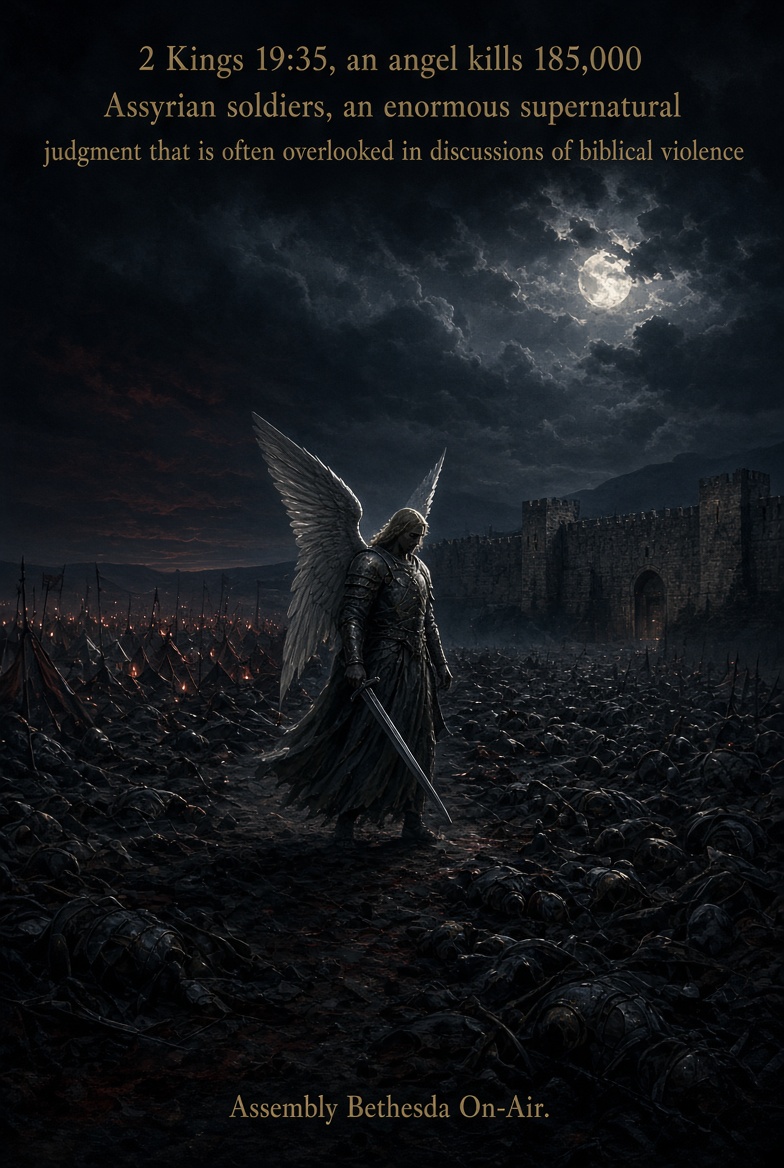
Usually when we talk about biblical violence, we talk about floods, plagues, or the conquest of Canaan. There’s a moment in Scripture that’s quiet and heavy, like a stone in a deep well. One of the largest single acts of divine judgment occurs almost in passing, when an angel strikes down one hundred eighty five thousand Assyrian troops. 2 Kings 19:35 deserves more attention than it usually gets.
In the scene are the Assyrians sweeping across the land, swallowing cities and mocking God. King Hezekiah watches the army roll across the land. The taunts are loud, the walls are thin, and the people are scared. In the dark, something moves that no human army can stop. An angel of the Lord leaves the camp. One hundred eighty five thousand conquerors never wake up. The survivors see only corpses when they look out.
Christian Gothic literature has always understood that holiness can be terrifying. The same God who comforts the broken can also walk through an army camp and leave nothing but stillness. It’s not random cruelty, it’s calculated, deliberate, and final. The angel doesn’t negotiate. The angel doesn’t warn again. It happens in quiet hours when the world isn’t expecting it.
Scripture refuses to let us keep just the gentle half of God. We like the shepherd more than the warrior, the healer more than the judge. The same Lord who binds up the wounded is the Lord who decides when an empire goes too far. Assyrians crushed nations, deported populations, and boasted that no god could stand against them. Their pride met power that didn’t need siege engines or battering rams. One messenger from heaven and one night of darkness were all it took.
It’s almost perfect in terms of Gothic atmosphere. Night. An unseen presence moving through a group of sleeping soldiers. Bodies left where they fell. Morning light revealing what the darkness already knew. No long battle descriptions, no sword clashes. All there is is the aftermath, the sudden emptiness of a camp that was full of noise and confidence a night before. Silence is the real terror, and the true glory.
Many people skip over this verse because it seems too big or too supernatural, but it doesn’t apologize for either. The text just records the fact. One hundred eighty five thousand were put to death by an angel. It wasn’t diplomatic or superior numbers that spared Jerusalem, it was a single act of divine will in the dark that spared Jerusalem. The king of Assyria turned around and went home.
Those Gothic Christian writers love stories like this because it doesn’t make God small. The angel isn’t a gentle messenger with a soft voice. Judah wakes up to a miracle that feels more like a nightmare for their enemies because the angel executes an entire judgment that disappears between sunset and sunrise. Mercy and terror come together.
The world we live in prefers its spirituality neat. We like explanations that fit within our categories. A nighttime angelic slaughter doesn’t fit. It’s too big, too sudden, too final. Because of that, it matters. It reminds us that God isn’t a projection of our preferences. God is the living God who can still the sea, open the ground, send a messenger through a military camp, and leave only dead silence.
It isn’t about celebrating the deaths. It’s about realizing the power of protection. The prophet Isaiah talked. Then the night came, and the angel moved. The sequence was deliberate. Prayer, word, judgment. The people of God didn’t lift a sword. They just waited for heaven to decide.
Christian Gothic art and writing have long understood that the holy isn’t always comforting. Cathedrals with high dark ceilings, candlelight that leaves half the room in shadow, hymns that talk about judgement as well as grace, these are the perfect places to tell a story like this. It’s not the angel of 2 Kings 19:35 who’s soft-winged. It’s the angel who breaks through an army without a sound.
It’s staggering. One hundred eighty five thousand. An entire invading force vanished in hours. The text doesn’t linger on the method, doesn’t describe pain or panic, it just states the result. It’s all about restraint. It’s left to the reader to wonder about the magnitude of what happened and the quiet authority that made it happen.
In discussions of biblical violence this episode is often skipped because it’s too clean, too supernatural, too one sided. God acts, the army dies, the threat ends. There’s no prolonged suffering, no moral ambiguity to discuss. It’s that simplicity that makes it unsettling. We like stories where we can argue about justice for pages. This one wraps up in one night.
For those who read Scripture as God’s living word, the account isn’t an embarrassment. It’s a reminder. It’s the same God that sent His Son to die for the world, and the same God who once decided that the Assyrian army had gone too far. The cross doesn’t cancel the angel. The angel doesn’t cancel the cross. Together, they paint a picture of a God whose mercy and his judgment are real, active, and beyond our grasp.
There is already a Gothic tone in the story. It’s not something we have to invent. Night. An invisible angel of heaven. A camp full of the dead at dawn. An empire forced to retreat. A people of God waking up to a deliverance they didn’t earn. There’s no explanation about how the angel did it. It’s intentional. We don’t have to figure out how it worked. We’re supposed to figure out authority, not mechanics.
Modern readers sometimes try to naturalize the account, looking for disease or panic or some other secondary cause. There is no way to escape the passage. It blatantly attributes the deaths to the angel of the Lord. To soften that claim is to ignore the passage’s plain sense. Christian Gothic sensibility refuses to accept such a suggestion. It looks at the verse and lets the weight sit. One night. One angel. One hundred eighty five thousand dead. God’s judgment isn’t always slow. There are times when it’s sudden, complete, and final.
This is the story we often overlook when we talk about violence in the Bible. It’s too big to fit neatly into our preferred narratives. It doesn’t show a long moral struggle. It just shows heaven acting with decisive force. The same night that brought death to the camp brought life to the city under siege.
It’s always been a Christian Gothic tradition to hold both realities at once: beauty and terror, mercy and judgment, light shining through darkness and darkness that can’t overcome it. It belongs to that tradition. The angel of the Lord walked through an army one night and left only silence behind. It stands as a quiet monument to that time.
We do well to remember it. Not to glory in the deaths, but to remember the power that stands behind every promise of protection. The same God who sent the angel that night still keeps an eye on His people. It doesn’t matter what His methods are, what His timing is, His authority remains the same. A single night in Judah’s history proved it for sure. While Jerusalem slept under the Almighty’s shadow, the Assyrian camp became a graveyard.
It’s dark, it’s vast, and it’s true. The night angel still walks through Scripture, and the morning finds the enemies of God where he left them.