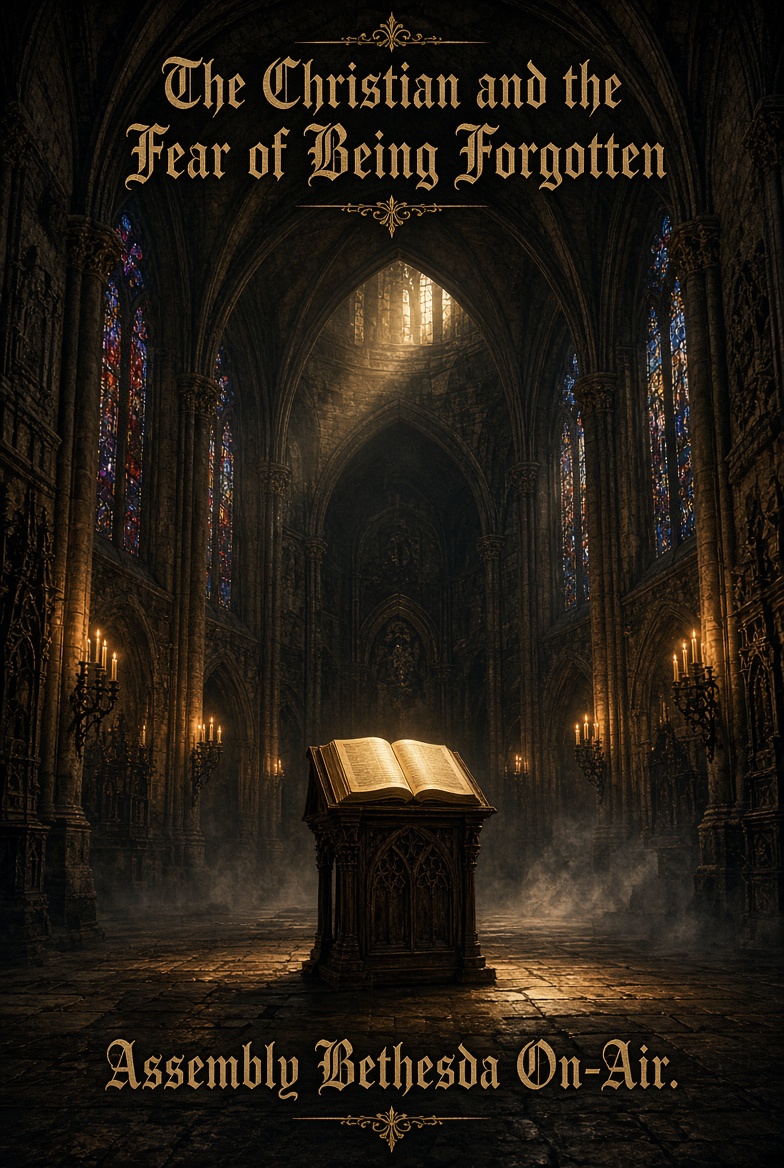
In many believers’ lives, there is a quiet fear that doesn’t always come out with drama or loud complaint. It settles in like evening fog around old stone walls. It’s the fear you’ll get forgotten. Not the ordinary worry about a forgotten birthday or a faded picture, but something deeper. It’s the feeling that the years will pass, the work will end, the name will fade, and the world will keep going like you never existed.
In a Christian Gothic frame of mind, this fear finds natural company among shadowed cloisters, candlelit chapels, and stone’s long memory. The people who built cathedrals and prayed in them are buried on weathered plaques, if they remain names. Fear makes us wonder if our own small faithfulness will face the same fate. Will the prayers, the quiet acts of mercy, the costly obedience just fade away?
The Psalms don’t treat this fear as imaginary. The writers of the Psalms often cry out to be remembered by God. They know how easily human memory fails. Kings rise and fall. Cities turn to dust. Even the most vivid lives can become footnotes. But the same Scriptures won’t let us down. They keep coming back to a different kind of remembrance, one that doesn’t depend on human attention or historical records.
There’s no way God forgets His people. It’s not a polite theological slogan. It’s a declaration that goes against the grain of everyday life. When the world measures worth by visibility and lasting impact, the Christian is invited to rest in a different way. The One who made the stars also keeps track of every tear, every hidden act of love, every moment of trust that nobody else noticed. Fear of being forgotten is met with the character of God himself.
Scripture speaks of names a lot. Names matter. They are in the Book of Life. They are engraved, the prophet says, on God’s palms. This isn’t a sentimental image. It’s deliberate and permanent. There is no fading of ink or crumbling of paper. Engraving doesn’t wash off. It’s an invitation to the Christian who feels the weight of obscurity to look at those palms and remember that that engraving wasn’t cheap.
Gothic spirituality has always made room for mortality and its long shadows. But that doesn’t mean the fear just vanishes. We live in bodies that age. Our churches can stand empty. Ministries that once flourished can quiet down. Fear can come back on Tuesdays when the work feels invisible and the results seem small. The Gothic instinct is not to deny that feeling but to walk with it into God’s presence, candles still flickering, stone still cool underfoot, and the Word still open.
What does faithfulness look like when there’s fear? It looks like praying when no one’s watching. It looks like serving without needing to tell the story later. It looks like building something that might not be remembered by the next generation, because God already notices it. If a believer stops measuring life from the world’s memory and starts measuring it from God’s memory, the fear of being forgotten loses some of its power.
There’s also a communal dimension. The church itself is a living memory. When one generation forgets, another may still hold the faith. There aren’t any perfect saints in the communion of saints. It is a long procession of imperfect people who trusted the same Christ, and whose faith still speaks today. Even when individual names fade, the pattern of faith continues. That’s comforting. Gothic hope grows in the dark and doesn’t need bright lights to work.
The fear of being forgotten can also become a teacher. It can strip away the desire for reputation and leave the simpler desire to be known by God. The Christian doesn’t need the world to remember every detail. He only needs the One whose memory is perfect and whose love doesn’t expire to remember him. It can quiet the frantic desire to leave a legacy that impresses, and replace it with a quieter desire to live a faithful life.
Even though the darkness remains, the believer can still stand there without panic. The fear has been named. It has been brought to the light that no darkness can hide. It’s in that light that the old promise still holds true. God remembers. His name is written. His life, no matter how small it felt, is held.
It’s enough. It’s always been enough. The Christian Gothic heart rests there not because the fear never returns, but because God is stronger than any silence.
Keep praying, keeping the small obedience, keeping the quiet trust. Let the fear come if it must, and then let it go through the same hands that were pierced. Those hands don’t forget. They never have.
In the end, the cathedral stands not because every name is still spoken, but because the presence that filled it hasn’t left. Every life that Christ has given to him is the same. The world may move on. The record books may close, but the book that matters stays open, and the name written there is secure.
That’s the answer the fear can’t finally silence. That’s the light that keeps burning.