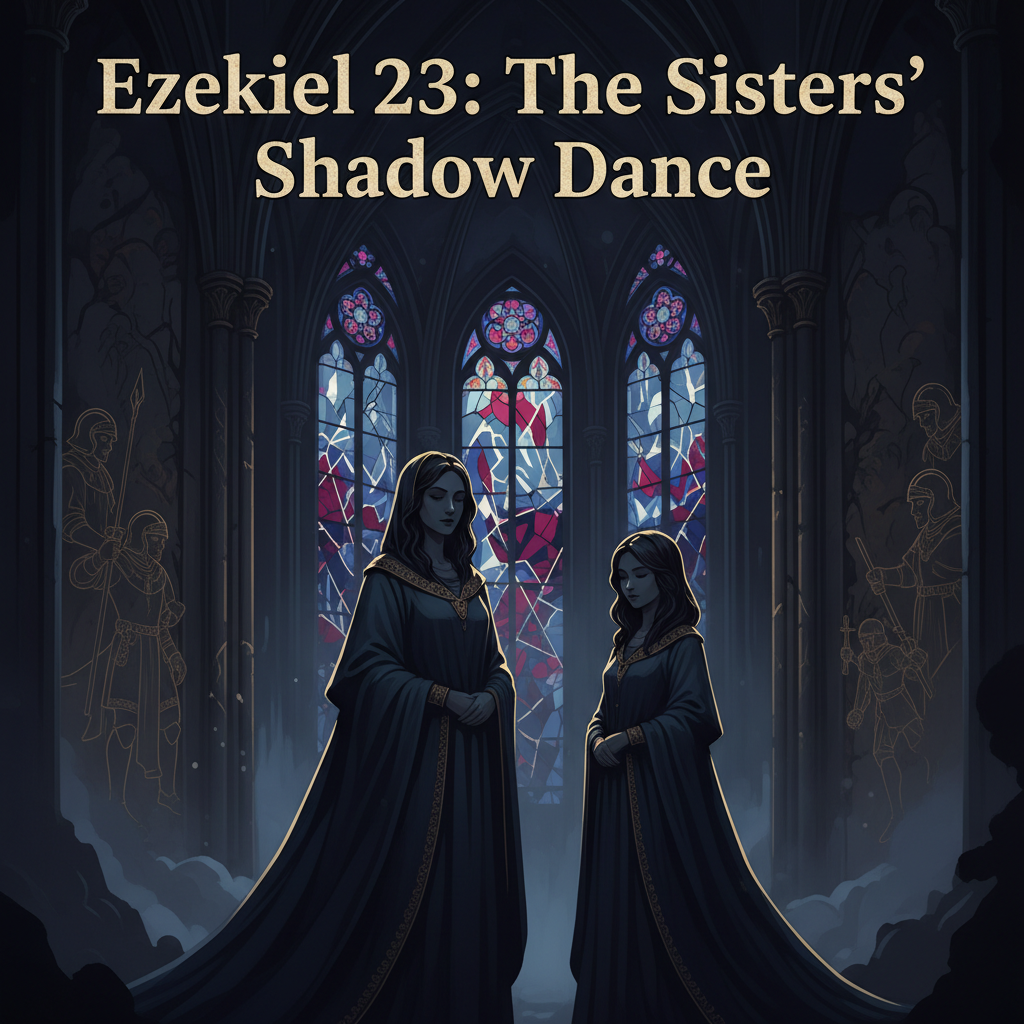
The pages of Ezekiel chapter 23 carry a heavy, haunting beauty, like an old cathedral window stained blood-red. God paints a raw and unflinching picture of two sisters, Oholah and Oholibah, in this raw and unflinching allegory, whose story drips with warning, sorrow, and the fierce love of a jealous God. Gothic in its darkness, vivid in its imagery, and deeply Christian in its call to be faithful. Let’s walk through these verses together with open hearts, letting the shadows teach us about true devotion.
Imagine two sisters born in the same house, raised under the same covenant. Their names mean something. Oholah means “her tent,” and Oholibah means “my tent is in her.” God set up His tent among His people from the beginning. He chose them, loved them, and called them His own. But they turned to the Assyrians instead. Oholah represented Samaria and the northern kingdom of Israel, but she gave her heart to them. Instead of staying faithful to the God who saved her from Egypt, she ran into foreign arms. She saw their warriors, their power, and their glittering armor, and she lusted after them. God describes her as a woman who offered herself to lovers that would eventually destroy her. And they did. Assyria crushed her, and her people fled.
You’d think her younger sister Oholibah learned what happened. She stood for Jerusalem and Judah’s southern kingdom. Oholibah didn’t. She not only lusted after the Assyrians, but she also turned her eyes to the Babylonians, the Chaldeans with their purple robes and fine chariots. Her desire burned hotter than her sister’s.
She defiled herself more deeply, chasing after idols and foreign gods with a hunger that shocked even the surrounding nations. It’s a harsh passage in Ezekiel 23. It speaks of nakedness, lewdness, and spiritual adultery that breaks God’s heart. Yet this isn’t written to shame people for shame sake. So we know exactly what unfaithfulness looks like when it’s without excuses.
A lot of Gothic things happen in this chapter because it lingers in the dark without rushing to comfort. The sisters’ choices lead to judgment as vivid as any horror film. God says He’s going to stir up their lovers against them. The very men they ran after will turn on them brutally. Swords, horses, chariots, and fire become the instruments of their punishment. Oholah and Oholibah are stripped, humiliated, and left desolate. Their cities fall. The temples that once held God’s presence have been profaned. It’s a sobering reminder of how sin, when left unchecked, invites its own destruction.
But even in this darkness, God’s character shines through. He’s not distant or indifferent. He’s the wounded husband who’s been faithful while his bride’s not. His words hurt. ‘You forgot Me,’ He says. ‘You’ve cast me behind your back.’ This isn’t cold justice from a distant ruler, it’s the grief of a lover who has been rejected time and time again. In the Gothic tradition, we often find beauty in brokenness, redemption hidden inside ruin.
Even as judgment falls, God’s ultimate purpose is restoration. He wants His people to know the horror of their sin so they can turn back to the only One who can truly satisfy them.
Let’s bring this closer to our own lives in a casual way. We may not bow down to wooden idols or chase after Assyrian soldiers, but our hearts wander like Oholah and Oholibah. We can dress up our idols in nicer clothes, but the spirit is the same. Success, comfort, entertainment, relationships, politics, even good things that become ultimate things.
It’s the same story when we give our deepest loyalty to anything else than God. This chapter invites us to look at our own “tents.” Where are we pitching our hearts? Do we live as if God’s presence is at the center of our lives, or do we look for love in broken places?
A spiritual adultery is serious too, according to Ezekiel 23. According to James 4:4, friendship with the world is adultery against God. It’s strong language because God and His people are that close. He’s the faithful bridegroom who died for His bride. When we chase after the world’s approval or its empty promises, we’re doing what Oholibah did, running after lovers who can’t save us and will eventually turn against us. In Ezekiel, the Gothic tone emphasizes the weight of the betrayal. It’s not just a list of rules broken. It’s about a love story gone wrong.
However, there’s hope. After the judgment, God promises a new heart and a new spirit. Just a few chapters later, God promises a new heart of flesh. The cross stands as the ultimate answer to the sins of Oholah and Oholibah. He will cleanse His people from their idols. He will restore them not because they deserve it, but because He’s merciful. The Gothic horror of judgment is swallowed up by resurrection light on Calvary, where Jesus took the shame, the stripping, the punishment our unfaithfulness deserved.
When we read this chapter casually but honestly, we see God’s jealousy isn’t petty. He’s protective. He knows nothing else can satisfy us. Every false lover, every idol, every distraction will leave us empty and broken in the end. The story of the two sisters is a mirror. We see the ugly side of divided loyalty, so we can run back to God who never leaves us or forsakes us.
Ezekiel 23 isn’t meant to be read quickly. It’s meant to linger, like candlelight flickering on cathedral walls. It’s meant to stir holy fear and holy longing at the same time. Fear of what happens when we wander. Longing for the God who still calls us home, despite all the worst betrayals. It’s the tension between darkness and dawn, mercy and judgment, death and life, that makes Christian Gothic so beautiful.
We want you to let the story of Oholah and Oholibah settle in your spirit. Let it make you more aware of your own heart. Let it make you more grateful for Jesus’ faithfulness, who didn’t turn away from His bride, even when she ran after other lovers. Our people should choose the tent where God dwells in a world full of glittering temptations. May we be loyal and single, pure in love, and rely completely on the only One who deserves our hope.