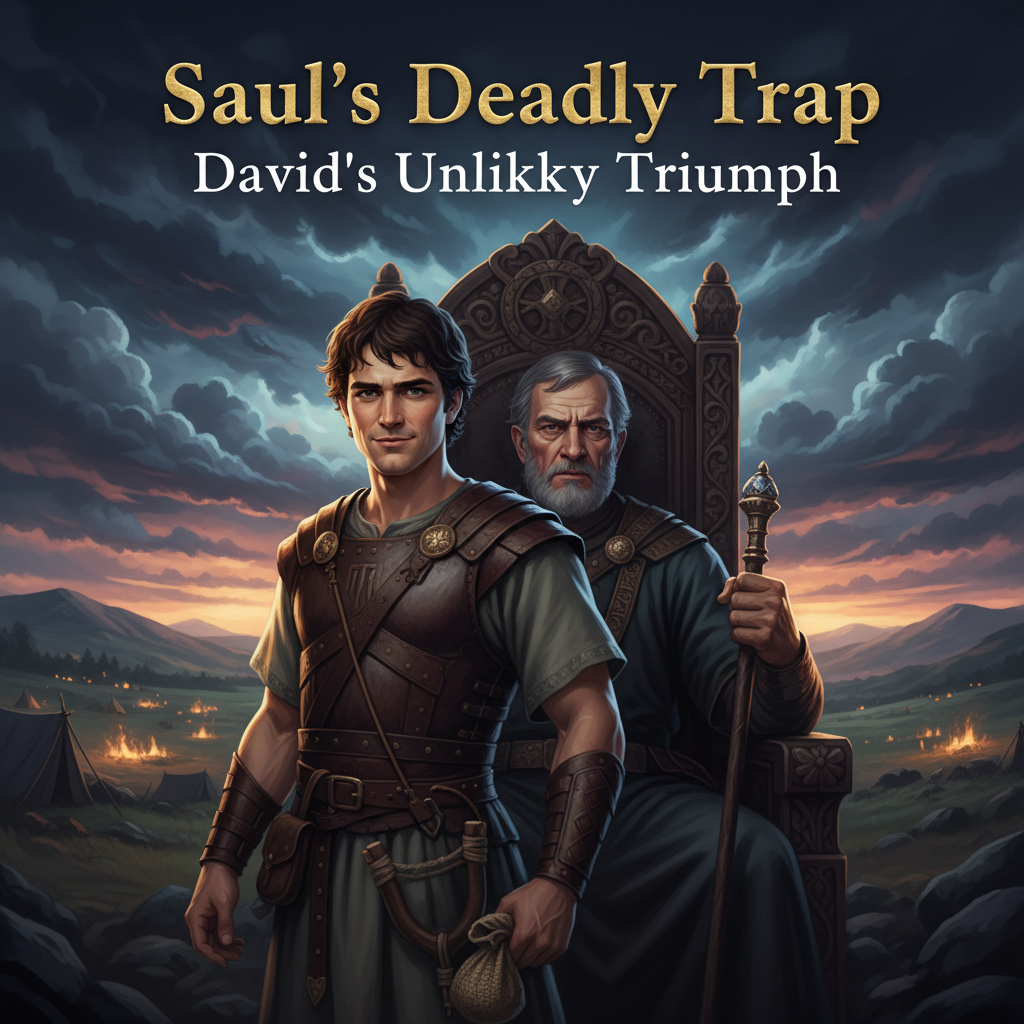
In the dim corridors of ancient Israel, where faith tangled with raw survival and kings schemed in the flickering light of palace torches, there stands one of the Bible’s most unsettling passages. Picture this: a young warrior named David, fresh from slaying a giant, now caught in the jealous gaze of King Saul. Michal, Saul’s daughter, falls in love with David, and instead of a simple wedding, Saul demands something straight out of a dark legend, a hundred Philistine foreskins as the bride price. David does not flinch. He returns with two hundred. This story from 1 Samuel 18:20-27 feels like it belongs in a Gothic tale of twisted motives, bloody proof, and divine favor shining through the horror. Let us wander through this shadowy chapter together, casual like friends around a dimly lit table, uncovering what it reveals about human schemes, God’s protection, and the wild ways faith plays out in the midst of danger.
The scene opens with Michal’s heart turning toward David. The Bible says she loved him, and when Saul heard the news, it pleased him, but not in a fatherly way. Saul saw opportunity in his daughter’s affection. He had already tried to pin David against the wall with a spear. He had sent him into battles hoping the Philistines would finish the job. Now, with Michal as the lure, Saul thought he could set a trap. He told his servants to whisper to David that the king delighted in him and wanted him as a son-in-law. David, humble as ever, replied that he was just a poor man with little status. How could he afford the price for a princess?
Saul’s response drips with calculated cruelty. No gold, no livestock, no fine gifts. Just one hundred foreskins from the Philistines, proof that David had struck a blow against the king’s enemies. In the ancient world, this was no random horror. The Philistines were uncircumcised, a mark of their separation from the covenant people of Israel.
Collecting those foreskins meant close, brutal combat, raiding enemy camps or battlefields, risking everything in hand-to-hand struggle. Saul figured David would die trying. One hundred was already a suicide mission for most men. Yet David accepted the challenge with quiet pleasure. He gathered his men, went out, and before the time ran out, he brought back not one hundred, but two hundred. They counted them out right there in front of the king. Saul had no choice but to give Michal to David as wife. The trap snapped shut on the schemer instead.
This moment feels so Gothic in its imagery.
Imagine the dim glow of oil lamps in the royal court, the metallic scent of blood still clinging to the evidence of victory, the stunned silence as servants tally the gruesome tokens. David stands there, not boasting, but simply fulfilling the demand with double the ask. It is raw, visceral, and strangely beautiful in its demonstration of courage and God’s unseen hand. The Philistines represented more than just enemy soldiers. They stood for everything opposing God’s people, their gods, their ways, their constant raids on Israelite lands. By demanding foreskins, Saul forced David into a covenant-like act of separation, proving loyalty through sacrifice and blood.
It’s not just the surface story. Ever since the women sang that David slain 10,000 men while Saul only slain thousands, Saul’s jealousy grew like shadows lengthening at dusk. It echoed in Saul’s mind, fueling his paranoia. Even though David played the harp to soothe the king’s tormented spirit, he saw him as a threat to the throne. Saul’s plan was clever in a twisted way.
Let the enemy do the dirty work with love as bait and a deadly price as hook. The same God who guided a stone into Goliath’s forehead protected David from every ambush. Let’s think about this in a casual, everyday way. Life throws us weird, uncomfortable challenges, and sometimes it looks like the path forward is impossible.
A “bride price” may be facing 100 impossible tasks at work, repairing broken relationships, or fighting cultural pressures. Despite the horror of the task, he didn’t complain about it. He trusted God would provide and protect him if He called him to it. And they did, in a dramatic way. There’s a lot of Gothic in this.
Imagine cathedrals with stained glass showing saints in agony, shadows playing on stone gargoyles, yet light piercing through. That’s this story. Saul’s envy, blood of battle, macabre proof of victory, all luminous by the quiet light of David’s faith. It wasn’t about shining armor for David. He was a farmer, a musician, a fighter who knew rejection and heat of pursuit. His collection of foreskins wasn’t about glory in gore.
It’s about obeying God, not letting fear or impossibility stop God’s unfolding plan. Saul’s fear deepens as he realizes the Lord’s with David, and Michal really loves him. The enemy within the palace becomes even worse than the Philistines outside. This pattern repeats itself throughout Scripture. Jesus before the cross, Joseph in the pit, Moses facing Pharaoh.
A human scheme rises like a storm cloud, but God’s light breaks through, sometimes shockingly. David’s double portion echoes other biblical themes of abundance. God doesn’t just give minimums. He multiplies loaves and fishes. He turns water into wine in jars overflowing with water. In this bloody context, David’s extra effort shows a heart that’s more than enough.
It pleased him to become the king’s son-in-law on those terms, not because he craved violence, but because he trusted God to take care of it. We know that God’s ways aren’t always neat and tidy. Faith isn’t a polite tea party. Sometimes that means facing messy battles, facing things that make us uncomfortable, and proving our commitment in tangible, costly ways.
In our spiritual lives, proof comes from perseverance, from choosing obedience even when it costs us something. David’s foreskins were undeniable proof that he had engaged the enemy directly. It was the Philistines who were ancient oppressors, giants in terms of technology and warfare, but their uncircumcised state symbolized life outside of God’s covenant. David’s act was a declaration.
Michal became his wife, and through her, the line continued in ways that pointed toward greater kingship. He was willing to risk everything to claim what God had set before him, even love wrapped in danger. David’s house would one day lead to the Messiah, the ultimate King who faced a dark cross. Gothic Christian reflection lingers on the tension between light and shadow. Life under fallen kings and warring nations is brutally described in the Bible.
It shows us Saul, tormented by an evil spirit, plotting in the night. It shows us David, anointed yet hunted, succeeding against all odds. The collection of those foreskins becomes a macabre trophy of grace, a reminder that what man intends for evil, God can turn for good. I’d like to think about the details for a minute. Saul instructed his servants to approach David privately, painting a picture of royal favor. David’s humble response emphasizes his character. He doesn’t grab power.
When he sees God’s hand opening a door no one could close, something shifts. It pleases him. Why? Maybe it’s because it aligns with his warrior spirit. Two hundred Philistines fall before the deadline. The foreskins are brought back, counted fully. Saul has to keep his word. He marries. But the jealousy doesn’t die. It festers, setting up future chapters of pursuit.
In spite of the casual retelling, collecting foreskins was gruesome, requiring stealth, strength, and resolve. It wasn’t symbolic in the moment. It was literal, bloody proof in a culture where trophies like that meant so much. David saw it as another step in his unlikely rise from shepherd to king. In this Gothic light, the story invites us to look at our own battles differently.
It’s not Philistine armies, it’s spiritual forces, personal doubt, societal pressures that demand compromise today. Go all in. Deliver more than you’re asked. Trust God’s protection. The same God counts our tears, our efforts, our faithful steps in the dark. I love how ironic the narrative is. Saul wanted David dead, but instead he gets a royal wife and a great reputation.
Throughout history, Christians have found comfort in such reversals, beauty rising from horror, favor rising from plots of destruction. Saul’s snare becomes David’s stepping stone. The pattern is old. Martyrs in arenas, reformers facing flames, believers today in places of persecution echo the ancient pattern. David’s harp soothed Saul earlier. Now his sword cuts through the trap. Music and might, both guided by God.
The young man who faced Goliath with five stones now faces a hundred, then two hundred foes, and prevails. It’s not just brute force. It’s God’s presence that makes all the difference. This story hits you like a dark fairy tale with a holy ending, but in a less academic tone. The prince schemes against the hero. The princess loves him anyway. The hero wins the hand and bonus points for completing an impossible, creepy quest. But there’s a deeper truth to the tale.
In the shadows, think about the cultural backdrop. God honors humility, courage, and obedience. He frustrates arrogant people. He uses unlikely vessels to display His power. As bride prices varied in ancient times, demand for enemy trophies made marriage into warfare. Saul weaponized love. David redeemed it through valor. Before the king, the count of the foreskins adds chilling courtroom drama. No fakes, no shortcuts. Full proof delivered.
In this passage, David’s future kingship is foreshadowed. He proves himself capable in battle, loyal yet unstoppable. Saul’s fear grows as he senses God shifting. His kingdom is slipping away from him because of God’s quiet sovereignty, not rebellion. Gothic Christian aesthetic fans will love this book. Dark stone halls, flickering candles, blood on the evidence of victory, yet a thread of redeeming light.
It reminds us that Scripture has both terrifying and triumphant stuff.
The Bible doesn’t have to be airbrushed to make it appealing. You can sit with it in its rawness and find God there. David’s collection stands out. Michal’s love, though complicated later, starts here as part of God’s plan. Even if it looks bloody and bizarre, stepping through in faith leads to unexpected blessings. It’s part of the bigger redemption story, and the marriage connects the lines.
Over coffee in a candlelit room, we might say, yeah, that foreskin story’s weird, but it’s got a lot to say. He didn’t run, he trusted God in the weirdest assignment, and it worked. Saul’s plan backfired big time. That’s encouragement when life throws us challenging tasks. Do it with all your heart, and God will show up.
Even as Saul’s envy grows, David’s name gets highly regarded. In this Gothic reflection, we see the cross already foreshadowed in faint outline. The Philistines keep coming out to fight, and David keeps winning. The shadow king can’t stop the dawn of God’s chosen. Blood, sacrifice, obedience to death, reversal of evil plans.
It’s about the Son of David who faces ultimate enmity and triumphs through a darker victory. We learn from the story to trust in spite of schemes, obey when the price seems too high, and to believe that God counts all our efforts and multiplies them accordingly. David gave two hundred, but God gave him a kingdom. That’s what’s quiet under the gore.