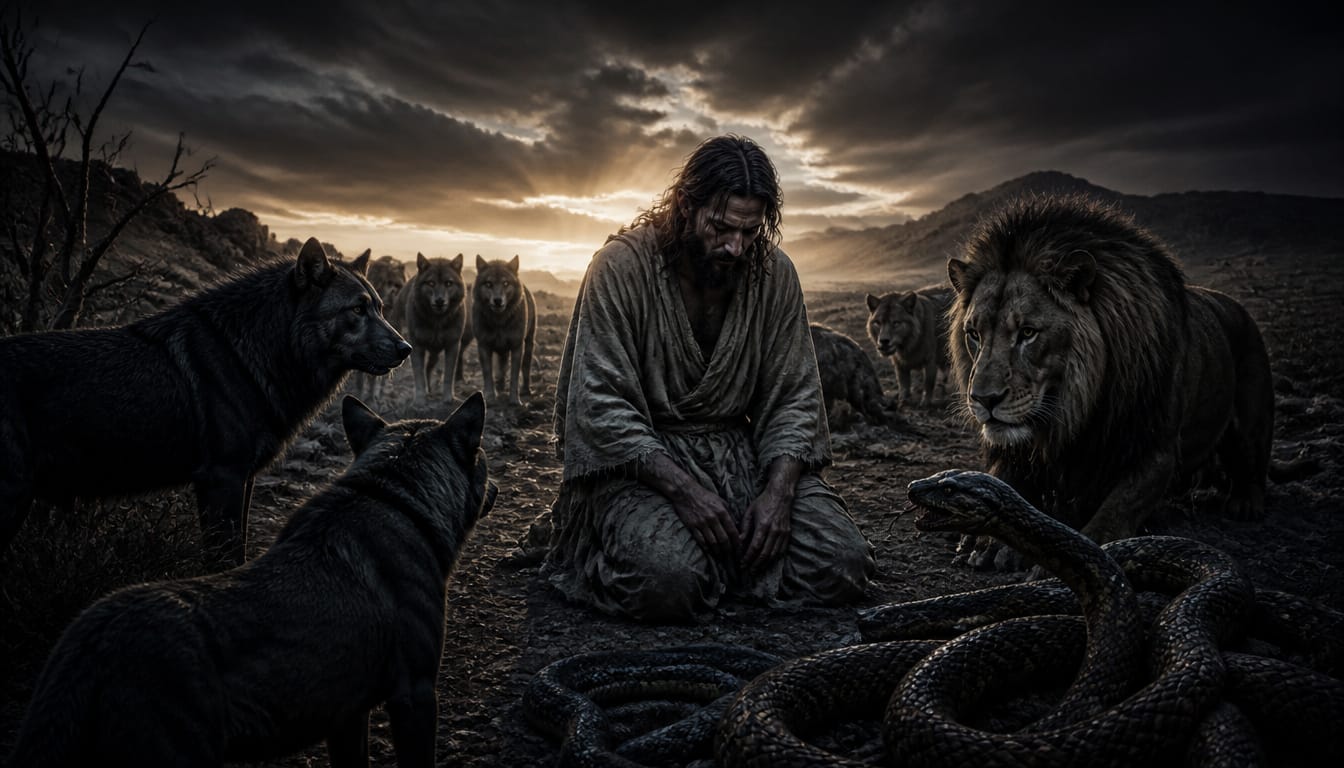
The image is strange, almost unsettling at first glance. Jesus, alone in the wilderness, fasting for forty days, facing hunger, weakness, and the voice of the tempter. And then, tucked quietly into the Gospel of Mark, a detail that feels almost out of place, yet deeply intentional. He was with the wild animals.
That single line in Mark 1:13 opens a door into something darker, older, and more symbolic than it first appears. The wilderness is not just empty space. It is alive. It breathes with danger, silence, and the presence of creatures that do not belong to human order. And in that place, Christ stands, not as a victim of chaos, but as one who moves through it untouched.
So why were there wild animals with Jesus?
The first layer is the wilderness itself. In biblical thought, the wilderness is not just geography, it is a spiritual landscape. It is where Israel wandered, where prophets were formed, where demons were believed to dwell. It represents disorder, testing, and the absence of human control. When Jesus enters the wilderness, he is stepping into a place that stands in contrast to Eden. Eden was ordered, cultivated, harmonious. The wilderness is fractured, untamed, and dangerous.
And in that wilderness, there are animals. Not domesticated, not named, not under human authority. Wild animals represent creation in its fallen state. They are not evil, but they are no longer aligned with humanity as they were in the beginning. There is tension between man and beast after the fall. Fear, violence, and survival replace harmony.
Yet here stands Jesus among them.
There is no indication of conflict. No attack. No fear. The text does not describe struggle, only presence. He was with the wild animals.
This echoes something ancient. In Genesis, Adam names the animals, and there is peace between them. Humanity and creation exist in a kind of unity. But that unity fractures after sin enters the world. The ground is cursed, animals become sources of fear, and the relationship changes.
So when Jesus stands among wild animals without conflict, it hints at restoration. He is not just enduring temptation, he is embodying a return to what was lost. The second Adam stands where the first failed, not in a garden, but in a wasteland. And even there, creation does not rise against him.
The wild animals become silent witnesses.
There is also a prophetic layer. In Isaiah, there are visions of a future kingdom where the wolf dwells with the lamb, where predators and prey exist in peace. These images are not just poetic, they point toward the reconciliation of all creation. The presence of animals with Jesus in the wilderness can be seen as a shadow of that future reality breaking into the present.
It is as if the wilderness itself pauses.
The beasts do not attack. The chaos does not consume. The Son of God stands in the middle of disorder, and for a moment, everything holds its breath.
There is also a darker reading, one that aligns with the Gothic tone of this scene. The wilderness is not only a place of natural danger, it is a place of spiritual confrontation. The tempter is there. The hunger is real. The isolation is complete. The wild animals can be seen as part of the atmosphere of threat, symbols of the harshness and severity of the environment.
They reinforce the reality that this is not a gentle retreat. This is not a quiet meditation in nature. This is a confrontation in a place where survival is uncertain. The presence of wild animals heightens the tension. It reminds us that Jesus is not shielded from the raw edges of existence.
And yet, even in that harshness, there is no mention of harm.
This suggests authority. Not the kind of authority that dominates or destroys, but the kind that restores order simply by being present. Jesus does not tame the animals in the narrative. He does not command them. He exists among them, and that is enough.
This aligns with the broader biblical theme of Christ’s relationship to creation. He is described as the one through whom all things were made. He is not separate from creation, he is its origin. So when he stands among wild animals, it is not an intrusion. It is a return.
There is also an echo of the exile motif. Humanity, after the fall, is driven out into a world that is no longer safe. The wilderness becomes a place of wandering, of testing, of encountering the consequences of sin. Jesus enters that space willingly. He does not avoid it. He walks into it, fasts within it, and faces temptation at its most intense.
The wild animals are part of that exile landscape. They are reminders that the world is no longer what it was meant to be. But they are also reminders that redemption is not limited to humanity alone. Creation itself is part of the story.
In Romans, Paul writes that creation groans, waiting for redemption. The presence of animals with Jesus can be seen as a quiet acknowledgment of that groaning. They are there, in the wilderness, as he begins the work that will ultimately lead to restoration.
There is something haunting about the stillness of that moment. No recorded movement, no described interaction, just coexistence. It feels almost like a painting, frozen in time. Christ, weakened by fasting, surrounded by creatures that should represent danger, yet nothing breaks the silence.
It challenges assumptions about power. Power is often imagined as force, as domination, as control. But here, power is expressed as peace in the presence of chaos. Authority is shown not through conquest, but through harmony.
The wilderness remains wild. The animals remain untamed. But something about Christ’s presence changes the atmosphere.
It also invites reflection on the nature of temptation. The devil’s voice is present, but so is creation. The temptation is not happening in a vacuum. It is happening in a world that is watching, even if silently. The animals become part of the setting, part of the witness to this confrontation.
And in that sense, they are not irrelevant details. They are part of the story’s texture. They deepen the scene, making it more vivid, more grounded, more real.
This is not a sanitized spiritual test. This is a raw, physical, and spiritual ordeal.
The inclusion of wild animals reminds us that the incarnation is not abstract. It is embodied. Jesus experiences hunger, isolation, and the presence of danger. He does not bypass the human condition. He enters it fully, even in its most desolate form.
There is also a quiet contrast with later moments in the Gospels. Jesus calms storms, multiplies food, heals the sick. He demonstrates authority over nature and disease. But here, in the wilderness, there are no miracles described. No dramatic acts. Just endurance.
And the animals remain.
It suggests that sometimes authority is not about changing the environment, but about remaining faithful within it. The wilderness does not transform into a garden during those forty days. It remains harsh. It remains empty. But Christ remains steadfast.
The wild animals become part of that endurance.
They are not enemies, but they are not allies either. They simply are. And in their presence, the narrative gains a layer of realism and symbolism that points both backward to Eden and forward to restoration.
In the end, the detail is brief, but its implications are vast. It speaks of harmony lost and hinted at again. It speaks of authority that does not need to assert itself loudly. It speaks of a creation that recognizes its Creator, even in silence.
And perhaps most of all, it reminds us that even in the most desolate places, where danger feels close and silence feels heavy, there is a presence that does not disrupt the world violently, but begins to restore it quietly.