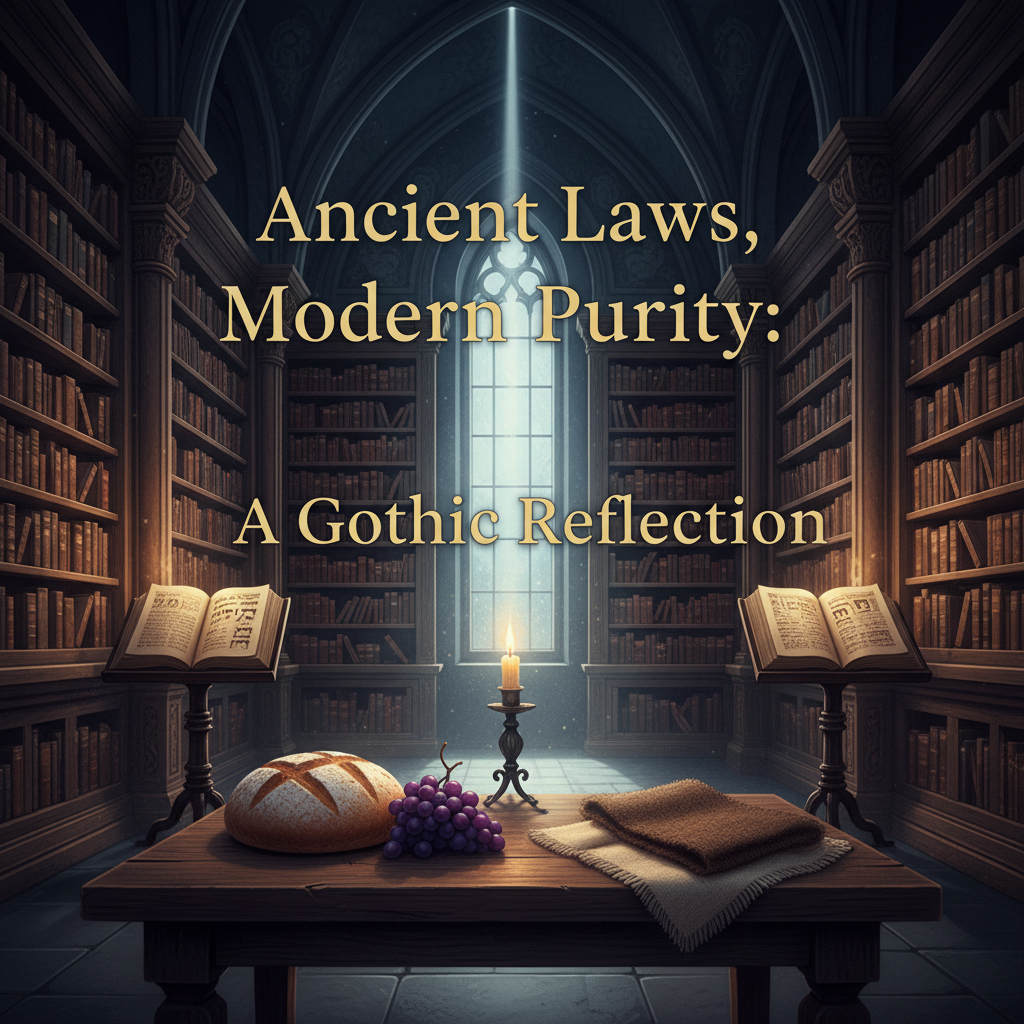
Hey friends , welcome to this casual chat about some old rules from the Bible that seem strange but have a cool , mysterious vibe when viewed from a Christian Gothic perspective. The Old Testament rules on food and clothing, like Leviticus 11 about unclean food and Deuteronomy 22 about mixed fabrics. Those rules aren’t just random, they’re God’s way of setting His people apart, and they point us to deeper truths.
We’ll start with Leviticus 11, which talks about what’s clean and what’s unclean when it comes to food. For the Israelites, God gives these instructions to Moses and Aaron. Animals on the land that have a divided hoof and chew the cud are clean. Think cows, sheep, goats, deer, gazelles, antelopes, and that kind of stuff.
It’s unclean if an animal only has one or the other, like a camel chewing the cud but not having a divided hoof, or a pig with a divided hoof, but not chewing the cud. In some cases, you can’t eat them or even touch their dead bodies. It’s all about keeping things clean.
Water creatures aren’t clean at all. Salmon and tuna are okay, but shrimp, crab, and oysters aren’t. Those are off the menu, too. For the birds , there is a list of unclean ones , including the eagle , the vulture , the raven , the owl , and a few others that are predators or scavengers. Clean birds aren’t listed, but you get the idea. There are some creepy things that are clean, like the locust, the cricket, and grasshoppers with their jointed legs, but most other bugs aren’t.
In a casual way, God said, live in a way that shows you belong to me, avoid the stuff that represents the unclean world. The laws are meant to make the Israelites separate from the surrounding nations. These laws look like dark tapestries hanging in an old cathedral reminding believers of the need for purity in the midst of life’s shadows, in the Christian Gothic style. Every meal became a quiet ritual, a moment to remember the covenant.
There’s a bigger picture here: These rules were woven into Israel’s daily life to keep the people focused on the Creator who made every creature and every detail. They weren’t meant to burden us, but to bless us. Gothic Christian views are like walking through stone corridors where each law casts a long shadow, guiding the soul toward holiness. If you don’t guard your heart carefully, the unclean animals stand as symbols of what could pull you away from God.
Continuing with Deuteronomy 22 , 11, about clothing, it says you don’t mix wool and linen. That’s not the only rule about not mixing things in that chapter. There’s also the rule about not sowing your vineyard with different types of seed. You don’t have to plough with an ox and a donkey at the same time. The point is to keep things separate, to honor God’s order.
A lot of people mix fabrics back then because of practicality or symbolism, but obedience is the key. There’s a difference between wool and linen, one from an animal and one from a plant, and God wanted them to be separate. Gothic Christian lensed it like a gothic painting, where light and dark don’t get blurred together. The clothing rules extended the separation principle seen in the food laws, so your clothes carried the mark of dedication.
They were part of the ceremonial laws given to Israel, both the food and clothing ones. They served to point forward to Christ, who would fulfill the law and give everyone a way to be clean through His blood. Jesus says in the New Testament that a person can’t be defiled by what goes into their mouth, but by what they do with their hearts. Peter had a vision and God declared all foods clean. As Christians, we’re not bound by these rules anymore, but holiness and not mixing with the world’s ways are still important.
It’s pretty to look back at old laws and see God’s heart in them. They show that He cares about everything, from what we eat to how we live. It’s a reminder that faith isn’t just big ideas, but everyday choices that reflect our relationship with Him in a casual , less stuffy way. In addition to teaching us to be careful what we eat, the food laws make us pay attention to what we think and do. We should keep our outer lives consistent with our inner commitment, no mixing the holy with the ordinary.
I like to think about the symbolism a bit more. The clean and unclean foods could symbolize the need to discern what we eat, not just physically, but also spiritually. In the dim light of faith, these laws cast long shadows that lead us to the cross. They symbolize not mixing sacred and profane, keeping our lives pure and dedicated to God without compromise. The Old Testament is full of these pointers, and it feels like wandering through ancient ruins where every stone tells a story.
The command made it easy for people to remember God every time they made a meal or chose what to wear. That kind of intentional living adds a rich , atmospheric depth to the faith, like flickering candles in a vast cathedral illuminating the path of obedience. While we walk in the freedom Christ provides, we can still let the spirit of these laws inspire us to seek holiness in our own context, choosing paths that set us apart in positive ways.
Ultimately, these Old Testament food and clothing laws aren’t just historical details; they’re also an invitation to reflect on God’s holiness and our call to live set apart. Take a moment to marvel at the casual beauty in these rules , how they whisper of a greater plan, whether you’re just exploring the Bible for the first time or have read it a thousand times. It adds depth and mystery to our faith in the Christian Gothic tradition, making it more immersive. In the end, they point to the brilliant light of grace, where every law finds its perfect fulfillment.