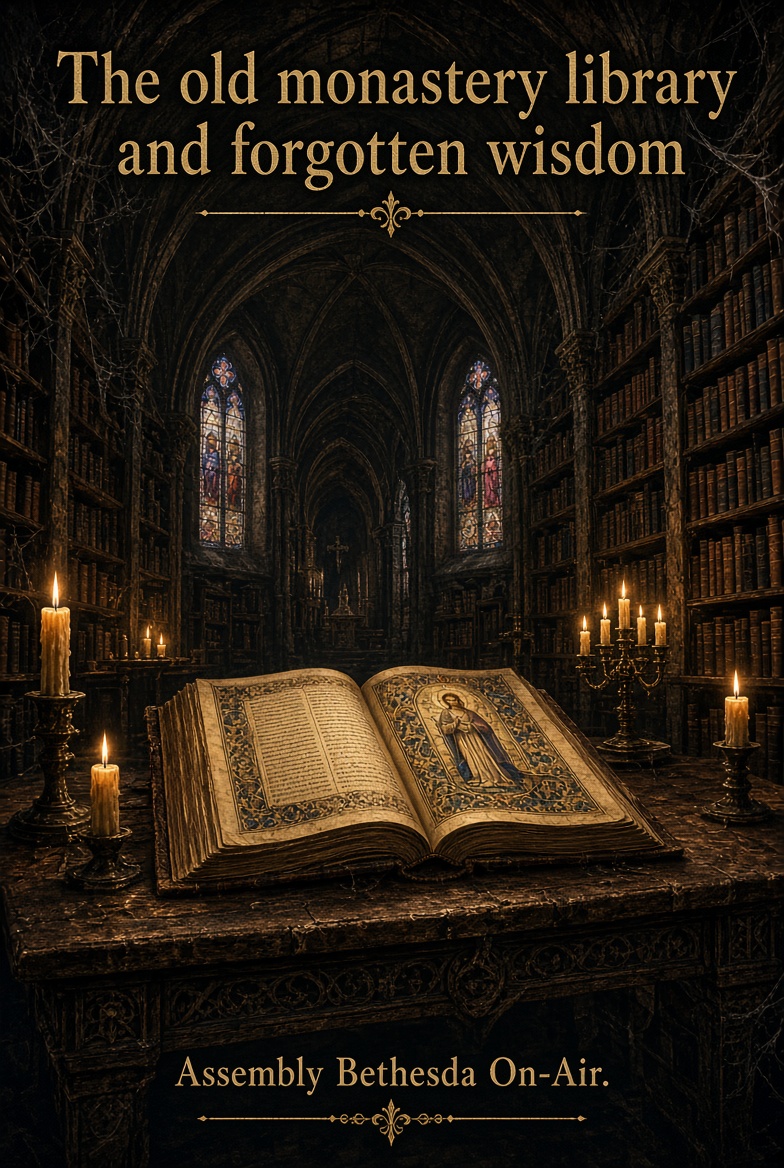
In the old monastery library, the air changes. Stone walls stand high, cool and solid, holding centuries of silence. Leather bound books lean on tall shelves, their spines cracked, their pages yellowed by candle smoke and time. Light filters through narrow windows, stained glass soft with age, painting the floor in muted reds and blues. Dust hangs in the air like a thin veil. Despite feeling forgotten by the outside world, this place holds something deeper.
Every shadow here carries a Christian Gothic feel. The architecture itself points upward, the arches lifting your eyes upward even as the corners remain dark. Candles burn low in iron holders, their flames tiny against the vastness of the room. Cobwebs stretch between shelves like pale lace. The smell of parchment mixed with faint incense clings to the stone. Nothing here is bright or modern. It’s all quiet.
When empires fell and chaos ruled the roads, monks wrote Scripture by hand, their fingers stained with ink, their eyes tired yet steady. The books themselves carry the weight of devotion. The truth survived because someone believed it was worth the effort to write psalms, gospels, letters of the apostles, and commentaries in careful script. Those volumes sit silent now, spines facing the dim light.
The phrase “forgotten wisdom” doesn’t mean lost wisdom. It means wisdom that’s been forgotten by a hurried age that prefers noise over stillness. While the language is formal at first, the heart remains clear. The pages speak of God. Fear of the Lord is the beginning of wisdom. Look and you’ll find it. The light shines in the dark and it hasn’t been overwhelmed. These truths don’t age. They just wait for eyes that are willing to look past the dust.
Every step feels measured as you walk the narrow aisles. Above the shelves, the ceiling fades into shadow. When the wind blows, a loose shutter knocks against stone. There’s a soft sound, almost like a reminder that the outside world still moves, but it can’t quite reach this inner quiet. In that quiet, you can hear again.
Darkness is real here, heavy stone, cold drafts, years’ weight. Yet light is real too. A single candle can pull the gloom back just enough to read a verse. A shaft of afternoon sun can make gold leaf on an illuminated page gleam for a bit. Faith doesn’t ignore the shadows. It walks through them with a lamp that won’t go out.
A library teaches patience. You can’t rush turning fragile pages. You can’t force understanding from a book that’s been waiting longer than anyone can remember. Sit at the heavy oak table, open the book, and let the words come to you at your own pace. Wisdom usually comes in the same way. Not in flashes of clever insight, but in slowly realizing the ancient truth still speaks to us.
The monks who once filled these halls chose silence over spectacle. They chose hard work over novelty. The reward was not fame. It was the knowledge that God’s Word would outlast them. There’s still a choice there. The old monastery library stands as a quiet challenge in a world that prizes the new and loud. Take a break from your own hurried thoughts for a while. Find the voice that never stops talking.
It’s not just a matter of hiding the forgotten wisdom by accident. It’s overlooked because it requires some humility. It requires stillness. It requires humility. It requires sitting with mystery instead of demanding instant answers. Gothic stones seem to approve of that posture. They’ve survived storms and centuries. They know how to wait.
A reader who comes to the library with an open heart may find more than history. Every book that still holds the Gospel carries living power. The Spirit that inspired the writers moves among the shelves. The living Christ may be speaking through ink and parchment, through the hands of long dead scribes, through the very air in that place.
Those reading desks are made of carved wood, worn smooth by generations of elbows and wrists. You can see it all. The immaterial truth can be carried by the material world. Just look at the iron latch on the great door, blackened by time. Candlelight trembles when a draft slips under the threshold. If you put stone, wood, or paper to God’s service, they can become vessels of grace.
In the Christian Gothic vision the sacred and the shadowed live side by side. The monastery library embodies that vision perfectly. It’s both beautiful and severe at the same time. It’s inviting and warning. It’s comforting and it’s demanding reverence. If you step lightly, the silence feels heavy. If you step with respect, the silence becomes companionable.
The wisdom waiting here is practical as well as profound. It speaks of endurance. It speaks of the value of slow work. It speaks of the danger of forgetting what has already been revealed. Modern life teems with new information every hour. The old library holds up a different measure. What’s worth preserving when the noise fades? What’s going to matter when the latest trend fades to dust?
Those questions are answered in Scripture without hesitation. Heaven and earth will pass away, but My words will never fade. The grass withers and the flowers fall, but the word of our God endures forever. They could have been written for this exact room. The shelves prove it. Empires have risen and fallen while the copied pages remain.
It’s not empty in places like this, but there’s a certain quiet that’s only there. It’s filled with presence. It’s the presence of those who did it before. It’s the presence of the God who called them to it. It’s the presence of truth that doesn’t have to be shouted to be heard. In the quiet, priorities shift. What seems urgent loses its sting. What seemed far draws near.
A Christian Gothic heart knows that beauty can wear a somber face sometimes. The pointed arches, the deep shadows, the flickering light, the sense of age and endurance, they all speak a language. Those words say the world is more than the surface. Under the ordinary lies the eternal. Under the forgotten lies the still alive. It’s in the old monastery library.
Not by spectacle, but by recognition. The wisdom was never lost. It was just waiting for someone willing to remove the dust, open the cover, and read by the light that remains.
A library doesn’t belong to just the past anymore. It belongs to anyone who looks for the ancient paths where the good way is found. It belongs to anyone who still believes in God speaking through the pages He’s kept. The stones stand. The books wait. Even though the light is small, it continues to shine.