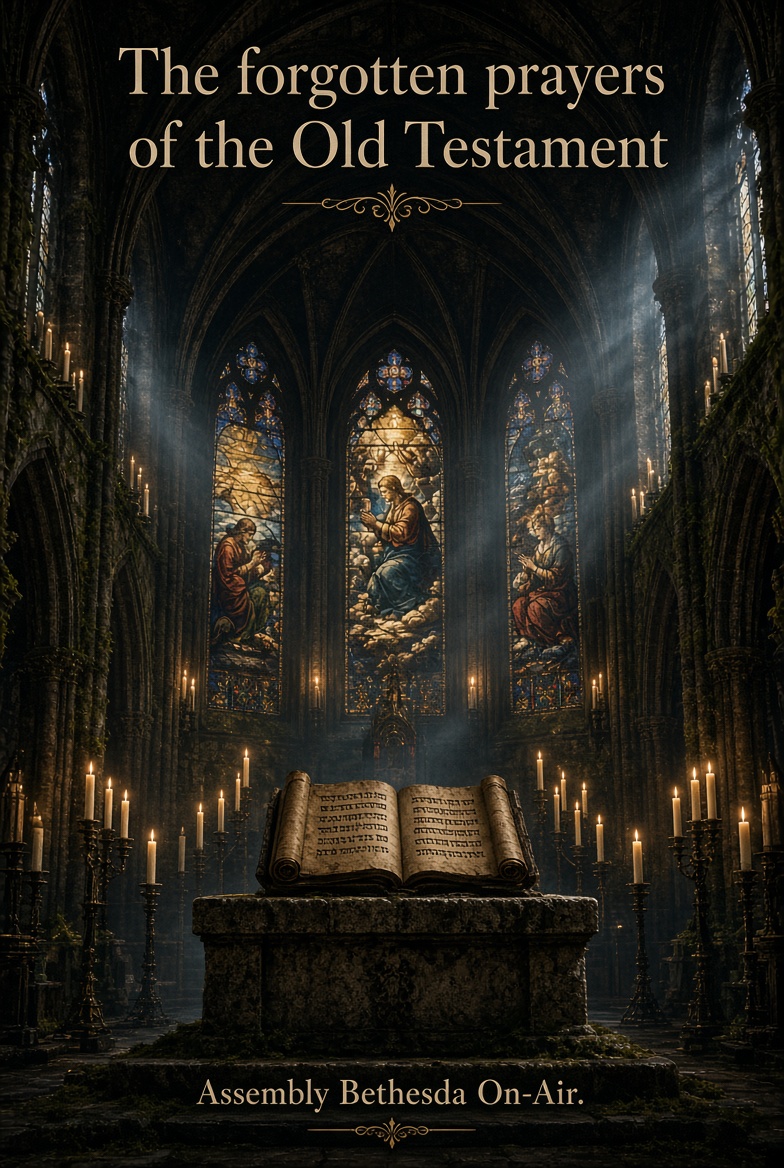
There’s something beautiful about the forgotten corners of Scripture. Psalms get the spotlight, David’s cries fill the air, and Solomon dedicates his temple in grand style. But there are prayers tucked away in the older pages that look like they’ve been waiting in the dim light of ancient stone halls, candle smoke curling around them, for someone to notice them again. In fish bellies, on ruined walls, in the face of invading armies, and from people who had nowhere else to turn, these are the forgotten Old Testament prayers.
It’s dusk in an old cathedral. The stained glass is still vibrant, but the light is dim. Candles flicker along the walls. In the shadows, a voice rises. It’s not polished, it’s not practiced for a crowd, it’s just honest. That’s the tone of these prayers. They’re not museum pieces. If we listen close enough, they still echo.
Start with Jonah. Almost everyone remembers the fish, the storm, the reluctant prophet. But less people remember the prayer that rises from the depths. Jonah doesn’t argue or demand. He remembers. From the belly of Sheol, from the roots of the mountains, from the place where the bars of the earth closed around him, he calls out to the Lord.
“I cried out to the Lord in my distress, and he answered me.” Before the deliverance happens, the prayer goes from despair to thanksgiving. That setting has something gothic about it, the dark water, the confined space, the sense of being swallowed up by forces greater than yourself. Even so, the prayer itself reaches upward while still in the shadows. It refuses to stay in the dark.
It’s like Habakkuk. He watches violence and injustice and asks hard questions. God says tough things to him. They talk about the Chaldeans, about judgment coming from ruthless people like them. The third chapter is where Habakkuk prays. He waits for the Lord to come in glory, the earth shaking, the mountains trembling, the ancient ways of God being remembered. It doesn’t end with a solution to every problem, but with a choice.
Even though the fig tree doesn’t blossom, the fields don’t give food, and the flock gets cut off, Habakkuk will still rejoice in the Lord. The feet of the prayer become like the feet of a deer, steady on the high places. In a world that feels cracked and dim, this prayer chooses trust. This is the kind of prayer that belongs in a stone chapel where the wind blows through broken windows, but the altar candle still burns.
It’s not like Nehemiah stands in a shadow. He’s a cupbearer for a foreign king. He hears the walls are broken and the gates burned. He weeps, fasts, and prays. He prays carefully, respectfully, and with covenant language in the first chapter. Besides remembering God’s promises, he confesses his people’s sins and asks the king for favor. It’s a prayer of quiet courage. He prays short, sharp prayers that keep his hands strong when enemies mock him while the work is going on. In these prayers, the man rebuilding while surrounded by opposition whispers prayers while carrying stones in half-light. They’re not the loud public prayers of a temple dedication.
Hannah’s prayer is more famous than some, but when we listen carefully, it’s still got a forgotten quality. Before the song of praise in chapter two, there’s a silent, anguished prayer in the temple. Eli mistakes it for drunkenness. Hannah is pouring out her soul. She makes a vow. She gets heard. Hannah’s later prayer of thanksgiving is a bold and theological one. It talks about the Lord who kills and makes alive, who brings low and lifts up, who guards the feet of the faithful. A prayer that sees the entire scope of God’s justice and mercy. In a sanctuary that once seemed empty of hope, her voice rises.
Daniel’s prayer in chapter 9 fits in too. He’s been reading Jeremiah. He understands the seventy years. He fasts and wears sackcloth and ashes to pray to the Lord. It’s a long confession. It doesn’t spare the people or the leaders. It’s a call for righteousness and for the sake of God’s own name. It asks for mercy on the desolate sanctuary. Despite the setting of exile and the weight of past failure, the prayer itself is full of hope.
Whenever we pray, we don’t pretend the world is bright and easy. Jonah’s in the depths. Habakkuk faces national upheaval. Nehemiah looks at the ruined walls. Hannah carries years of barrenness and mockery. Daniel lives under foreign rule. But each prayer reaches to the same God that listens, who remembers covenants, who can make life from what looks like an end.
Having a look at these texts has a Gothic quality. Gothic isn’t horror for its own sake. It’s about seeing that the sacred often meets us in the shadows, in the ruins, when our strength runs out. Faith isn’t just about sunny certainty. It’s also about kneeling in half-light and still calling on the Lord’s name in the dark. That’s why old cathedrals had soaring arches and dark corners. Old Testament prayers do that. They don’t let darkness win.
Our shadowed seasons give us language when we recover them. When the path ahead looks closed, Jonah’s prayer from the depths gives us words. When injustice seems to win and the harvest fails, Habakkuk’s choice to rejoice becomes a companion. Keeping our hands strong when the work is hard and the opposition is real is Nehemiah’s short prayers. When the weight of collective failure presses in, Daniel’s confession and appeal to God’s name show a way forward. Hannah’s bold thanksgiving reminds us that God hears the unspoken as well as the spoken.
They teach us how to pray too. They are honest. They remember what God has already done. They confess without excuses. They ask boldly and remain humble. In an age that tends to favor polished, positive, carefully curated spirituality, these older voices feel like a corrective. They invite us into a deeper, quieter, more durable kind of conversation.
The stained glass still holds its color when the sun is low. A candle still casts light in the corner where the old prayer book is. Even now, the voice still rises from the fish, the ruined wall, the prophet’s watchtower, the temple at Shiloh, and the exile’s chamber. We may find these prayers waiting for us all along, ready to shape our own words when the light gets dim and the need gets big.
The forgotten prayers of the Old Testament aren’t relics. They’re living invitations. They call us to kneel in the shadows, to speak honestly, and to trust the God who still answers from the depths, from the ruins, and from the quiet places where faith survives.