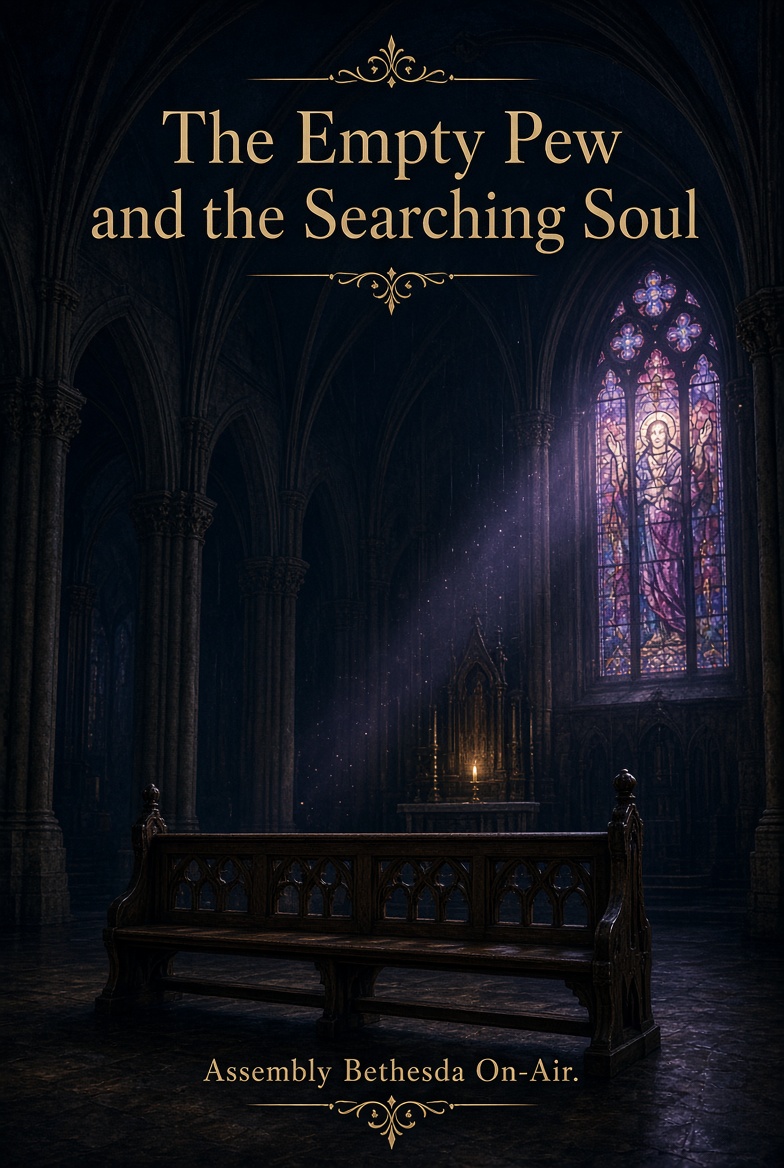
The church stands quiet after the last hymn fades. Candle wax cools on the brass holders. Shadows extend long across the stone floor. In the middle of it all sits an empty pew. Not dramatic. Not broken. Just empty. In the same city, or in the same quiet room, a soul keeps searching.
There’s nothing scary about Christian Gothic. It’s about the weight of sacred space when the crowd goes. It’s about how light lands on wood where no one is sitting. Even when the bench feels colder than it should, it’s about the honest ache of a heart that still believes God is near.
An empty pew doesn’t mean the church has failed. It means the invitation remains open. The wood still holds the memory of bodies that used to lean forward during the sermon. The cushion still remembers the shape of someone who used to rest there every Sunday. Now the space is free. It’s free for the ones who walk in late, it’s free for the ones who haven’t walked in in years, it’s free for the souls deciding whether to sit down or keep standing.
Despite bright storefronts and glowing screens, the searching soul still feels pulled toward something older. Something quieter. Something that smells like old paper and candle smoke. The soul isn’t looking for a show. It’s looking for a place where questions can sit without being rushed to an answer. Gothic spaces get that. High ceilings don’t want quick answers, and stone walls don’t mind silence.
It’s never a final word in the language of faith. The empty tomb is the center of the story. If we let it, the empty pew can point in the same direction. It can be a sign that someone’s still coming. That the seat is still there. You can’t lock the door from the inside.
You can feel the texture of the moment. Rain slides down the outside of the tall windows. The air is still inside. A light burns near the altar. The searching soul steps inside and feels the temperature change. Not colder. Just different. The kind that says, stop running for a minute. Put the weight down. Sit even if you don’t know the words to every song.
The Gothic imagination has always loved thresholds. Doorways that lead from bright street to dim sanctuary. Steps that climb toward a place where ordinary time slows down. There is an empty pew right in the middle of that threshold experience. It’s where searching stops being motion and becomes presence. There’s nothing wrong with presence. Sometimes it’s just one person and a lot of wood.
God is all in the quiet corners of Scripture. Elijah heard his still small voice after the wind and fire were done. The disciples met the risen Christ on a road when their hopes had already faded. It didn’t take a packed house for the woman at the well to meet living water. It just took a heart that was still willing to look.
So the empty pew isn’t a problem to solve as much as a space to honor. It’s a visual reminder that faith isn’t just about attendance numbers. It’s about keeping the door unlocked and the lights on. It’s about treating every open seat like an invitation, not a failure.
People who are searching often have a private weather system. There are clouds of doubt. Sudden rays of hope. Long stretches of gray where nothing dramatic happens, and yet the longing stays the same. Gothic language gives that weather a place. It doesn’t demand constant sunshine. It lets the rain fall on the roof while you listen underneath.
Old churches that’ve been empty for years have a certain kindness to them. The floor is still swept. The hymnals are still in the racks. The cross hangs where it always has. These details tell the searching soul that someone has been faithful in the little things. Even when it wasn’t full, they kept the space ready.
A candle against a high, dark ceiling is warmer than a room full of fluorescent lights that never dim. The Christian Gothic mood recognizes this. It doesn’t apologize for the shadows. It just puts a light inside them and trusts that someone will notice.
The empty pew also asks a quiet question of the people who still come. Are we keeping the seat warm just for ourselves, or are we prepared for the person who might show up with wet shoes and tired heart? Are we willing to leave room, both physically and emotionally, for the one who doesn’t yet know the words? People aren’t always strangers when they’re searching. Sometimes they’re the ones who’ve been coming for years but aren’t quite there yet.
A faith that survives empty seasons lasts. It’s the kind that doesn’t collapse when it’s quiet. It’s the kind that can sit in silence and still say, I’m here. I’m still looking. It’s still my belief that the One I’m looking for is also looking for me.
In spite of how low the heart feels, pointed arches lift the eye up. Flying buttresses hold the walls open and full of glass. An empty pew sits inside this engineering of hope. It’s supported. It’s held. It doesn’t have to carry the whole building by itself.
It’s a simple story at the end. There’s a place that remains open, and there’s a soul that keeps looking. The two of them are in a conversation that doesn’t require a full congregation to start. All it takes is honesty, courage, and a willingness to sit down in the silence and wait for a Presence that never really left.
It’s empty. The soul is searching. The light is still on.