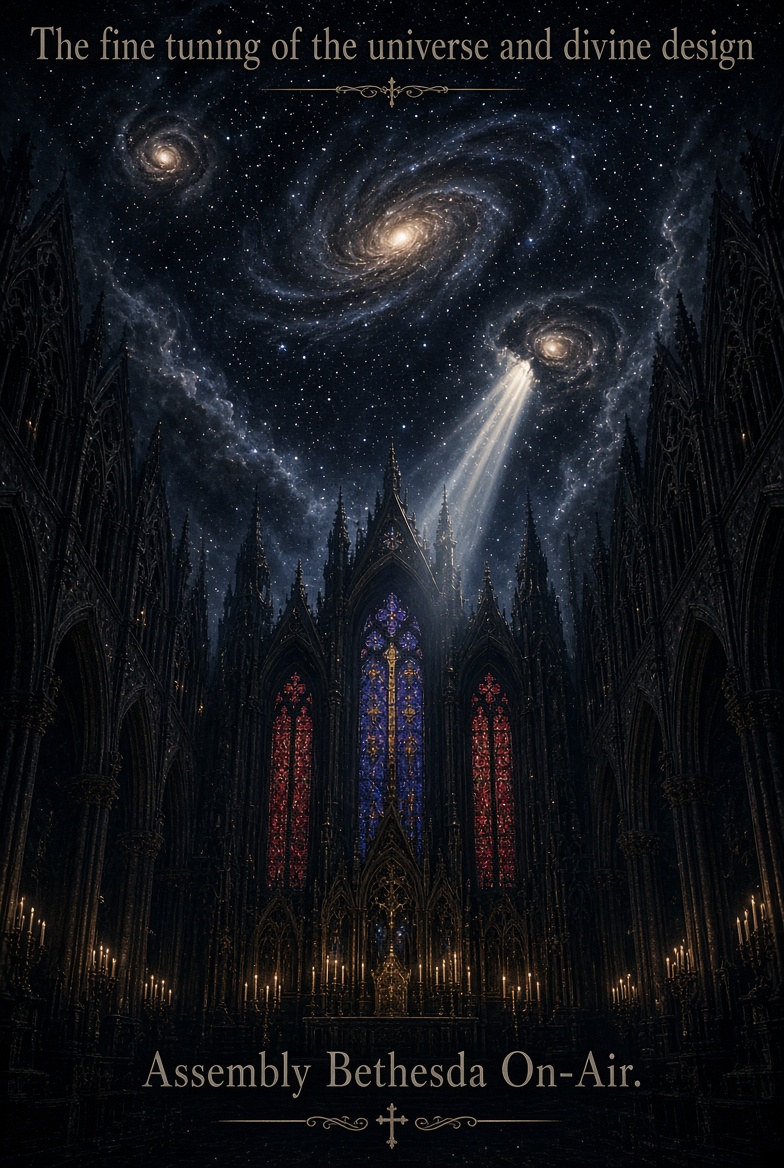
There’s something deeply moving about the way the world holds together. If you look closely at a leaf or shoreline, or how a pinecone opens its scales, you’ll see a quiet order that’s older than time. Numbers don’t shout, they just arrange. From the tiniest seed to the vast expanse of sky, patterns come and go. It’s not a cold calculated order in the Christian Gothic imagination. It’s a mystery wrapped in structure, beauty wrapped in measure, the fingerprint of a Creator who loves both freedom and form.
Spirals are everywhere. They’re in ferns, sunflower heads, rams’ horns, arms of distant galaxies, and more. The same proportion keeps showing up, a ratio that feels almost like a breath held and released. It has been called the golden ratio, the divine ratio, but the name doesn’t matter as much as its presence. The pattern is just there, patient, repeating, inviting the eye to follow it. In a Gothic sense, this spiral becomes a kind of visual prayer. It suggests that creation itself is reaching, never quite finishing, always open.
The same quiet insistence appears in the way branches fork, rivers split, lightning finds its way. A tree’s branching logic seems random until you notice how often it follows simple rules like growth and resistance. Trees don’t calculate. They just grow the way they’re supposed to, so they have a structure that’s both unique and familiar at the same time.
Walking through an old forest on a gray afternoon feels like walking through a living vault, with wood and leaf ribs arranged with care. In that moment, the mathematical order of creation doesn’t feel abstract. It feels almost companionable. Light filters through broken patterns, stained glass made of living matter.
Even the night sky participates. Stars don’t scatter without connection. Constellations are human stories laid over real distances and real motions, but they follow paths that can be described using elegant equations. Though orbits aren’t perfect circles, they’re steady enough for seasons to return, tides to rise and fall, and the moon to stay on course. There’s a sense of reliability here that calms the soul. The same God who spoke light into being also established the speed, angle, and patient turn of spheres. Mystery and measurement work together.
Inside the human body the patterns continue. The heartbeat isn’t a random pulse. The lungs expand and contract based on what’s needed. All of this displays a craftfulness that is both precise and generous. We’re not machines, we’re living architecture, temples made of tissue and intention. The arrangement of bones, the branching of nerves, the spiral of the inner ear, all of it. In sickness or injury, our bodies fail, and the disruption reveals how much we depend on the order that usually goes unnoticed. Healing is often a return to rhythm, a re-establishing of measures that had been out of sync.
Gothic cathedrals are human attempts to answer this order with stone and glass. Pointed arches rise with careful calculations of weight and thrust, and ribbed vaults distribute force so walls can open up. The rose window is pure geometry made luminous, circles within circles, petals of color arranged around a center. Light comes in through measured openings and falls across the floor in shifting patterns.
The builders didn’t invent the math. They found it in the world and used it to make spaces where people could gather and look upward. The cathedral doesn’t explain the mystery. It houses it.
This impulse still lives in the quiet disciplines of counting and measuring that still go on today. The gardener who spaces seeds according to the needs of each plant is participating in the order. When you hear the right interval between notes, you listen to proportions that have always existed.
The parent who notices the steady growth of a child is watching a pattern unfold in time. All of these things don’t take advanced training. They just take attention. They require a willingness to realize the world isn’t chaos held together by luck. It’s order that leaves room for surprises, structure that lets you go.
There’s a temptation to treat mathematical order as something distant, something that belongs only to specialists. The Christian Gothic view resists that separation. The patterns are democratic. Anyone can see them if they slow down long enough to see them. A child counting the petals of a daisy is already inside the mystery. An elder tracing the grain of wood with a fingertip is reading a kind of scripture written in fiber and growth rings. No technical stuff. It’s just the language of looking carefully.
In a storm, fault lines shift as pressure builds over time. The same math describes the beauty of crystals also describes the path of falling objects. Creation isn’t a polished surface. It’s a lot of weight, resistance, and the possibility of fracture. Gothic sensibility knows that. In its art and architecture, there’s shadow as well as light, stone weight as well as arch lift. The mathematical order doesn’t erase suffering. It puts suffering inside a larger coherence that’s still being revealed.
Faith enters here not as an interruption of the patterns, but as a way to live inside them. To believe that the order is intentional is to believe that the patterns are personal. The same mind that set the proportions of the spiral also numbers the hairs on a head, watches over the fall of a sparrow, holds the times and seasons in steady hands. The mystery deepens rather than dissolves. The One who delights in both the vast and the particular invites us into a relationship.
In daily life, you can practice being aware of things like how raindrops arrange themselves on a window. Notice how a flock of birds turns together. Notice how a melody returns to its starting note after wandering. These little observations aren’t distractions from spiritual life. They’re part of it. They teach us to recognize God’s signature in everyday things.
Gothic atmosphere keeps the recognition from becoming sentimental. It’s always austere, a reminder that beauty is serious, that order is hard, and that light often gets filtered through darkness. It’s best to see stained glass when it’s gray outside. The candle flame is most visible in shadowed rooms. The patterns of creation are most visible when we admit we don’t know all the answers. Mystery isn’t about not knowing. Knowledge can only begin to explore its depth.
I’m inviting you to look again at what’s already around you. Let the patterns register. Let the quiet architecture of numbers, growth, and proportion speak on its own. It doesn’t matter if you force meaning, it’s already there. It’s patient as stone, lively as a vine, steady as the earth turns. This isn’t an issue that needs to be solved once and for all in the Christian Gothic vision. As long as we keep looking, it’s a companionship to be lived.
Both order and mystery are real. They’re both part of the same generous hand.