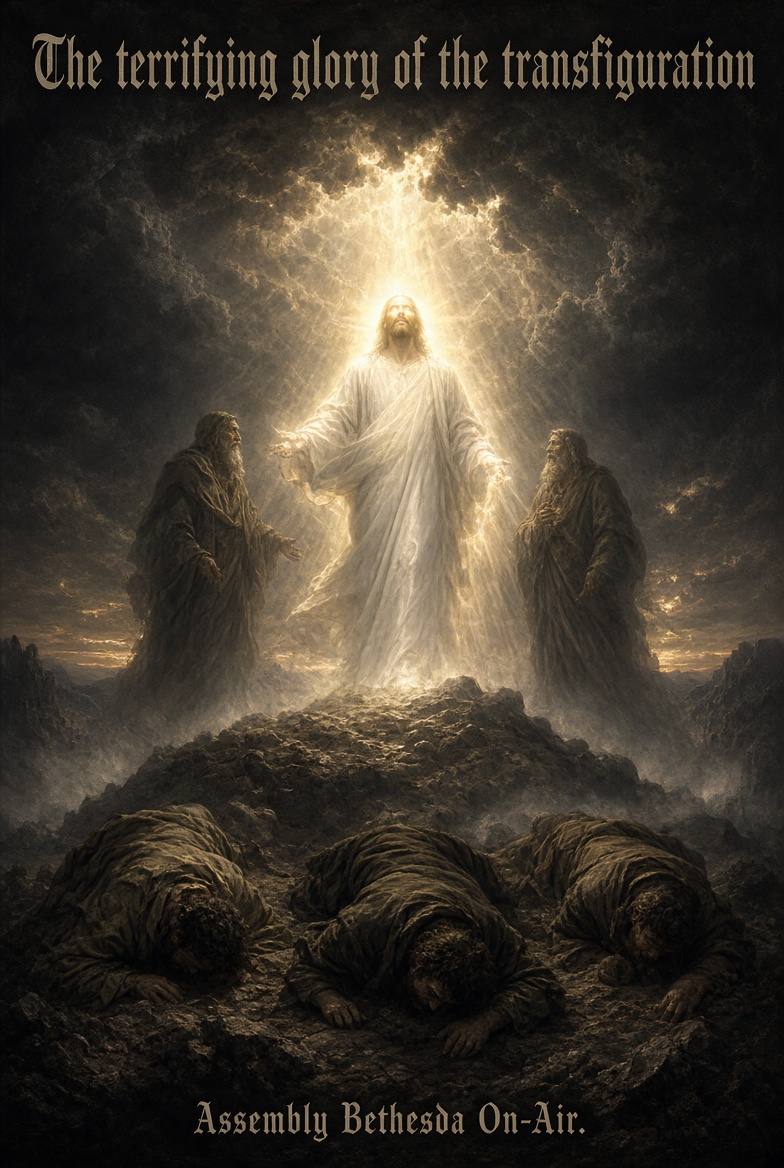
Jesus takes Peter, James, and John up a high mountain, and what happens next is not gentle. It is not soft. It is glory so pure it terrifies.
A fierce, living radiance pours from Jesus, not the warm glow of a candle, but a fierce, living radiance that belongs to another realm. His face changes. A cloud descends, bright and heavy. A voice speaks from within. The disciples fall on their faces, overcome with fear. The lawgiver and the prophet, Moses and Elijah, appear to talk to Him about the departure He’s about to make in Jerusalem.
Transfiguration isn’t a quiet revelation. It’s glory that terrifies.
It’s easy to talk about God’s glory as something beautiful, something comforting. But God’s glory is always beautiful. The light that spills through when the veil between heaven and earth thins is too much for us to handle. The disciples are undone when the veil thins. Peter, always ready with words, suggests building shelters, like he could contain the moment, keep it safe, make it last. But the cloud answers him. The voice answers him too. Fear is the only honest response.
Christian Gothic atmosphere lives in this tension. There’s dark mountains, storm clouds, half-seen figures in blinding light. Glory isn’t pastel. It’s white-hot. It’s the kind of light that reveals every shadow in a person’s heart. When the disciples see Jesus for who He is, they just can’t believe what they see.
Think of the mountain itself. High places in Scripture are places of encounter, places where heaven and earth come together violently. Sinai shook. The bush burned without being consumed. Here on this unnamed peak, the same pattern holds. The same God who spoke from fire and cloud speaks again, and his word is simple and absolute: My son, listen to him.
Here, fear isn’t the enemy, it’s the doorway. They’re scared, but they stay. They don’t run down the mountain. They stay in the presence of the One whose glory has broken them. When Jesus comes and touches them, saying rise, don’t be afraid, the touch is gentle, but the memory of the light remains. They’ve seen something they’ll never forget.
Peter’s confession and the cross are sandwiched together here. At the beginning of the suffering path, the disciples get a glimpse of the end. The glory revealed is the same glory that will be hidden in blood and nails. The terrifying light on the mountain is the same light that will shine from an empty tomb. God’s life already shines through the One who will be crushed.
The Transfiguration refuses to shrink in a world that prefers manageable spirituality. It’s not a metaphor for self-improvement, it’s an invasion. Heaven invades the ordinary mountain. The eternal steps into time. It’s a combination of terror and longing. The disciples want to stay, but cannot. It’s the Christian Gothic heart of the story: beauty so intense it’s judgment, light so pure it’s exposure, glory so real it’s terrifying.
They’re covered by the same cloud that filled the temple, the same presence that led Israel through the wilderness. The Shekinah, the dwelling glory, stops conversation. Plans stop. The only position is down on the ground. Modern faith tends to stand upright in front of God, to negotiate, to analyze. The Transfiguration won’t allow it. Glory demands bowed heads, closed eyes, silence.
Yet the voice that speaks isn’t a voice of condemnation. It’s an affirmation voice. This is my Son. It’s not the terror of rejection. It’s the terror of proximity. Near the Holy is a reminder of how unholy we are. The disciples don’t get cast away. They’re drawn closer to him. The hand that lifts them is the same Jesus’s that still sparkles in their minds.
They’re not supposed to talk about the vision until after the resurrection, Jesus says. The glory is real, but it isn’t ready for public display yet. It’s got to pass through death first. Only then can the full meaning be told. The mountain points to the cross and the empty tomb. The glory that terrifies is the glory that saves.
There’s still a lot of shadow and light on this mountain in Christian Gothic imaginations. The rocks are dark. The sky is heavy. The figures of Moses and Elijah stand like silhouettes against the Son’s blaze. The disciples are small, almost swallowed up by the scene. The light doesn’t destroy them, but rather remakes the way they see everything afterwards.
This mountain’s afterglow lives on. Every time we read the story, the same light presses against the page. Every time we worship, the same voice still talks. Listen to Him. The command is simple, but the cost is dying our own agendas. Listening means letting the glory interrupt us. It means letting the terror of holiness do its work, stripping away the false lights we prefer.
Light breaks through, fear rises, the voice speaks, the hand touches. It’s the pattern of all true encounters with God. We rise changed. The mountain remains there, waiting in the text, waiting in the quiet places where the Spirit still opens the sky. It’s terrifying because it’s still real. And the real is always bigger than we can handle.
The story keeps haunting and healing because it refuses to accept a domesticated Jesus. The One who shines on the mountain is also the One who walks the dusty roads, weeps, and dies. The glory and the suffering meet in one person. We see the cost and the beauty of belonging to such a God when we look at the Transfiguration with honest eyes.
Having come down the mountain, the disciples were different men. The light had gotten into them. Fear had purified them. They would still fail. They’d still run, but their memories of the mountain would never fade. After the resurrection, the same light would come back and they’d recognize it. They’d prepared for the great glory yet to come with the terrifying glory.
This mountain stands in Scripture as an invitation. Come up. See. Fall down. Rise. Listen. The glory is still there, too bright for comfort, still kind enough to lift the fallen. The Christian Gothic faith embraces both the light and the darkness at the same time. It knows that the One who shines is also the One who broke, and true peace starts with His terror.