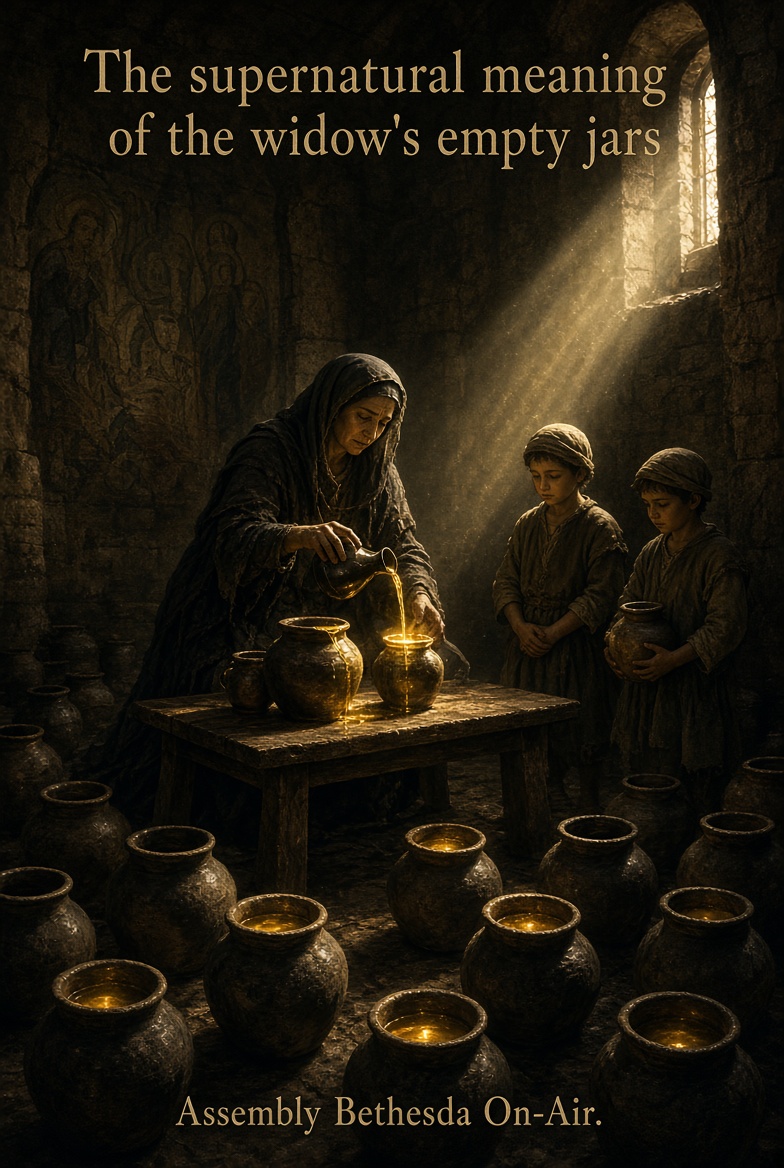
It’s haunting to see empty vessels in the dark. Something that pulls at the edges of the soul when you see a woman standing in a quiet room staring at jars that hold nothing, while the weight of debt and the threat of losing her sons press against her. There’s no comfort in the story of the widow and her empty jars. It’s a Christian Gothic picture of desperation meeting the supernatural, of barren space becoming the place where God decides to pour Himself out.
The creditors are coming. They want her sons as payment. We find her in 2 Kings. Her husband, a man who feared the Lord, is gone. She’s left with a flask of oil and a crushing fear that tomorrow may take everything. She comes to Elisha, the man of God, and lays her emptiness before him. The man doesn’t lecture her or give her a distant promise. He just tells her to borrow empty jars from all of your neighbors. Then shut the door and start pouring.
In that moment, the atmosphere shifts. The ordinary kitchen becomes a place where natural and supernatural get closer. Empty jars sit like open mouths, waiting for something they can’t produce on their own. After the widow and her sons pour, the oil starts flowing. It keeps flowing. Jars fill until there are no more vessels left, and only then does it stop. She sells the oil, pays the debt, and survives.
In the Christian Gothic sense, emptiness isn’t neutral. It’s either a tomb or a sanctuary. This isn’t a story about clever problem solving. The widow has run out of her own supply of jars, so the jars are empty. She has nothing to offer, nothing to trade, nothing to pretend with. I can’t stand that kind of emptiness. It’s like a dark hallway where creditors’ footsteps echo, where the future looks like a closed door, and the past doesn’t offer any comfort. Yet God chooses precisely that emptiness.
In Scripture, oil means more than just oil. It means anointing, the presence of the Spirit, provision that goes beyond human effort. By pouring, the widow doesn’t manufacture a miracle. She’s cooperating with one. The supernatural doesn’t wipe out the emptiness first, it fills it. The jars are empty until the pouring starts. There’s no sudden flood of miracles that overwhelms the room. It comes as a steady, quiet overflow, so the vessels have to be ready and available.
A deep gothic beauty in that picture. The closed door. The private room. The mother and sons working quietly while the oil multiplies. Outside, the world continues with its demands and threats. Inside, heaven is rewriting scarcity rules. The emptiness makes the miracle possible. The oil would not have been able to demonstrate its endless supply if the jars had already been full. Empty jars reveal the character of the One who fills them. God isn’t limited by what we can see or what we can hold. He is only limited by the space we make for Him.
Today, we’re afraid of emptiness. We fill every silence with noise, every quiet moment with distraction, every lack with frantic activity. The widow’s story stands against that impulse. When emptiness is brought to God honestly, He gives His abundance. The jars don’t argue with their emptiness. They just receive. The widow doesn’t stretch the little oil she has. She just obeys the strange word and watches it happen.
Also woven into the gothic texture is a warning. The oil runs out when the jars run out. The limitations aren’t God’s fault. They’re on the vessels’ side. We keep a lot of empty places in our lives because we don’t want to borrow jars, admit we’re lacking, shut the door, and start pouring. It’s up to us to acknowledge and offer the emptiness to the supernatural. Our own solutions don’t clog up the space.
Darkness doesn’t make the light unmistakable in this story, it’s about the kind of darkness that makes the light unmistakable. The widow’s house is a place of grief and threat. The empty jars symbolize that grief. Yet when the oil flows, the same space becomes a place of quiet triumph. The supernatural doesn’t deny the gothic weight of loss and fear. From the inside out, it transforms it.
This is the invitation the empty jars still hold. Bring the emptiness. Borrow the vessels. Shut the door. Start pouring. Watch what heaven does with what you thought was nothing. There’s still oil flowing. There’s no dry source. You just have to figure out whether the jars are ready.
She’s free from debt and her sons are safe at the end of the story, but what’s really important is that emptiness is never the end. It’s the beginning of overflow. That’s what the widow’s empty jars meant. They weren’t symbols of failure. They were a sign of how much space God would fill.