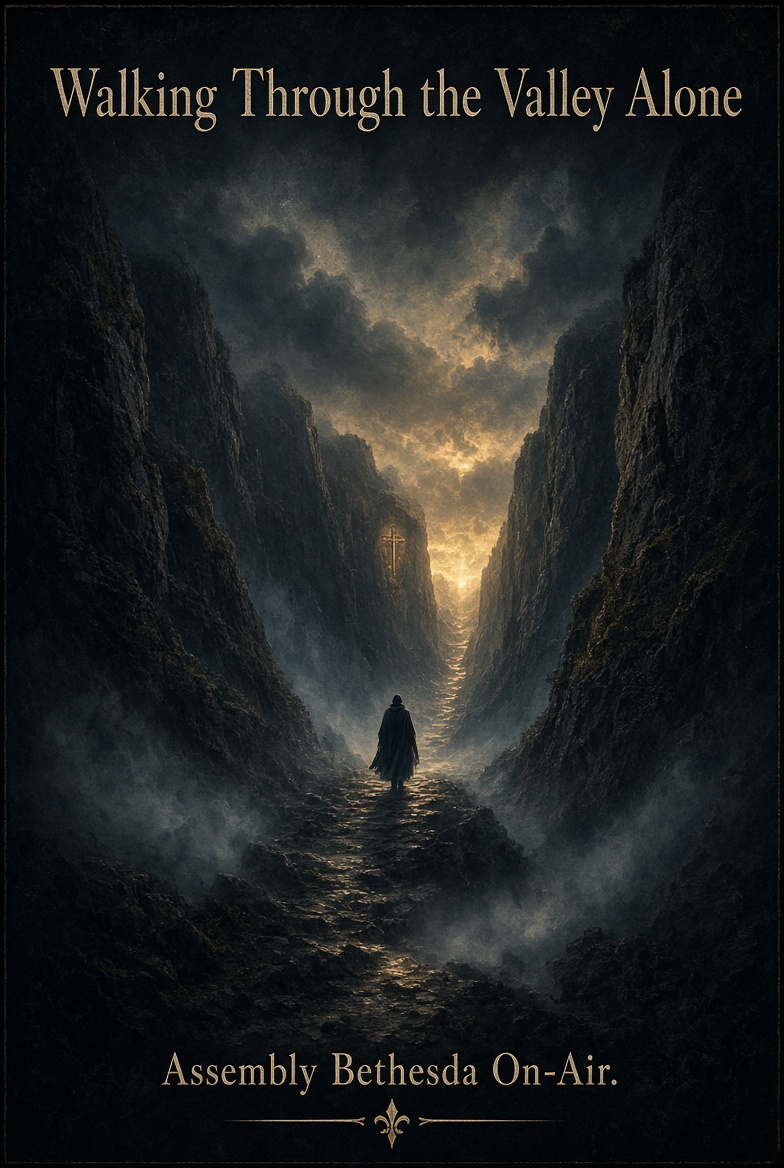
Long and low, the valley is a place where the ground softens underfoot and the air is quiet. It’s not abandoned to walk through it alone. In Christian Gothic imagination, this valley isn’t a failure of faith. It’s the honest recognition that some parts of the road belong only to the traveler and the One who watches over every step. This is where faith takes shape, where the old stones of Scripture feel cooler to the touch and the distant light of promise burns brighter.
The psalmist doesn’t pretend the valley is pleasant. He names death without flinching. The rod and staff are in the same breath as the danger. Comfort isn’t the absence of danger. Comfort is the presence that refuses to leave even when the path narrows. This is the gothic heart of the Christian story. Beauty and terror live together. The cross stands against a darkening sky. Solitude in the valley is not isolation from God. It is stripping away every lesser voice until only His remains.
There’s a lot of people who arrive expecting company, but it never comes. Friends grow quiet. Advice grows thin. The sound of ordinary encouragement fades because it can’t reach the valley floor. It can feel like judgment, but it’s not. Darkness isn’t the enemy of revelation, it’s the stage on which it steps forward. It’s what the soul needs to learn to listen differently. In the Gothic tradition, darkness isn’t the enemy of revelation. The same God who formed the mountains formed the low places between them. He isn’t waiting at the far end. He’s already there. Candles are lit because the room is dark. Hope is spoken because the night is real. Walking alone doesn’t mean walking without witness.
Take a look at the psalm again. “Even though I walk.” The verb is present and continuous. The valley isn’t a brief interruption. It’s a season with its own rules and weather. As that season approaches, the eye adjusts. What used to seem like endless shadow begins to show texture. Roots that were just obstacles become handholds. The wind that once felt only cold begins to smell like rain that has already fallen elsewhere.
In Gothic art, these tensions have long been held together. Cathedrals have pointed arches reaching up, while their foundations are hidden in shadowed crypts. Stained glass catches the light because the walls are thick. Faith flourishes in the valley when it starts trusting quieter forms of illumination instead of constant sunlight.
There’s a lot of loneliness in this place. It’s not a sign of weak faith. It’s just the cost of following a path you don’t have to share with others. Jesus himself knew the cost of solitude. His garden was full of sleeping friends. His cross was surrounded by voices that didn’t understand. The resurrection morning started with a woman standing alone before an empty place. It’s the same pattern. It’s not a detour from the gospel. It’s one of the gospels most often used location. Even when there’s no living voice nearby, the soul walks there with every pilgrim who’s gone before.
The gothic sensibility refuses easy comfort. It won’t paste bright slogans over real ache. But it will insist that ache isn’t the whole story. The same chapter that names the valley also sets a table in front of enemies. It anoints the head. It talks about goodness and mercy that pursue instead of merely wait. There’s nothing polite about it. This is a declaration from within the shadowy place. Those walking the valley alone aren’t supposed to pretend the darkness is light. They’re invited to trust that light still exists and that it’s patient, personal, and moving toward them.
Only in solitude do you get a particular kind of courage. It’s quieter than the courage of the crowd. It doesn’t need applause to keep going. It learns to measure success by faithfulness instead of visible results. There are no usual markers of success in the valley. There’s no need to worry about career, reputation, or community affirmation in the valley. It’s just about taking the next step, and then the next, and then the next. In the quiet, that decision becomes a form of worship. It’s the body saying yes when the emotions are tired.
Besides, beauty survives the dark in the Gothic tradition. One candle in a ruined chapel is more beautiful just because the walls are broken around it. The soul that’s been through the valley learns to notice the stubborn beauty of a voice singing in an empty nave. A verse that once felt familiar now feels like a hand on the shoulder. A hymn from childhood has new weight. Once you get over your fear of silence, even silence can become companionable.
There’s still difficulty in this valley. Shadows still lengthen. The path still rises and falls without warning. There’s no promise that the path is going to be easy. There’s a promise that the path isn’t walked alone. He doesn’t just send the sheep into the dark and wait at the other end. He goes in with them. The rod and staff aren’t just theoretical tools. They’re actual tools for real situations. Guidance and protection don’t wait for the light to return. They’re active now.
It’s a burden and a strange privilege to walk alone through the valley, because it’s where secondhand faith is shaped into something the walker owns, where the old words of Scripture stop being just remembered and start being lived. The valley doesn’t last forever. Seasons change. The path eventually climbs. It’s where the Gothic meets the gospel. Against the backdrop of real shadow, holiness is most evident. The invitation remains the same while the feet are still on low ground. Walk. Trust the presence that won’t leave. Let silence teach what words can’t. The One who already knows every step already walks it with you.
In the Christian Gothic imagination, solitude isn’t denied, but it refuses to let it win. Ultimately, the valley isn’t a tomb. It’s a passage. And the One who walked it first still walks it with every soul that finds itself there, even when there’s no one else around.