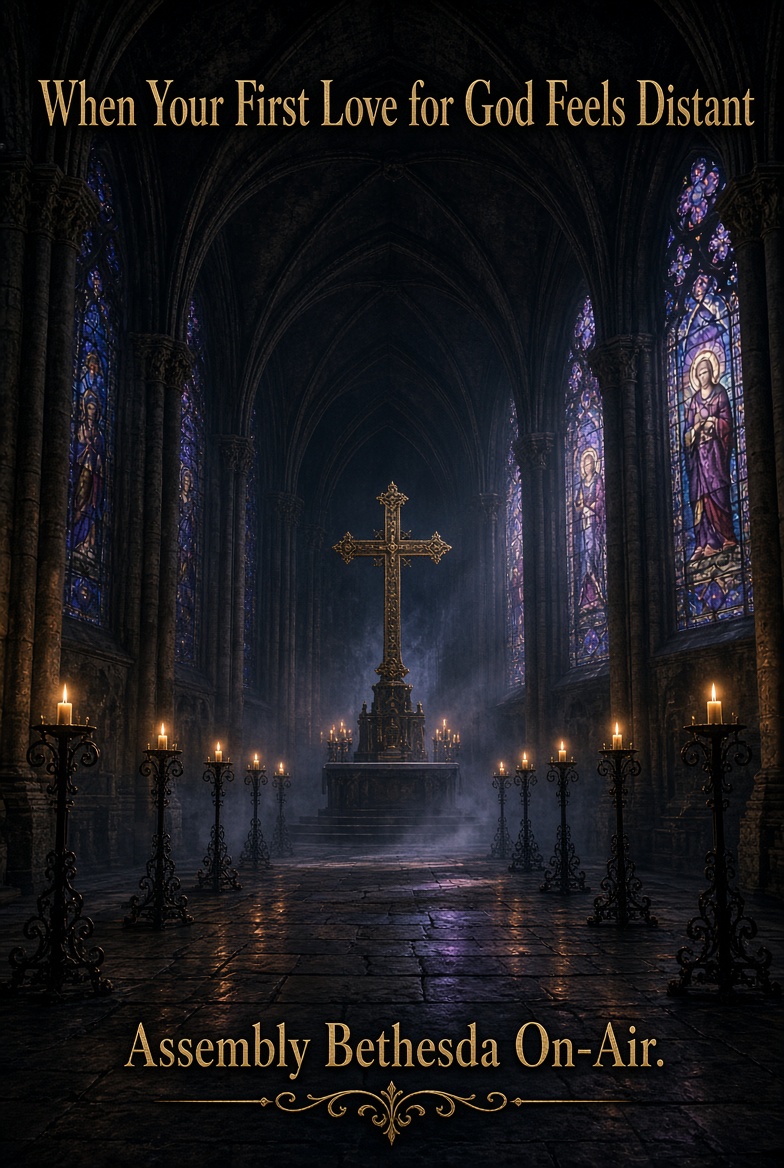
There comes a season when the bright flame of first love for God settles into something quieter, something that feels farther away than it once did. The early days often arrive with a rush of wonder, every prayer electric, every verse alive, every moment edged with the sense that heaven has drawn near. When the ordinary settles in, you know what you’re doing now. Worship feels familiar rather than overwhelming because the words that used to elicit joy now sit still. Someone who used to feel close has stepped into the next room, and the door has closed just enough to leave a draft.
There’s nothing wrong with this. It’s just the kind of landscape that many walk through, and it’s holiness. Candles still burn in the dark of a stone chapel. The stained glass still holds its colors even after the sun goes down. Distance doesn’t erase the foundation, it just changes the way the light falls.
Waiting can feel like absence, but absence isn’t the same as abandonment. Scripture talks about God who lives in both thick darkness and blazing light. When the soul feels dry, when the voice that once answered seems quiet, the psalms don’t hide those seasons. They’re in the same book as those shouts of praise. They’re right there next to each other, proving they’re both part of faith.
It’s tempting to force the old intensity, chase the feeling until it comes back or decide that the feeling was never real when the first love feels distant. In either case, it doesn’t lead home. The better way is to remain. Remain in the places that were once light, even when they feel dim. Open the same pages. Speak the same simple words. Put on a candle if it’s dark. Sit in the silence without making it do anything.
It’s always been a hallmark of Gothic faith to see shadowed naves, the echo of footsteps on cold stone, and the single flame that doesn’t go out. It doesn’t have to roar. It just needs to keep burning. The same is true for the heart that keeps turning toward God even when it feels heavy. The turning itself is love. The distance is where that love is tested and proven.
Consider the ancient practices that weren’t meant for peak emotion alone. The daily office, the quiet repetition of a short prayer, the simple act of kneeling when the soul feels nothing. It’s not like they’re performances. It’s like anchors that hold the heart in place despite the weather of feeling. Faith walks those stones one step at a time as the end of a long hallway becomes shadowed, but the stones remain solid.
It was real the first time. It’s real the quiet now, too. Both of them can be offered. Say the words even if they sound flat. Show up even if the room feels empty. God doesn’t only show up in the blaze. The same God who met the heart in the blaze is still there in the hush. It doesn’t always announce itself with emotion. Sometimes it just stays there.
It takes a certain kind of courage to keep going when the emotions have thinned. It’s the courage to keep a candle burning through the longest night, not because the flame is dramatic, but because the darkness doesn’t have the final say. That courage is itself a form of love. It’s quieter than the first rush, but it might prove deeper. Roots grow in the dark. In perpetual sunlight, trees don’t grow their strength.
You don’t have to wait for the old intensity to come back before you start moving. If the distance has grown, start where you are. Even if it’s just a thin thread, move with the intensity you have. Read one verse slowly. Speak one honest sentence. Sit for five minutes and don’t fill the silence. It’s these small acts that rebuild the path the heart once walked along.
Gothic imagination has always allowed for the glorious and the grey. Cathedrals were built to hold the full range of human experience under one roof, the high feasts and the ordinary Tuesdays, the loud alleluias and the whispered pleas. If faith is only about bright times, it’s too fragile for a long life. Faith that knows how to live in the quieter rooms becomes a house that can withstand any storm.
It’s okay if you don’t manufacture the feeling of closeness. It’s okay to stay. When the first fire settles into coals, staying is the work of love. The coals still hold heat. They can still be stirred. It might take time. It’s not a waste of time.
It teaches you that God is not a sensation to chase, but a Person to trust. It teaches you that love can be found in both the ordinary and the extraordinary. Even when it feels like a gentle and almost imperceptible pull, the One who first drew the heart near is still drawing.
If the room is bright or dim, keep walking the stone floor. Keep the candle lit. Keep looking at the One who remains. The first love was a beginning. When the feeling is gone into the next room and the door stands slightly open, the love that stays. What grows in the quiet may prove to be the deeper thing.
It’s in the shadows that faith learns to see without relying on the old light alone. And in that seeing, something more steady is born.