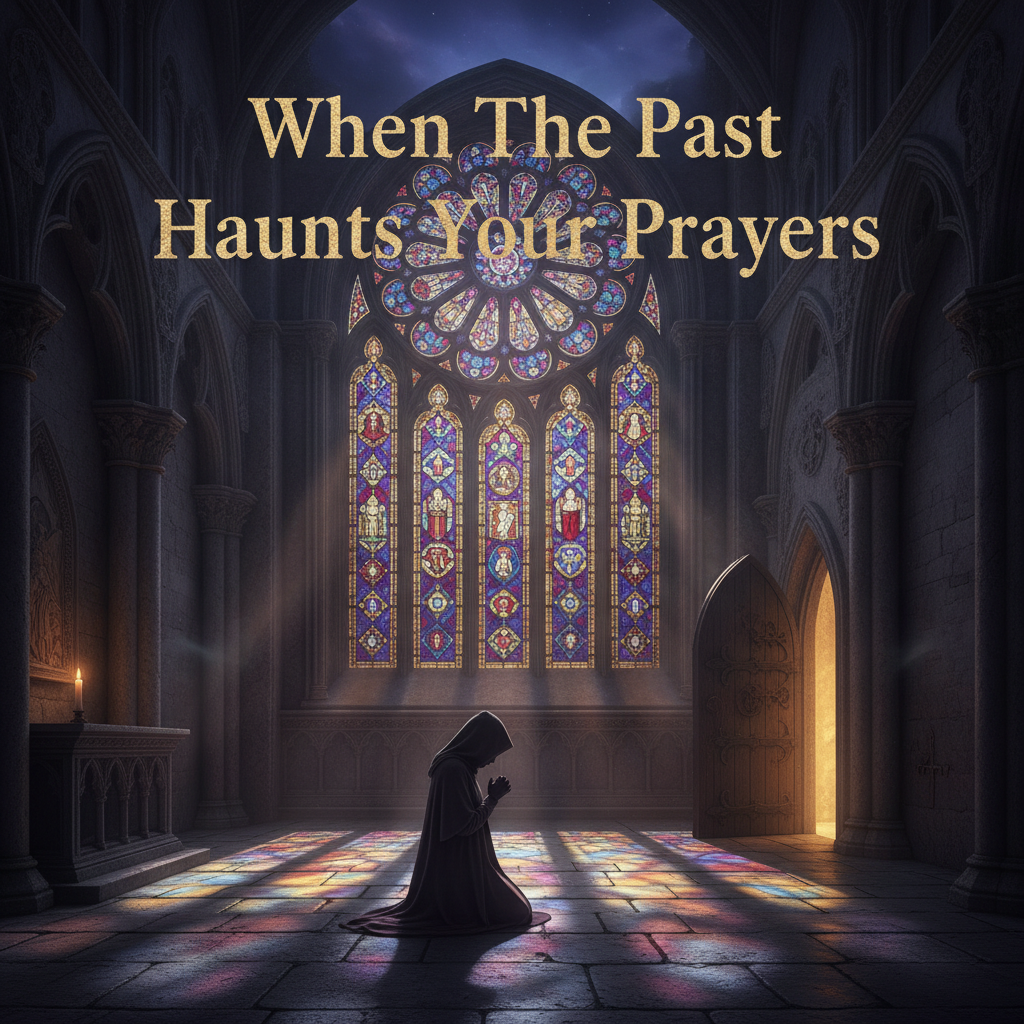
If you kneel or sit to pray, there’s a certain hush that settles in, almost sacred like that. Candles might flicker nearby, or a single lamp might cut through the evening darkness. The heart turns to heaven, ready to speak, ready to listen. But sometimes the past just won’t stay put. Your old failures, sharp words you said years ago, choices that still hurt, memories that carry the weight of regret rise like mist from cold stone floors and settle right in the middle of your prayers.
It’s no surprise that the Christian gothic atmosphere understands this tension well. Think about ancient cathedrals where light filters through stained glass in deep red and blue, casting long shadows across worn pews. The beauty is real, the holiness is there, but the shadows still exist. Faith doesn’t erase memory’s architecture. It just lets the light keep moving through.
When the past haunts your prayers, often arrives without invitation. You start out praying for God’s nearness, or confessing, or simply longing for him. The enemy of the soul knows how to use these images. A moment of weakness. A relationship that ended in silence. A decision that hurt someone you loved. He doesn’t need new material when old files still open. Prayer can feel interrupted, as if an unwelcome guest has paused the conversation with the Father.
David remembered his own failures in the psalms. Peter remembered long after the resurrection morning the sound of the rooster. Paul talked openly about the man he once was, the persecutor. Rather than living as if memory had been wiped clean, they learned to bring those memories into the presence of the One who already knew every detail. Dark wood, stone walls, the smell of incense rising through dim air, these elements remind us that light is most visible when it has something pushing against it.
A haunting is sometimes triggered by a simple question that loops inside the heart: How can God still hear me after what I’ve done? How can these hands, the same ones that once hurt, now fold in prayer. How can this voice, the same one that once spoke carelessly, now speak praise? There’s a reason these questions feel heavy, because they’re rooted in real awareness of sin. Not the awareness, but when it becomes a wall instead of a doorway. Unaddressed guilt can become a constant companion every time you pray.
Yet the gospel doesn’t leave us there. The cross stands as the central answer to every haunting memory. At the cross, the past is confronted, judged, and covered with blood that speaks louder than any accusation. The Lord carried every failure, every sharp word, every hidden thought with full knowledge of the details. Nothing was left out of scope. The empty tomb says the story doesn’t end with the weight. It ends with a life that can’t be held by death or yesterday.
Practically speaking, praying under the shadow of the past requires a deliberate turn. It’s not about pretending the memories are gone. You name them in God’s presence. You say the quiet words that admit what happened. Then you place those things beneath the finished work of Christ. The same truth can be rehearsed over and over again. Some memories come back with the change of seasons. Past is real, but Jesus’ blood is more real.
This is where Christian Gothic imagery comes in. Imagine a stone chapel at dusk, with heavy doors and cool air. There are faded tapestries hanging along the walls that tell stories of failure and redemption. You don’t feel worthy, but the door has been opened by another. You sit in the half light and talk. The shadows don’t leave the room, but they don’t define it anymore. As the light moves slowly across the floor, there’s a quiet assurance that the past doesn’t win.
The haunting goes away when prayer is less about performance and more about presence. If prayer is viewed as a test of spiritual cleanliness, every remembered failure gets a failing grade. When you pray with a Father who already knows the whole story, the failures become part of what’s being revealed. That kind of honesty replaces hiding. The Gothic tradition has long valued it. Faith that can look at the dark without flinching is faith that can also look at the past without owning it. Its art and architecture never shy away from skulls, from reminders of mortality, from the visual language of death and resurrection.
In addition to the spiritual dimension, the past that haunts private prayer can sometimes be relieved in the presence of trusted brothers and sisters. Confession isn’t just vertical. Scripture encourages horizontal practice too. The power of a memory starts to thin when it’s mentioned to another believer who responds with the truth of the gospel rather than shock or judgment. Gothic churches understood the importance of shared spaces where sin could be acknowledged and grace could be received.
As you bring the past into prayer more often, your relationship with those memories changes. They’ll still come up, but they’ll be less powerful. The heart learns to answer them quickly. Yes, it happened. Yes, it mattered. And yes, it’s been carried by the One who rose from the grave. It’s possible to transform an interruption into a deeper trust in a prayer that once felt interrupted.
The atmosphere of Christian Gothic faith doesn’t demand that every shadow disappear before you approach God. It simply insists that the light of Christ is strong enough to keep company with those shadows until they no longer hold power to silence you. You don’t have to end the prayer when the past comes up. You can bring it into the conversation, and the finished work of Jesus will answer it every time.
When the old scenes try to claim the space during your next prayer, remember the stone walls and the stained glass. Remember the light that keeps moving. Remember that the door is still open because Someone has already been through every failure on your behalf. Speak. Listen. Stay. The past may visit, but it doesn’t get to stay in the house as master. Christ does.
Grace continues to outlast ghosts in every dimly lit room where a believer kneels once again.