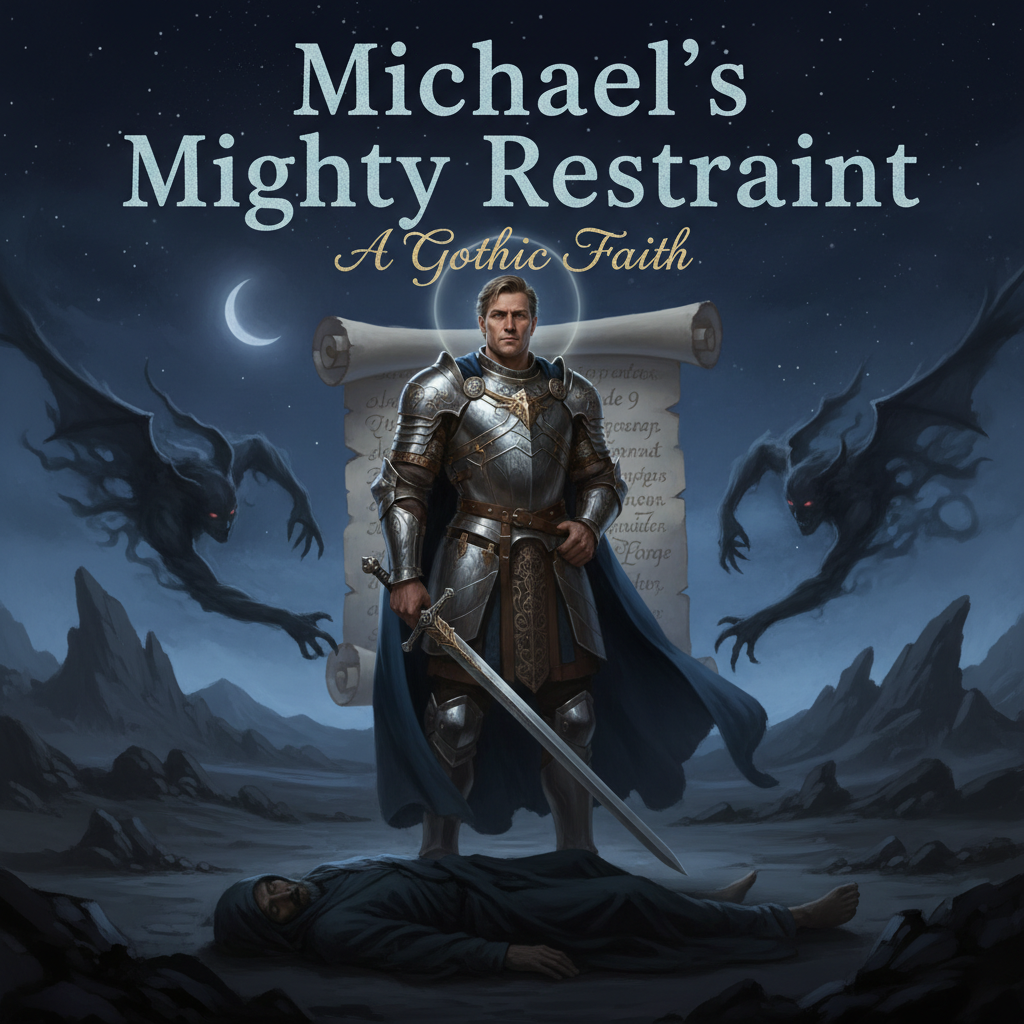
I’d like you to step into the candlelit shadows with me for a moment. We’re talking about one of those Bible verses that feels like it was carved into an ancient cathedral wall at midnight, the kind of moment when heaven and hell brush past each other in the dark and all you can see is God’s calm authority.
The archangel Michael, locked in a dispute over Moses’ body, stands face-to-face with the devil himself in Jude 9, but he doesn’t sling accusations or drag the enemy through the mud like a single beam of moonlight through stained glass. Instead, he just says, “The Lord rebuke you.”
The film is raw and Gothic, heavy with mystery and power, yet wrapped in humble restraint. No thundering battle cry, no list of the devil’s crimes, just a calm handover to the only One in charge. Even the greatest warrior angel knows his place, and that place is under the Lord’s command, even in the dim glow of old tombs and forgotten wilderness graves.
Imagine the setting the way the old Gothic artists would have painted it, swirling fog over silver sand, the body of Moses lying there like a sacred relic that both sides want to claim. Michael could have ended it with an angelic rage. The devil shows up with his legalistic arguments, maybe pointing to past sins or old failures, trying to stake a claim on God’s stuff.
As the protector who stands guard over God’s people, he throws Satan out of heaven in Revelation. Yet here, in this quiet standoff, he holds back. He doesn’t slander. He doesn’t stoop to accusations and insults. In the shadowy corridors of faith, the Lord rebuke you.
There’s something profound about spiritual warfare in that simple phrase, not the flashy sword swinging kind, but the deep, steady one that happens in the hidden places. It’s like a thousand Gothic hymns sung in stone naves. We need to learn from Michael that real power doesn’t need to tear the opponent down with words. Real power rests in pointing everything back to God.
It whispers that we don’t have to match the enemy’s tactics. We don’t have to sling the same mud. We just have to stand tall, speak truth, and let God handle the rebuke.
For a reason, Jude slips this story into his short letter. He is warning about false teachers who creep in, who speak evil of things they don’t understand, who speak against spiritual authorities without fear or reverence. Michael is the bright angel in the dark example. Even though he has more might, he doesn’t rail at him. He models humility Jude wants all believers to copy. It’s not weakness. It’s wisdom dressed in black robes and silver armor, the kind that doesn’t let darkness change the way you speak.
Think about how this plays out in the bigger story of Scripture. Michael appears in Daniel as the great prince who fights for Israel, in Revelation as the leader of the heavenly armies. He’s no stranger to battle. Yet he chooses restraint over Moses’ body. According to some ancient texts outside the Bible, the devil tried to accuse Moses of murder or taking glory from God, but Michael doesn’t get involved. That’s Gothic faith at its core, mysterious and majestic, where the shadows only make the light look brighter. He doesn’t argue with the devil or list countercharges. He hands it over to the Lord.
In this verse, we see a hidden river of resurrection hope. Moses’ body was special. God buried him in a secret place so nobody could make it into an idol. The devil wanted to use it for division or false worship, but Michael guarded it. We need to guard the sacred things in our own lives, the quiet callings, the places of obedience, without letting the enemy drag them into the mud of slander or gossip.
The verse invites us into a Gothic kind of courage, the kind that doesn’t roar but stands still in the storm. It’s the courage to stay silent when every instinct screams to talk, to trust when everything looks like a disaster. It’s the name of the Lord that gives Michael’s words authority. We can echo that pattern when we face our own disputes, whether it’s with dark forces or difficult people. We can refuse slander and stoop. Let’s lift this mess up to heaven and ask the Lord to rebuke it.
It’s always true in the candlelit chapels of our hearts: The devil is real, the battle is real, but the victory already belongs to the One Michael points to. Our job isn’t to fight the darkness, but to stand in the shadows and let God’s rebuke do what only it can. That’s the heart of this verse, simple yet endless in its depth, casual in its everyday power, Gothic in its ancient beauty.
We could linger here for hours, tracing how this one line has inspired poets, painters, and believers throughout history. Angels and demons are often depicted in stone reliefs in Gothic cathedrals, locked in eternal struggle, but Michael’s pose is always one of poised strength, never frenzy. Like incense smoke curling around vaulted ceilings, that image stays with you, despite his sword drawn but his mouth only speaks the Lord’s name. Because we know who holds the light, it calls us to live the same way, steady, reverent, unafraid of the dark.
Think of Michael at that graveside as you walk through your own shadowed valleys this week. When the urge to accuse or slander comes, pause. Breathe the cool night air of faith. Speak the words that carry real power: I rebuke you. Watch what God does. The mystery unfolds, the shadows part, and the light wins again, just as it always does.