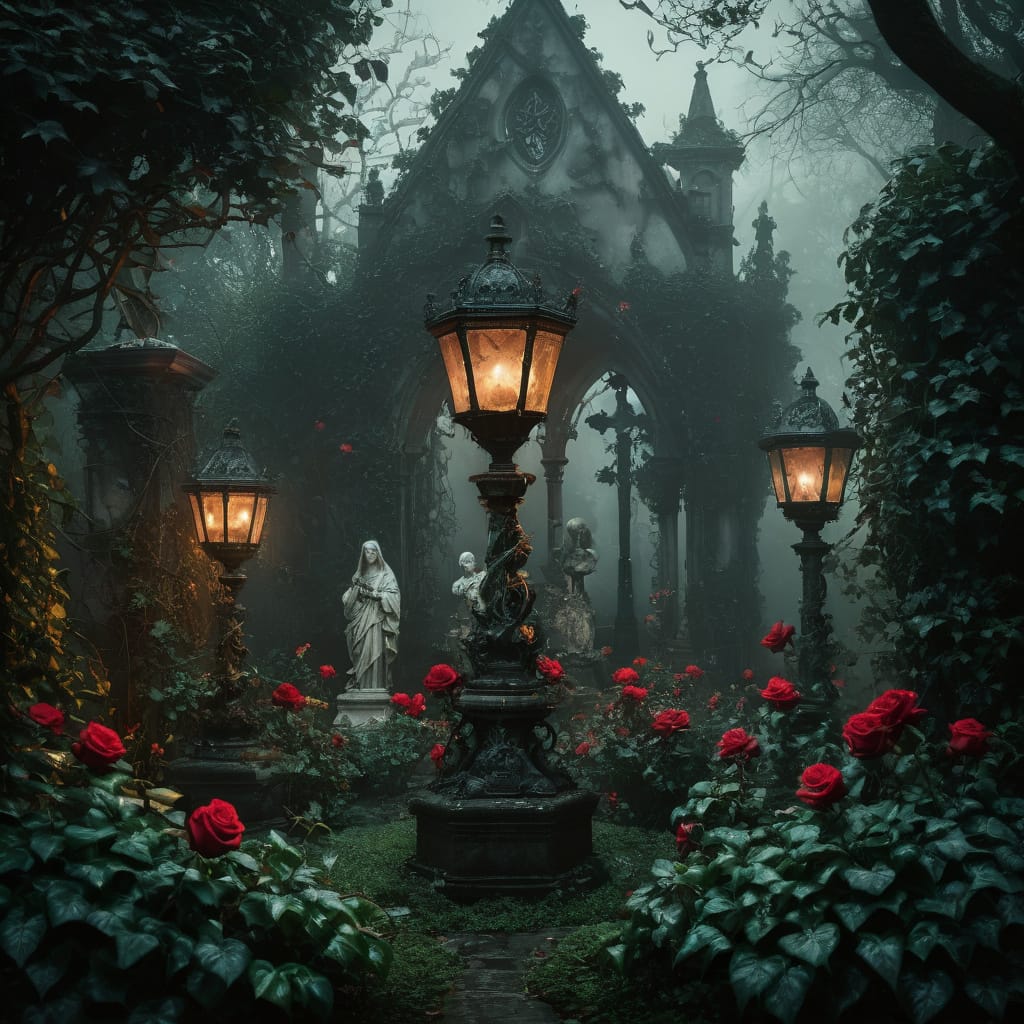
Let’s walk through the overgrown paths where beauty and ruin hold hands under a pale moon, midnight gardeners and velvet wanderers. Gothic gardens aren’t your grandma’s rose beds. Vine tangles choke marble statues, flowers wilt in black soil, leaves turn crimson, and crumble into dust.
All that decay is God’s own signature, a reminder that death is never the end, but the gateway to something greater. Nature here preaches resurrection without needing a sunny sermon.
There’s a sacred weight in the hedges that have grown wild for decades. Every fallen petal, every mossy bench whispers the same truth that the Bible plants deep in our hearts. If a grain of wheat falls to the ground and dies, it remains alone, but if it dies, it bears a lot of fruit. When you’re standing in a real garden, where things are just starting to go back to dirt, that line from John hits you differently. Rot isn’t ugly. It’s the slow alchemy of divine love.
Goth eyes love this scene. A stone fountain drips green water over cherub faces worn smooth by time. Black butterflies land on decaying lilies that still smell sweet in their final hour. A fog swirls around gnarled apple trees heavy with overripe fruit splitting open. Eden was lush and perfect before the fall, but God never abandoned the soil. It’s the garden we celebrate because it mirrors the Christian story so perfectly. The curse turns into a place where new seeds sprout when he works through it.
Gothic gardens are our thing. We like night blooming flowers, dark foliage, angel statues with weathered wings. We let the ivy grow unchecked because it teaches patience. Faith is like that ivy, persistent even when the walls look dead. When you know autumn’s not an end but a sacred pause, decay becomes divine. Fall brings a riot of color to the ground, making the next spring even richer. To teach us to trust the dark seasons, God designed the cycle that way.
Garden imagery in the Bible fits our aesthetic like a custom cloak. Jesus prayed in Gethsemane under olive trees that probably looked ancient and twisted even then. The ground there drank his sweat like tears as he wrestled with what was coming. It wasn’t pretty. Gothic gardens share the same feel. They were heavy with crushed herbs and impending loss, yet they became the birthplace of our salvation. Sitting on a bench at dusk, you can almost hear ancient prayers.
It’s comforting to know that nothing is wasted in nature. The fallen fruit feeds worms that feed the soil that feeds the next bloom. Christian Goth theology loves the economy of grace. We put our broken pieces, our faded dreams, our moments that seem like they’re rotting away, and God composts them into something that’s gonna burst with life again one day. Decay isn’t defeat, it’s preparation, slow and deliberate, and strangely beautiful when we stop fighting it.
The garden changes with the hours. At twilight, it’s burgundy and obsidian. Dew collects between spider webs. A white rose, half wilted, shines like a candle against the dark leaves like a candle. Our faith is strong enough to celebrate that process instead of fearing it, and that God is present in the fading, the withering, the return to dust.
Also, Gothic gardens remind us of a graveyard, a place where the dead rest under flowers and ivy. The crosses rise like dark blooms themselves, like the dead themselves. Walking there with a lantern at night feels like a prayer without words. Nature preaches the resurrection gospel in every turning leaf and every returning bulb. You sense the communion of saints buried beneath your feet, their bodies returned to the earth in hope of the final spring.
Let the imagery linger because it deserves it. Just imagine a wrought iron gate half open, leading into a secret plot with nightshade growing beside rosemary. There are statues of mourning women holding stone lilies that never fade completely. It smells like damp earth and distant rain. The decay is God’s gentle hand mixing the soil for tomorrow in that space. It’s where you lay down whatever is dying in your life and trust that God is already at work.
Christian Goth believers have always been drawn to these places because they refuse the lie that faith must look cheerful all the time. Our black lace stands with the black roses, and we feel right at home. Seeing the garden teaches us to slow down, to watch the process, to find beauty in the parts most people skip. That patience becomes a spiritual discipline, like the long wait between Good Friday and Easter Sunday.
In this sermon, every season has its own sermon. Spring is explosive new life, summer is fullness, autumn is glorious surrender, winter is quiet rest. All four are needed, all four are divine. Decay is simply autumn and winter doing their holy work. When we embrace that rhythm, we don’t fear the downturns in our own stories. They’re a part of God’s bigger garden.
You can almost hear the wind blowing through the dried stalks like a low choir chanting ancient hymns. The garden sings in minor keys and we know every note by heart. That music prepares us for the day when the trumpet blows and everything withered rises. In the meantime, we tend the plot, light lanterns, and keep climbing vines.
In the end, Gothic gardens are living altars. They show us that divine decay is not destruction but transformation. Slow and patient, it is full of promise. We walk their paths in velvet and lace, carrying the same hope the first gardeners carried after the fall. The soil remembers, the roots reach deep, and the next bloom is already stirring underground.