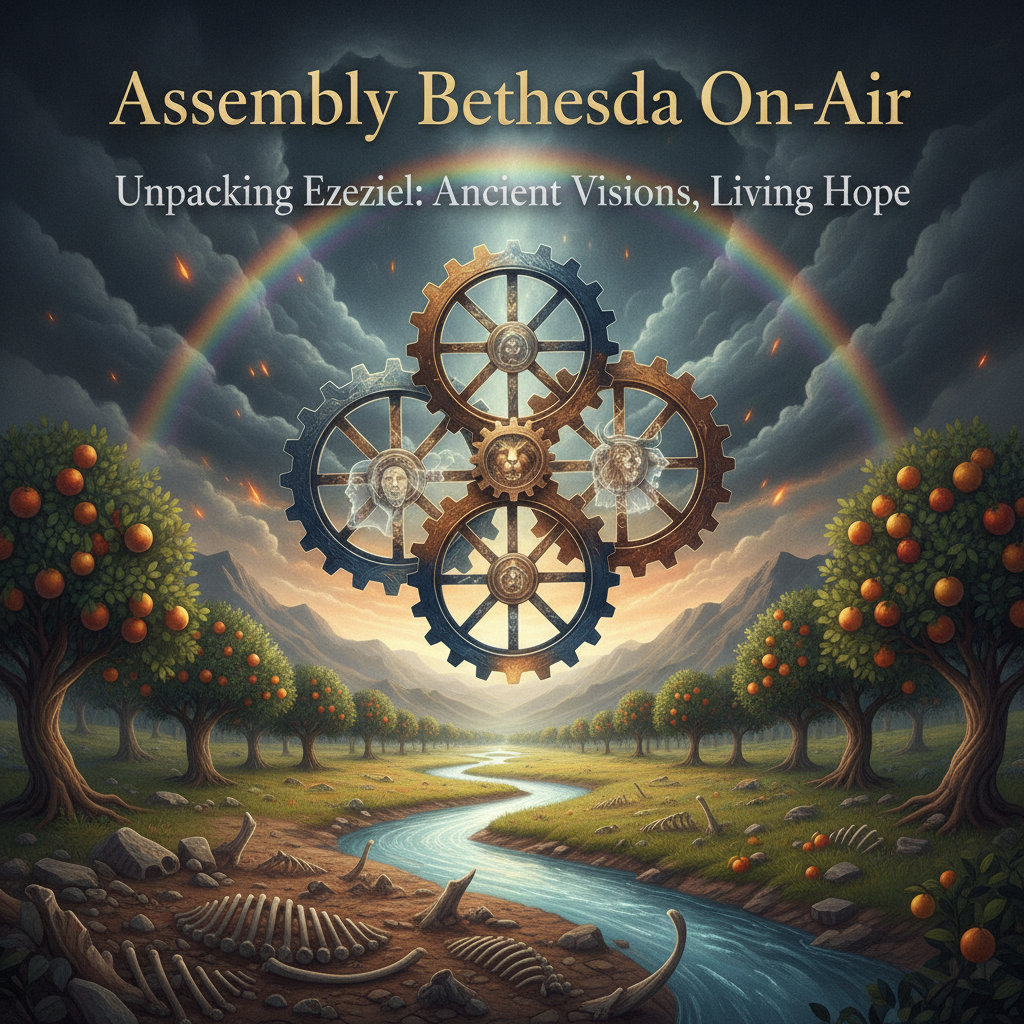
A certain part of Ezekiel’s book seems to be written for nights when the world seems broken and the sky looks heavy. His visions don’t come in soft light or gentle meadows. They come with fire, with weird creatures, with wheels that move all over the place at the same time, with bones scattered across a valley, with a temple measured out while everything else falls. Despite all that strangeness, God keeps speaking right in the middle of it. That’s what matters.
There was no pretty picture for Ezekiel. God left a temple that had been treated like a lucky charm. He saw wheels within wheels, full of eyes, turning without turning, moving wherever the Spirit walked. In a valley full of dry bones, he stood and heard the question that still echoes: Can these bones live? He saw water flowing from the threshold of a new temple, growing deeper and deeper until it became a river that brought life wherever it went. These aren’t museum pieces. These are living images that keep speaking into places where people feel most lost.
For a moment, think about the wheels. They’re not stuck. They can go forward, backward, sideways. The Spirit directs them. Eyes cover them so nothing gets hidden. In a time when so many feel trapped by systems that only move in one direction, or by personal stories that seem stuck in place, this vision says something different. God isn’t limited by those tracks we think are permanent. Any angle can move things forward. As everything around us seems rigid and predetermined, the vision of the wheels reminds us that divine purpose isn’t bound by human expectations.
Secondly, there’s the valley of dried bones. The bones have been there so long they’re beyond hope. No flesh, no breath, just scattered remains under a starry sky. God asks the question, and Ezekiel answers: You alone know. It’s time to prophesy to the bones. Speak to what looks finished. Watch as bones join up, sinews and flesh return, breath enters, and an army stands up. This isn’t a positive story.
That’s a declaration that God can bring life to what looks like it’s beyond saving. That valley today can look like communities that have lost their way, hearts that feel too drained to care anymore, and institutions that once carried life but now seem hollow. The vision doesn’t deny the dryness. It’s just not going to let it win.
The departure of the glory is another part that still cuts close. Ezekiel sees the glory of the Lord rise from the threshold, pause, move to the east gate, then leave the city. The presence that once filled the house goes down because people treated it like a guarantee instead of a place to meet. The image isn’t meant to scare you. It’s meant to make you honest. God doesn’t get trapped in buildings or traditions. He moves when people turn away.
Even when you’re leaving, there’s still the promise that you’ll come back. Later visions show the glory returning, filling a new house, and the name of the city becoming “The Lord is there.” That arc matters. Faithfulness isn’t about holding onto structures. It’s about staying open to presence that can’t be owned.
There’s a river under the threshold. It starts out as a trickle. With every measurement, it grows deeper until no one can walk through. Trees grow on both banks. They keep their leaves from withering. Their fruit is good for food and their leaves are good for healing. Wherever the river flows, the salt water becomes fresh. The vision doesn’t mean we’re escaping the world, it’s about God’s presence changing the world.
The river runs in a culture that feels like it’s drying up or turning bitter. It starts small. It doesn’t stay small. The source is the sanctuary, where God dwells with people who have been brought home.
There’s something in common between all of these visions. They don’t let the present condition dictate the final reality. When it’s hard to move, the wheels move. When life seems to be over, the bones survive. Glory goes and backs according to a deeper faithfulness. It’s the language of a God who meets people in the middle of collapse and refuses to let them go. It’s a river that starts as a trickle and becomes a force that transforms everything it touches.
What does this mean for the way we live now? The dry places don’t have to be green. We can recognize the scattered bones for what they are. We can admit when the glory is far away. And then we can still talk. We can still listen for the Spirit that moves the wheels. We can still trust that breath can enter what looks finished. We can still look forward to the river deepening.
There has always been a gothic edge to the Christian faith. Gothic isn’t about costumes or gloom for its own sake, it’s about knowing that light can come out of shadow, resurrection happens in places where it smells like death, and the holy can show up in ways that startle you before they comfort you. There’s a tradition in Ezekiel’s visions. They don’t clean up the mess. They walk straight into it with the authority of the One who speaks and makes things better.
These things are still spoken by the same God who showed them to a prophet at Chebar. The wheels still turn. The bones still wait. The river still flows from where God chooses to dwell. In the end, those who listen, who speak what they’re told to say, and who don’t accept dryness as the end of the story find themselves standing in the middle of something that looks like hope.
This is what the visions keep showing us. Not just ancient curiosities, but a pattern that lives on. God moves in ways we don’t expect. God speaks life into what looks finished. God doesn’t abandon a house forever. God sends a river that heals as it flows. That’s what happens in every generation.
Whether we stand in the valley and open our mouths, whether we watch the wheels and trust the Spirit that directs them, whether we follow the water as it deepens and let it change the landscape around us is the only question.
While the night may still feel long, the bones may still look dry, the wheels may still seem strange. But the voice that spoke then still speaks. And the one who listens finds that the dark is not empty. It’s where God chooses to reveal what’s next.