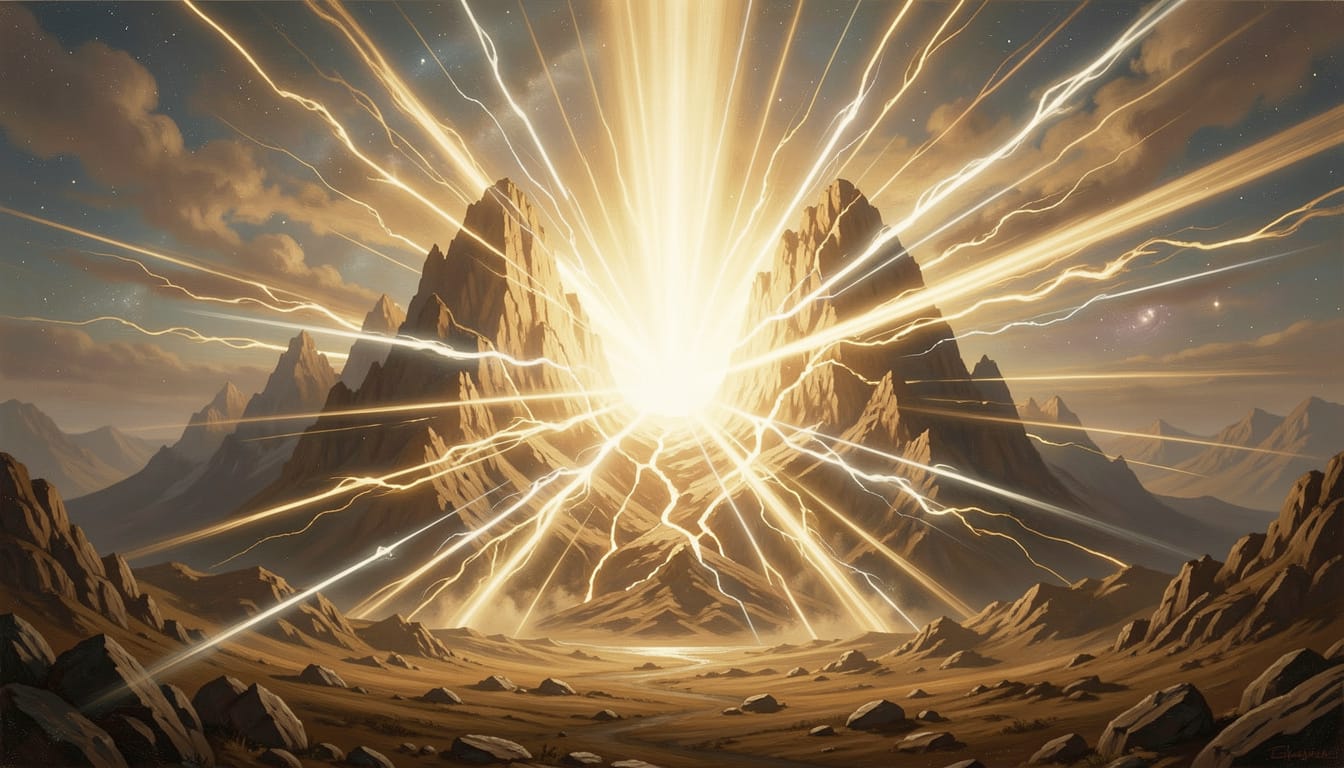
We skip over a moment in the Gospels that we tend to skip over. It’s like a brief pause between hard teachings and the cross. The Transfiguration isn’t gentle. It’s the kind of glory that makes strong men fall on their faces and beg for it to stop. It’s the terrifying glory of God stepping out from behind the veil on top of a high mountain for a few breathless minutes.
Imagine the scene without soft filters. Jesus takes Peter, James, and John up a steep slope. The air thins. Everything crumbles down below them. Then suddenly, the ordinary man they’ve followed for months changes. It’s like he’s becoming the sun. His clothes light up so bright it hurts your eyes. Moses and Elijah appear and talk with Him about leaving Jerusalem soon. The mountain gets swallowed up by a bright cloud. Three disciples collapse in terror when a voice speaks from the cloud, the same voice that once shook Sinai.
It’s not the Jesus from Sunday school illustrations. It’s the Lord of glory whose holiness is so intense people can’t stand in front of it without trembling. The same Jesus who will later sweat blood in Gethsemane first shows these three men what He truly is. The glory doesn’t come with it, it’s the truth of who He has always been, briefly unveiled just so it won’t look like a defeat.
There’s a lot of talk about glory as something soft and golden, a kind of light that makes everything beautiful. Scripture doesn’t say that. Glory usually appears in the Bible as a result of fire, earthquake, thick darkness, and a command to stay away. It was so fierce that Moses couldn’t enter the tabernacle. It drove the priests out of Solomon’s temple. It left Isaiah crying he was undone when he saw the glory. The glory that met Saul on the Damascus road knocked him to the ground and left him blind. The Transfiguration stands in that same tradition. It’s gorgeous, yes, but the kind that undoes you.
It’s Peter’s instinct to turn the unbearable into something he can control, something he can stay with. He offers to build three shelters, one for Jesus, one for Moses, one for Elijah. This is my beloved Son, listen to Him,” said the voice from the cloud. The vision vanishes. Jesus remains, ordinary in appearance again, but forever marked in their minds as the One whose true face is too bright to look at for long.
The terror isn’t the point for its own sake. The terror is the doorway. The disciples fall facedown because they’ve seen something true. Holiness isn’t safe. Holiness isn’t manageable. Holiness is the living God, and when God draws close, all pretenses go down. Still, there is a tenderness in the same voice that terrifies. “This is my beloved Son.” The glory that could consume them instead claims them. For their sake, the One who shines like the sun will soon be crucified.
The Transfiguration won’t let us keep our preference. We want the gentle shepherd without the Lion of Judah. We want the friend of sinners without the Judge of all earth. It forces us to hold both realities simultaneously. The same Jesus who walks dusty roads and eats with outcasts is the same Jesus whose face can outshine the sun. He touches lepers, who Moses and Elijah discuss His coming death with. Glory and suffering don’t cancel each other out. Glory makes suffering weighty, suffering makes glory accessible.
Consider what the disciples carried down that mountain. They saw the end of the story as they were still in the middle of it. They saw the King in His beauty before the King was crowned with thorns. When the nails went in, when the sky went dark, when the body was laid in the tomb, they would remember the mountain. That light wasn’t a flash. What they had seen was the real nature of the One who was dying. Death couldn’t hold it.
The light still shines. The Transfiguration isn’t over. The risen Christ is still carrying that glory, and everyone will see it one day. But now the invitation is open. There’s still that voice that says, “Listen to Him.” It’s still the same glory that made Peter, James, and John fall facedown, but now it calls people to fall down in worship rather than dread. Love casts out fear, but it doesn’t erase awe. Fear that knows it’s standing on holy ground and stays.
We need that holy fear again. We need the kind of Christianity that can still tremble. We talk about God as if He were a life coach instead of the consuming fire. Our faith has become so casual to the point of carelessness. The Transfiguration refuses that reduction. As it places us on the mountain again, it asks us if we’re willing to look at the real Jesus, the one whose glory is beautiful and terrifying, the one who won’t be managed, the one who demands our attention.
A mountain still stands. A light still burns. The voice still speaks. The question is whether we’re going to climb, whether we’re going to look, whether we’re going to let the glory undo us so we can build something better. The terrifying glory of the Transfiguration isn’t a story we read and put aside. It’s a present reality that keeps calling us higher, deeper, and closer to the One whose face is like the sun and whose love is stronger than death.
Even a little pull back of the ordinary veil changes things. Ordinary days come with the possibility of sudden revelation. Ordinary obedience becomes the path that leads to the mountain. Jesus still walks with His people, and the glory that once flashed on a high hill is still waiting to be revealed in full. Until then, we live in the tension of already and not yet, of glory glimpsed and glory hidden, of terror transformed into worship.
That’s the crux of it. The glory that once terrified the disciples is now saving them. The light that made them fall is now lifting them. The voice that shook the mountain still says, “This is my beloved Son.” We listen to Him and find that the terror and the glory are one thing, the terrifying glory of a God who loves us so much that He showed us His true face and then died so we could see it without dying.