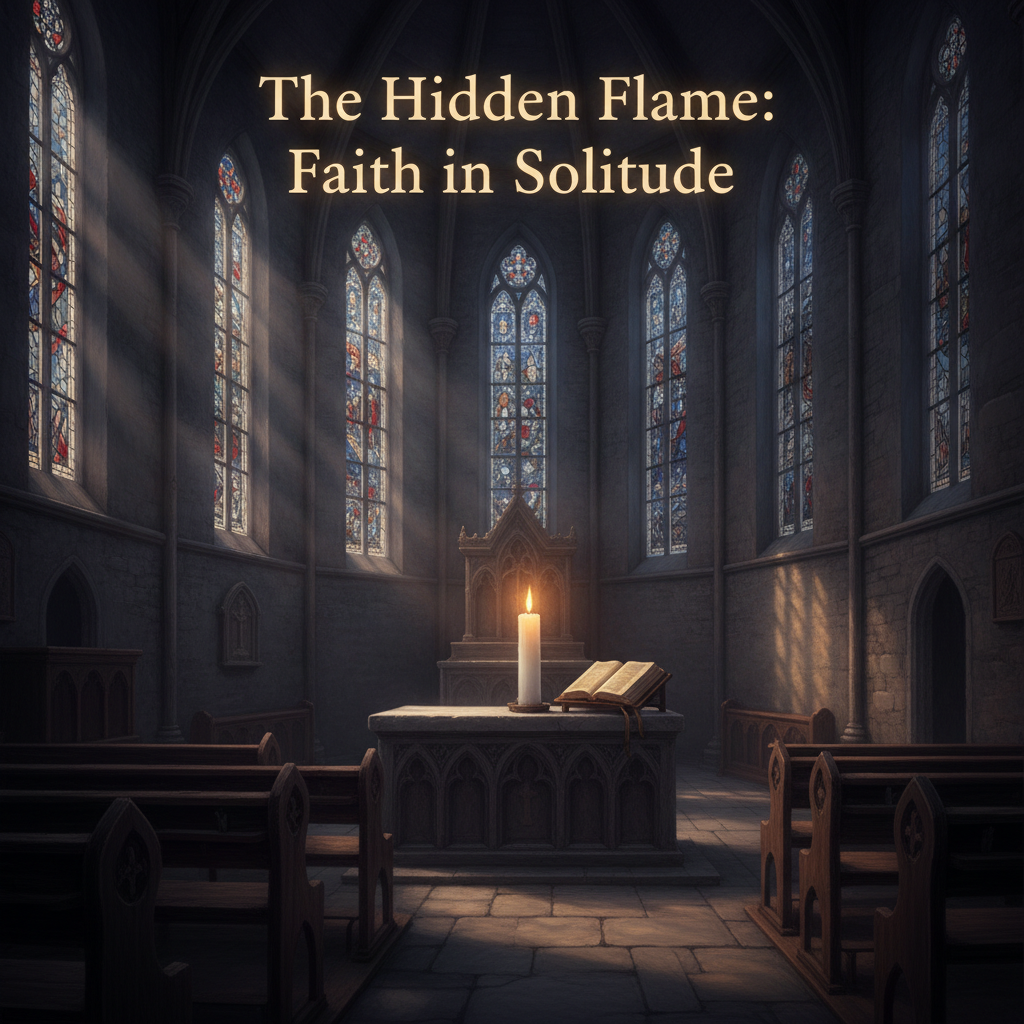
In the vast hush of evening when city lights fade and country roads empty the world settles into a deeper silence. Many hearts move through that silence carrying a faith that remains unseen by the crowds. It’s a hidden faith of lonely believers, a conviction that holds strong when no one’s watching and no voice joins in. God sees what others miss, so this faith is shaped in solitude and refined by long hours of waiting.
Christian Gothic vision finds beauty in the shadowed places. Think ancient stone churches with high vaulted ceilings where candle flames tremble against the dark. Stain glass holds colors you only see when light passes through, but it stands strong in the darkness. The lonely believer is the same way. While the outer life may seem plain or even barren, the light within it burns steadily. It’s not loud. It doesn’t ask for attention. It just keeps going.
In fact, loneliness becomes a kind of sanctuary when it’s offered to Christ. The believer who is alone with Scripture finds that the words speak more clearly. In the quiet room, the Psalms rise like incense. Jesus’ lonely nights in the garden and on the hillside are told in the Gospels. A lonely believer can relate to those moments. Trust in the One who never leaves grows not through constant affirmation from others, but through slow accumulation of trust in Him.
There is a particular strength in hiddenness. Public faith sometimes relies on the energy of the group, the songs, the visible community, but hidden faith is all about God. When the lonely believer rises each morning and chooses once more to believe, it’s a pure choice. No one will applaud. No one will notice if the choice is postponed. Yet the choice is made and the day is given to God. Throughout the years, this repeated offering builds a resilience that can’t be shaken.
A single candle in a bright room gets hardly noticed, but the same candle in a dark hall attracts everyone’s attention. Gothic imagination understands that darkness is not the enemy of light, but where it becomes most visible. So the quiet faith of the lonely soul stands out in the spiritual landscape precisely because it has no human support structure. It’s held by grace alone. It’s no wonder the hidden believer feels close to God all the time. It’s easier to hear the still small voice when there are fewer voices competing.
Some of those believers carry a lot of weight through their ordinary days. They work, care for their family, deal with illness, or disappointment, but they have a private conversation with Jesus. The world sees the surface. God sees the depth. The outer life of the Christian Gothic chapel is the weathered stone; the inner life is the glowing chapel inside. Even if the stone cracks and the weather stains, the chapel remains warm and lit.
As a result of this hidden faith, lonely believers become intercessors for communities that overlook them. Their prayers come from solitude and reach out to needs public prayers don’t. They stand in the gap not because they were appointed by a committee but because the Spirit laid a burden on a solitary heart. It’s not unusual for history to be filled with unseen intercessors whose names only exist in heaven, yet whose prayers shaped history.
Hidden faith isn’t bad in itself, but it’s bad for you if you think that loneliness means abandonment. The enemy whispers that isolation equals rejection. Scripture answers with the constant presence of Christ who walked lonely roads with His people and still walks them with His people. The lonely believer learns to answer the whisper with the truth of the Word. God is near the brokenhearted. God is close to the person who calls in the dark. Whenever I feel that nearness most intensely, it’s in the Gothic atmosphere of the soul, the sense of vast spaces and deep shadows.
The lonely believer has to treat solitude like a gift instead of a curse. The empty chair becomes an invitation to sit with Christ. Second, Scripture should be read not for information, but for companionship. The pages become conversation. Third, prayer has to be more than just lists of requests. Being still before God is faith in itself. Fourth, don’t measure your spiritual health by visible results. The hidden life is measured by faithfulness, not by applause.
Although lonely, the hidden faith isn’t really hidden from the Body of Christ, even when it feels isolated. A quiet life of devotion strengthens the whole. The Spirit weaves solitary prayers into the larger tapestry of the Church. Gothic cathedrals stand because countless stones, each unseen by most visitors, carry the weight. So the lonely believer often bears weight for the wider fellowship without realizing it.
One day the hidden will be revealed. The faith kept in secret will be openly honored by the One who sees in secret. The lonely hours will be shown to have been hours of deep communion. Until then, the believer keeps going in peace, trusting that the God who made the soul in the womb also makes the soul in isolation.
Gothic Christian vision doesn’t romanticize suffering. It just refuses to look away from the beauty that grows in shadowed ground. The lonely believer isn’t a figure of pity but of quiet strength. Faith that endures without human affirmation is rare and precious. A faith that points beyond itself to a God who is enough.
In the end, the hidden faith of lonely believers becomes a testimony written in invisible ink. Only eternity will make it clear. The candles keep burning in the quiet rooms, prayers keep coming from the solitary hearts, and the ancient stones of the Church keep standing because of those who lean on them in the dark. The light never goes away. There’s just waiting for the moment when every hidden flame will be gathered into God’s great and open presence.