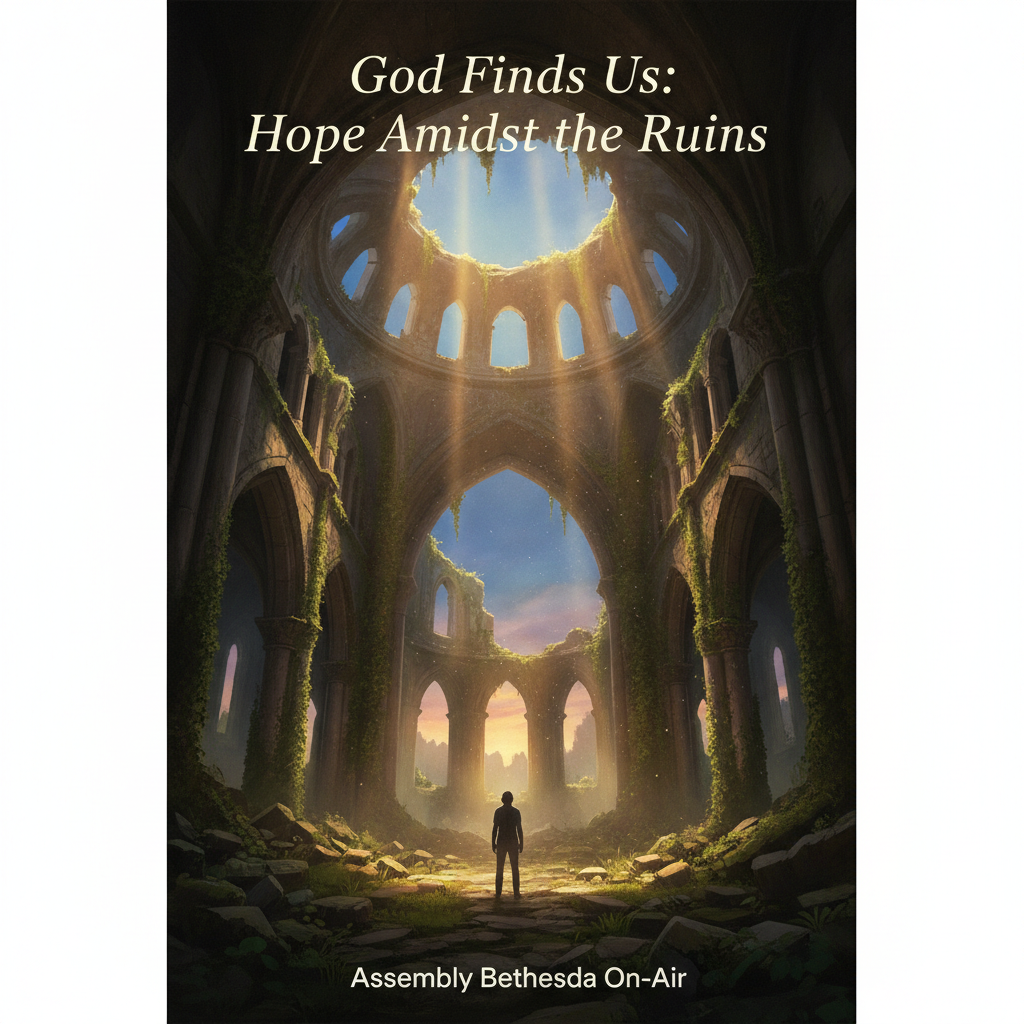
In the field, where the road turns to gravel, and then nothing, stands the church. With each passing season, its stones are sinking deeper into the soil. In the lower walls, ivy has claimed the walls, and the roof sags where rain gets through. A single candle burns in the upper window, where the choir once stood. The doors remain closed. The hinges are rusted into stillness.
It’s a little flame. It doesn’t fight the wind with dramatic leaps. It just holds. Night after night, the light returns, soft and steady, casting a thin gold rectangle on the path. The candle stays. Some people notice it on the distant road, but most don’t stop. It’s quiet enough to be dismissed as a memory or a trick of the eye, but it’s there.
Despite the air being cool and still inside, dust lies thick on the pews. Hymnals are open for pages long unread. The altarcloth is faded to parchment color. But the candle’s light reaches across the empty nave, touching the edges of the stained glass that still holds fragments of color, blues and reds that once told the story of the cross. The light doesn’t restore what’s lost. It just witnesses that something hasn’t been completely erased.
The only sound in this place is the occasional settling of timber and the soft hiss of the wick. Faith is now more of an endurance thing than a spectacle here. No congregation gathers. No organ fills the rafters. Yet the presence that once filled these walls is still there. Despite becoming quieter, more concentrated, the flame keeps the gospel. It doesn’t shout it, it keeps it.
After everything else has fallen away, there is a holiness left behind. The forgotten church doesn’t pretend to be what it once was. Its silence is real. Its emptiness is real. And yet the light persists. It’s not the shine of polished floors and perfectly timed services in a city sanctuary. It’s the light that lasts after the schedule ends and the people are gone. Because the darkness outside is real and the night is long, it’s the light that burns because it must.
Basically, such a flame consumes itself slowly. Wax melts, wicks shorten, the candle won’t last forever as it is. While it burns, it does what it was meant to do. It marks a place. It refuses to let shadow win completely. Faith that lingers in forgotten places doesn’t claim permanence in its outward form. The story doesn’t end as buildings crumble, communities scatter, traditions fade. All that’s left is the quiet insistence that the story isn’t over yet.
The candle’s window faces west. When the sun sets, the last light drains from the sky, and it’s the only thing warm for miles. Travelers on the far road see it as a pinprick against the gathering dark. Some feel a stir they can’t name. Others look away. It doesn’t ask for any response. It just keeps going.
Throughout history, light has always carried a deeper meaning for Christians. God has always been present among His people through light, from the pillar of fire that led the people through the wilderness to the lamp that was placed on the stand so everyone in the house could see. The candle in the forgotten church belongs to that same lineage. It’s small. It’s solitary. It’s enough.
Keep a light burning when nobody’s watching takes a lot of courage. The forgotten church doesn’t perform for an audience. It’s devotion is private, almost secret. If there’s still a candle-walker, they tend the candle without fanfare. The act itself is enough. In a world where faith is measured by attendance numbers and visible impact, this hidden faithfulness stands as a quiet rebuke and quiet encouragement.
It’s the stones of the church that remember more than the living do. They have borne the weight of prayers that were offered in joy and desperation. They have absorbed the sound of weeping and the sound of song. As carefully as they once held the voices of the assembled, they now hold the candle’s light. The building has become a frame for one single flame. It is a vessel for something smaller and more essential than its original purpose.
Snow falls on the roof and melts. Spring brings new growth that forces its way through cracks in the foundation. Summer heat dries the wood more. Autumn leaves fall against the doors. Through it all, the candle continues to burn. It’s not dramatic; just faithful.
This image presses against the modern preference for the large and the loud. It implies the kingdom of God sometimes looks like a single light in a place no one visits. It suggests that the work of grace continues even when the structures that once supported it have started to fail. The forgotten church doesn’t mean defeat. It means refusing to be erased altogether.
The flame itself is fragile. A sudden gust through a broken pane could extinguish it. A careless hand could knock it over. Yet night after night, it holds. It’s true Christian hope never claims invulnerability in its earthly forms. It just claims endurance. The light is small. It’s threatened. But it’s not going anywhere.
In the silence of the nave, the candle’s glow reaches the place where the cross once hung, or still hangs, depending on how thoroughly the years have stripped the interior. There’s nothing wrong with a polished cross. All that matters is that the cross remains, as a center of the story the building was built to tell, whether in memory or in fact. Candles and crosses keep company in the dark.
There’s a mercy in the way the light softens the edges of decay. Cracks become less severe. Dust on the floor takes on a faint golden sheen. There’s less emptiness when there’s a candle. In this, it mirrors the deeper truth of the faith it represents. Death and decay are real, but they aren’t ultimate. The candle doesn’t deny the ruin. It just won’t let it have the final word.
Even when some people still know the old paths, they sometimes stop at the edge of the field and look at the window. They don’t always enter. The doors are locked, or it’s too much effort. But they don’t mind the sight of the light. It reminds them that God is not restricted to the buildings that remain open and well-attended. It reminds them that the story continues in places they don’t visit.
The candle burns without explanation. No plaque describes its purpose. No announcement explains its presence. It just is. It’s power lies in its simplicity. In a culture that demands constant productivity and visible results, the light justifies itself by existing. It’s a form of resistance to a culture that demands constant productivity and visible results.
In forgotten places, faith learns a different language. Instead of talking about triumph, it talks about staying. It doesn’t measure success by growth charts, but by the fact that the flame still burns. In other words, this faith isn’t a lesser faith. It’s faith that has been refined by long periods of silence and absence. It trusts God even when the usual signs of His presence aren’t there.
There’s a history behind the window where the candle sits. A window once filtered morning light onto the faces of everyone. Now it holds the evening light for no one in particular. The change is complete. There’s only one thing left to do: keep the flame visible. In that narrowing, something essential has been preserved.
Night deepens. The fields beyond the church grow black. There are no vehicles left on the road. The candle continues. Its light doesn’t shine any brighter than it did at dusk, but against the darkness, it seems stronger. That’s how such lights work. The darkness just makes them more important, not more intense.
In the forgotten church, we see that Christ’s light doesn’t depend on structure. There’s nothing wrong with abandoned buildings and dissolving congregations. The light itself doesn’t have any particular arrangement of stone and wood. It can live in a single candle and still work. I’m doing this work to mark the place where hope hasn’t quite left.
It’s inevitable that the candle will burn down. The wax will pool, the wick will shorten, and someone, or no one, will replace it. The church itself may eventually disappear. But the meaning of light won’t change. With its solitary candle, the forgotten church becomes a temporary sign of an eternal reality that isn’t dependent on a single flame. It pointed to a presence that doesn’t depend on any single flame, so long as it burned.
The road continues past the field. Those who do turn their heads see a small gold point against the dark mass of the building. There’s a moment when the night gets interrupted. Then they move on. But the candle does what it’s supposed to. It burns. The forgotten church isn’t completely forgotten in its burning.