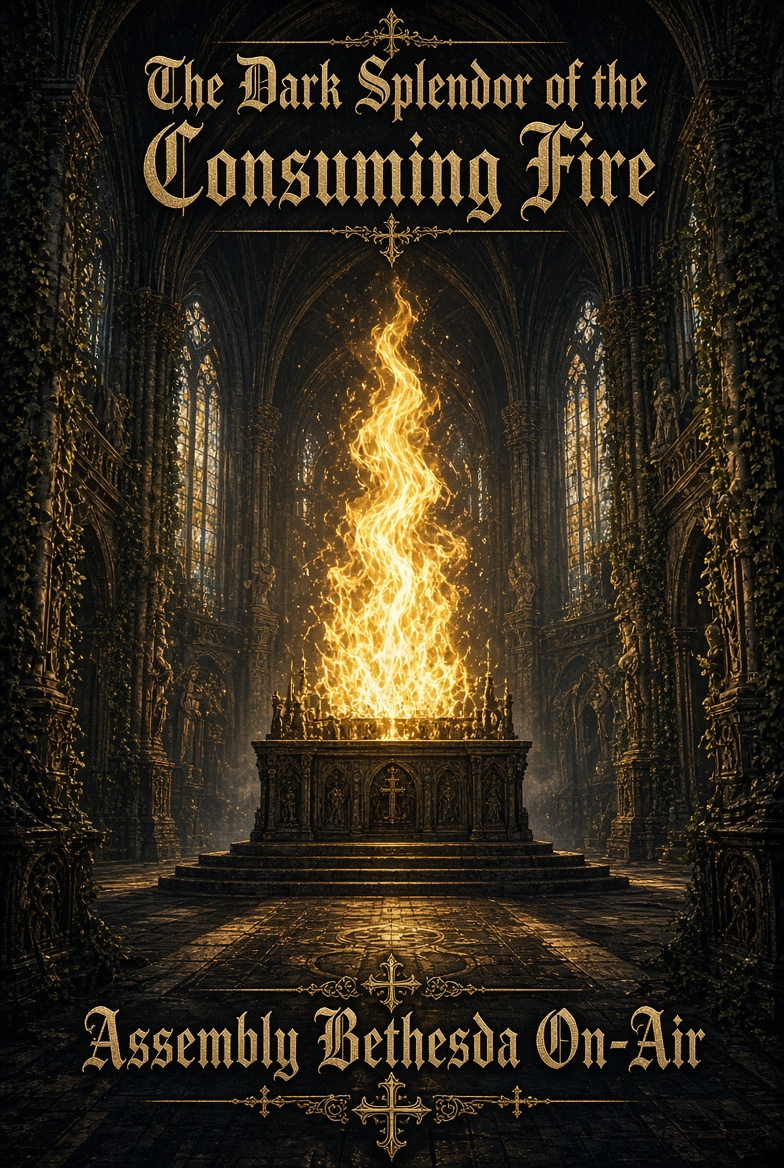
Scripture calls God a consuming fire, and the picture isn’t gentle. It’s fierce, holy, and weirdly beautiful. It doesn’t just burn. It purifies. It reveals. In the shadows of our lives, when everything feels dark and the path grows uncertain, that fire still burns darkly. In other words, it’s the glory that won’t share the spotlight with anything less than itself, the flame that burns away what can’t stay and leaves behind what should stay.
There’s nothing wrong with softer images of God, like the shepherd, the still waters, the gentle voice. But the same God who leads beside quiet streams also caused the mountain to shake and the people to tremble. That fire on Sinai wasn’t decorative. It was a revelation. A holiness you can’t approach casually, a purity you can’t mix with. The same fire still burns. When truth is spoken and falsehood cracks, it burns in the open. It burns when we stop defending things that weren’t meant to last.
In this fire, the darkness isn’t like a lack of light. It’s like the kind of darkness that comes when something so bright enters the room that ordinary light looks pale. When you’re close to a true fire, everything else seems blurry. Details that used to matter fade away. God’s consuming fire doesn’t always shout. It just shows up and leaves us behind. Pride softens. Fear loses its arguments. Our carefully built walls start to crack. What remains is not emptiness. What remains is space, space for the real, space for the holy, space for the presence that was waiting all along.
This is the paradox at the heart of this truth: God’s fire doesn’t always destroy what it touches. It holds what’s genuine in the midst of the flame. Think of the bush that burned and wasn’t consumed. Moses turned around because he couldn’t believe it. We can come out cleaner, clearer, more ourselves if we’re rooted in Him. The fire can hold what’s genuine in the midst of the blaze. There’s a lot of scaffolding that falls away. It can feel severe. It often does. But it’s love that won’t leave us half-dead.
In the gothic imagination, ruins speak. Broken arches, weathered stone, empty windows that once held colored light, all of them point to something that was and something that still lingers. A consuming fire works the soul the same way. Often, it leaves us looking like a cathedral after a long night of storm, walls standing, roof partly open to the sky, but still a place where presence can live. The splendor is dark because it doesn’t hide the cost. It shows the cost, and then shows that the cost was worth it.
We meet this fire in different ways. Sometimes it comes through Scripture that won’t let us stay comfortable. Sometimes it comes through circumstances that strip away everything we trusted. Sometimes it happens in the quiet of prayer, when all we have left is honesty. There’s the same fire in each case. It’s the holiness of the One who won’t be reduced to our size. It’s the love that burns away what keeps us away. Glory insists on being known as it is, not as we’d like it to be.
I’m comforted here, but it’s not soft. It’s comforting to know that fire isn’t just random. It’s purposeful. It’s not just about destruction, it’s about preserving what’s real. When the heat gets too much, the invitation isn’t to run but to stay near the One who keeps the flame going. He knows what can endure. He knows what has to go. He’s not careless with the work. It’s the same hands that set the fire that hold us through it.
Consider the altar. In the old patterns of worship, fire fell on the offering. The sacrifice was accepted in the blaze. Something of that pattern still holds true. Our imperfect lives, mixed motives, half-hearted efforts, all meet the fire. We take what can’t be kept, purify it and give it back. It’s not neat. The smoke rises. The heat rises. The end isn’t just ash. It’s a life that’s been through fire and still stands, more ready for God’s presence than before, marked by the encounter.
It’s why the splendor is dark. It doesn’t hide the difficulty. It doesn’t pretend it’s easy. It just refuses to treat fire as an enemy. The enemy is what fire takes away. It’s the fire itself that’s the friend, even when it feels like an adversary. Once you start seeing it that way, the flame starts to annoy you and you start respecting it more. Rather than just asking for rain, we should also ask for fire to clear the ground so new growth can grow.
Many have known this fire. Some have described it as the dark night of the soul, when old comforts dry up and the only light that’s left is the one that burns inside it. It’s also called the furnace of transformation, the place where God’s image in us is refined. It’s been thousands of years since the language changed, but the reality stayed. God is still a burning fire. We still need to draw near with reverence and trust.
We stop pretending the parts of us who can’t stand the heat are somehow sacred, so we bring them out into the light, or rather, we let the fire find them. It looks like patience. The flame does not always finish its work in a single night. It looks like hope. It doesn’t mean we won’t get through it, but rather that we’ll come out more whole than when we got there. It looks like worship. Even in the heat, even when all we can manage is a quiet “yes,” the presence is still there.
There’s beauty in the dark splendor of the consuming fire. It’s the glory that costs something and gives so much in return. It’s the flame that burns away the false so that the true can shine. In the shadows, when the path is hard to see, that fire still burns. It burns for us, not against us. It burns with a holiness that is also home, and when it’s all over, there’s nothing left. The only thing that’s left is a life lived, marked by the dark splendor of the One who’s both the flame and the shelter.
You’re invited. Let the fire do its thing. Trust the One who tends it. The dark splendor isn’t the end. It’s the beginning.