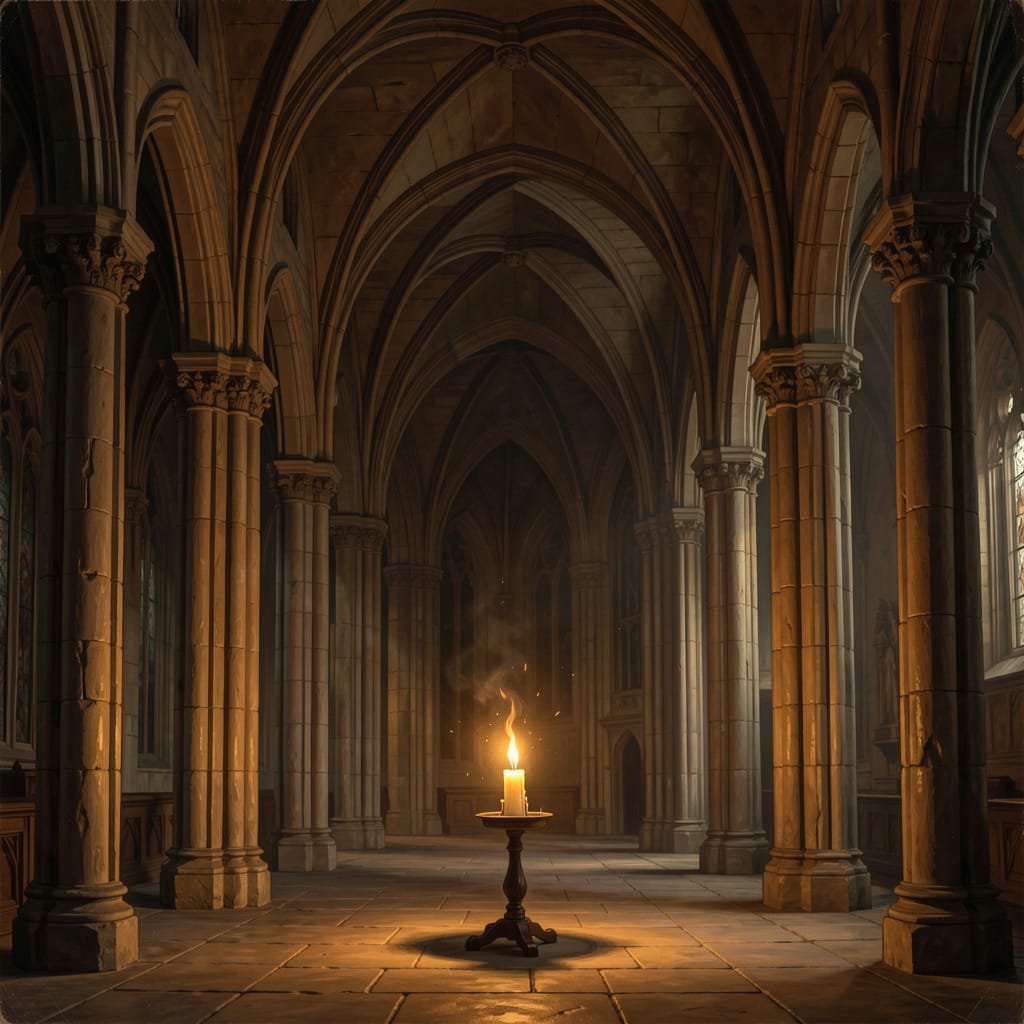
In the shadowed halls of faith there is a quiet practice that has endured longer than empires and outlasted every fashionable doubt. Prayer. Not the polished performance of public religion, and not the desperate bargain struck in crisis. The kind of prayer that happens when the room is still, the light is low, and the heart finally stops pretending it can manage on its own. Christian Gothic sensibility has always understood that the divine often arrives in dimness rather than brilliance. Stone arches, flickering candles, the long silence between spoken words. In that atmosphere the question rises naturally: can prayer itself offer evidence that God is real?
Many people treat evidence as something that must be weighed on a laboratory scale or recorded in a ledger of measurable outcomes. Prayer refuses that demand. It operates in a different register. When a person kneels, or sits with head bowed, or walks slowly through a quiet church with words forming behind closed lips, something shifts. The shift is not always dramatic. Sometimes it is only a softening of the chest, a sense that the isolation has thinned. Sometimes it is a clarity that arrives without explanation. Sometimes it is simply the discovery that the silence is not empty.
Christian tradition has never claimed that prayer proves God the way a geometric theorem proves a line. Instead it has insisted that prayer is a place of encounter. In Gothic imagery the cathedral is both shelter and threshold. The high vaults draw the eye upward while the stone keeps the cold at bay. Prayer functions in the same way. It is a shelter from the relentless noise of self-sufficiency, and it is a threshold where the self meets something larger. The evidence is not a signature on a contract. It is the change that follows the meeting.
Consider the quality of attention that prayer requires. Most of daily life trains the mind to skim, to react, to defend. Prayer asks for a different posture. It asks the pray-er to become still enough to notice what is already present. In that stillness many people report a presence that feels distinctly other. Not the echo of their own thoughts rearranged. Not the comforting projection of childhood stories. Something that answers, even when the answer is only a deepened quiet. The Gothic imagination has long recognized that the sacred often wears the face of mystery rather than certainty. The stained glass filters light into colored shadows. The chant rises and falls without resolving every question. Prayer participates in that same aesthetic. It does not erase the darkness. It teaches the heart to see by a different light.
There is also the matter of transformation. People who pray over years often become, in small and stubborn ways, different. Anger loosens its grip. Fear loses some of its volume. Compassion becomes less theoretical. These changes are not always visible to outsiders, and they are rarely instantaneous. Yet they accumulate. A life shaped by regular prayer begins to carry a different weight. The Gothic tradition understands that holiness is not a sudden blaze. It is the slow work of candlelight on stone, the patient erosion of hardness by grace. When prayer produces that kind of gradual reformation, it functions as evidence. Something is at work that the self alone cannot manufacture.
Skepticism has its own gothic flavor. It loves the ruined abbey, the cracked foundation, the claim that nothing remains but atmosphere. It is easy to stand in the nave of an abandoned church and declare the silence proof of absence. Yet the same silence can be read another way. The absence of noise is not the same as the absence of presence. Prayer teaches the distinction. It trains the ear to hear what remains when the arguments fall quiet. In that training many discover that the void is not void. It is inhabited.
Prayer also resists the demand for immediate results. The modern mind wants evidence delivered on schedule. Prayer operates on a different clock. Sometimes the answer arrives years later, recognized only in hindsight. Sometimes the answer is the capacity to endure without an answer. That endurance itself becomes a form of testimony. The Gothic heart knows that the long night is part of the story. The vigil is not wasted time. It is the place where faith learns its own strength. When a person continues to pray through seasons of dryness, the persistence itself points beyond the self. Something keeps calling the heart back to the practice. That something is not easily explained by habit or superstition alone.
The Christian claim is not that every prayer produces a miracle visible to the watching world. The claim is quieter and more radical. Prayer opens a relationship. Relationships produce evidence of a different order. A friendship is not proven by laboratory instruments. It is known by the cumulative weight of presence, conversation, and change. Prayer works in that register. Over time the one who prays learns the particular character of the One addressed. The character is consistent enough to be recognized. Mercy that does not collapse into indulgence. Justice that does not harden into cruelty. Love that refuses to abandon even when it is refused. These qualities, encountered repeatedly in the hidden space of prayer, form a kind of evidence that is personal yet not private. It can be shared, described, and tested against the lives of others who pray.
Gothic Christianity has always been comfortable with paradox. The cross is both defeat and victory. The tomb is both ending and beginning. Prayer participates in the same tension. It is the admission of need and the discovery of provision. It is the confession of distance and the experience of nearness. When those paradoxes are lived rather than merely discussed, they generate a quiet conviction. The conviction is not arrogance. It is the settled knowledge that the conversation is real.
In an age that prizes visibility, prayer remains largely invisible. That invisibility is part of its power. The evidence it offers does not compete with billboards or algorithms. It accumulates in the interior life and then leaks outward in altered habits, softer speech, steadier courage. The world may not notice the source. The one who prays knows. That knowledge is not a proof that ends all debate. It is a form of evidence that continues to invite further prayer.
The candle does not abolish the darkness of the cathedral. It makes the darkness visible as something that can be inhabited without terror. Prayer does the same with the larger darkness of existence. It does not erase every shadow. It reveals that the shadows are not the final word. In that revelation many find the first solid ground they have stood on in years. The ground is not constructed by argument. It is discovered in the act of speaking into the quiet and discovering that the quiet answers.
So the question remains open for every person who is willing to try. Can prayer provide evidence for God’s existence? The Gothic answer is not a syllogism. It is an invitation to enter the dim nave, to light the small flame, and to wait. The evidence arrives in the waiting, not always as thunder, often as the simple discovery that the silence has a voice, and the voice knows your name.