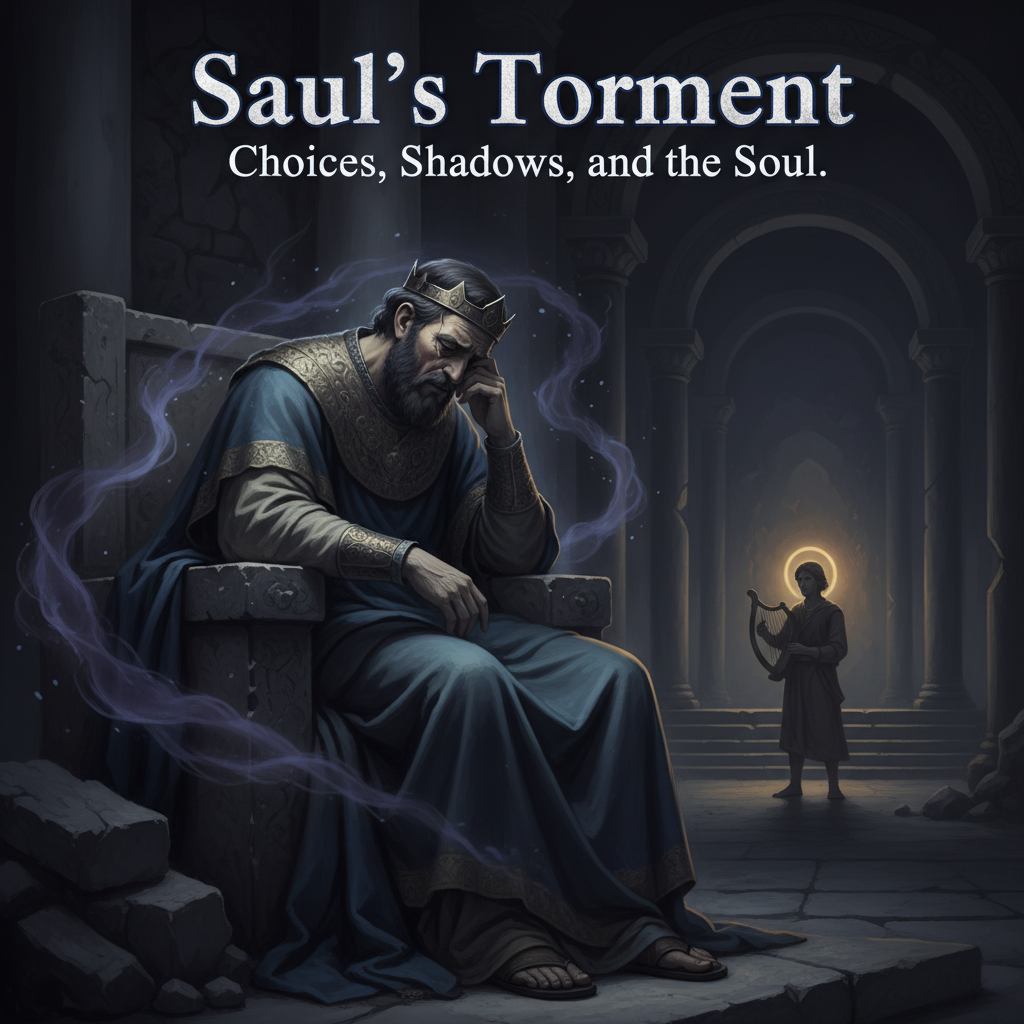
In the ancient hills of Israel, a king stood tall, chosen by God himself, but the weight of his crown pulled him down into torment. From 1 Samuel 16 through 31, Saul’s story unfolds like a gothic tale of shadows creeping over an once bright soul. An evil spirit torments the king, jealousy festers as poison, and choices lead to an end on the battlefield. Let’s walk through this in a casual way, friends, as we explore what happens when a heart turns away from God.
During Samuel’s anointing of young David, the Spirit of the Lord comes to him while it leaves Saul. An evil spirit from the Lord troubles Saul, and his servants suggest music to soothe him. David, the shepherd boy, enters the court with his harp. The strings bring peace for a while, but then the torment comes back, deeper and deeper. Saul’s eyes used to be full of promise, but now they’re cloudy. Like a cold wind blowing through the palace halls at night, you can feel the shift in the air.
Saul’s victories in battle mix with growing fear as the chapters go by. David kills Goliath, and the women sing that Saul killed thousands, but David tens of thousands. Jealousy takes hold. Saul throws a spear at David, repeatedly, while the young warrior plays music to calm him. The king offers his daughter in marriage, but it’s a trap. Michal loves David, but Saul uses her as bait. The palace is filled with whispers and plots. Every corner seems darker, every conversation loaded with danger.
David flees into the wilderness, and Saul chases him with armies. Caves become hiding places, like Adullam and En Gedi. Saul enters the cave where David hides, and David cuts only a corner out of his robe. Even then, Saul weeps for a second, realizing David’s mercy, but the darkness pulls him back. The evil spirit does not let go easily. It stirs paranoia, makes the king see enemies in every friend. Rocks hide both refuge and danger in the wilderness.
The witch of Endor is introduced in chapter 28. Saul, desperate and cut off from God, looks for forbidden counsel. Samuel’s spirit rises, foretelling defeat and death. The words hang heavy like fog over a graveyard, and Saul falls to the ground. He knows his army will lose to the Philistines. That night at Endor carries such a heavy gothic chill, which makes you pause and think about the cost of turning away from God’s voice.
As the battle rages on Mount Gilboa, Saul’s sons fall, Jonathan in particular. Wounded and cornered, Saul asks his armor bearer to kill him. Saul falls on his own sword when the man refuses. Once anointed king dies by his hand in a moment of total despair. His head and armor are taken by the Philistines as trophies. That’s a sad end to an incredibly hopeful life.
In spite of all the gothic darkness, light breaks through for those who listen. Disobedience opens doors to evil. His jealousy blinded him to God’s plan with David. The story whispers to us today: guard your heart, seek the Lord while you can, and don’t let bitterness grow. Even when surrounded by madness, David’s mercy proves grace.
Saul started strong, tall and handsome, hiding among baggage when chosen. God gave him a new heart, but he drifted. The evil spirit came as judgment and consequence. In David’s music, we’re reminded that worship pushes back darkness, but only surrender keeps it away. Saul’s mind was filled with invading shadows as those harp notes echoed against stone walls.
Saul pursues David through the desert, but divine intervention saves him. Ziphites betray him, Saul nearly catches him, but divine intervention saves the day. Despite seeing God’s hand on David time and time again, Saul can’t repent fully. His heart hardens. As if fate is heavy, each narrow escape adds to the brooding atmosphere.
We feel the chill even in the witch scene. Necromancy is forbidden, yet Saul sinks to that level. No prophets answer him anymore, no dreams, no Urim. The silence from heaven drives him mad. It’s louder than any evil spirit’s voice. Saul’s isolation grows stronger, surrounded by soldiers but utterly alone.
Saul’s suicide marks the end of an era. The kingdom passes to David, God’s chosen. The rain mixes with blood on Mount Gilboa, a gothic gothic image of a fallen king.
With brooding kings, haunted souls, and fateful battles, this account in 1 Samuel carries a gothic weight. It calls us to faithfulness. Turn from jealousy, embrace humility, and cling to the Lord. Saul’s fall is more than history, it’s a mirror. Where are we letting torment in? What spears of anger do we throw at God’s blessed ones?
David, even though imperfect, trusted God in the caves. We can too. The shadows in Saul’s life point to God’s mercy for those who choose differently.
The relief in the early chapters is real, but it’s fragile. Saul feels better for a while, but the rage returns stronger when David succeeds elsewhere. The king tries to bind David closer through marriage, first with Merab, then Michal, but each offer hides a deadly plan. The arrows of jealousy fly just like real spears.
Friends like Jonathan get caught in the middle in the court intrigue. Jonathan warns David, helps him escape, showing loyalty that contrasts sharply with Saul’s madness. It must have been a frenetic atmosphere in the palace, servants walking quietly, wondering when the next outburst would happen.
The chase becomes almost relentless in the wilderness years. Saul takes three thousand people after David at one point. But when opportunity knocks, David refuses to harm the Lord’s anointed. The king acknowledges that David is more righteous after he calls out to Saul afterward. But that moment fades, and the hunt resumes. All this rocky terrain, constant moving, reliance on God for protection build this sense of gothic endurance.
Saul’s experience at Nob shows how far he’s fallen. Suspecting conspiracy, he kills the priests, and only one escapes. Innocent blood stains his hands, adding to his torment.
David lives among the Philistines for safety in chapters 27 and 29. Meanwhile, Saul keeps searching, but with little success. The tension builds up towards Endor’s final night. Saul disguises himself, approaches the medium, and demands Samuel. The appearance shocks everyone. It’s clear: your sons and you will be with me tomorrow. You’re gonna lose.
He trembles and falls, revealing how broken he really is. He doesn’t have food, no strength, until the medium feeds him, a last meal before doom. Then the battle on Gilboa. The Philistines overwhelm, arrows strike Saul, he begs for death to avoid mockery. The armor bearer won’t do it, so Saul takes his own life. His body gets stripped, head gets displayed, armor gets sent as trophy. It’s a dark ending, but it clears the way for David to rise.
A gothic element stands out in these events, the tormented mind, the haunted king, and the fateful decisions. This isn’t dry history, it’s a living warning. Disobedience invites trouble. Jealousy destroys from within. Forbidden paths lead to deeper darkness. But God’s plan still moves forward despite them.
We see music and worship as a tool against evil, but it’s not a substitute for a good heart. Saul’s life teaches us to finish well, repent quickly, and stay humble before God. David’s character shines in mercy and trust. We should learn a lot from 1 Samuel 16 to 31. It might bring us closer to the Lord who delivers us.