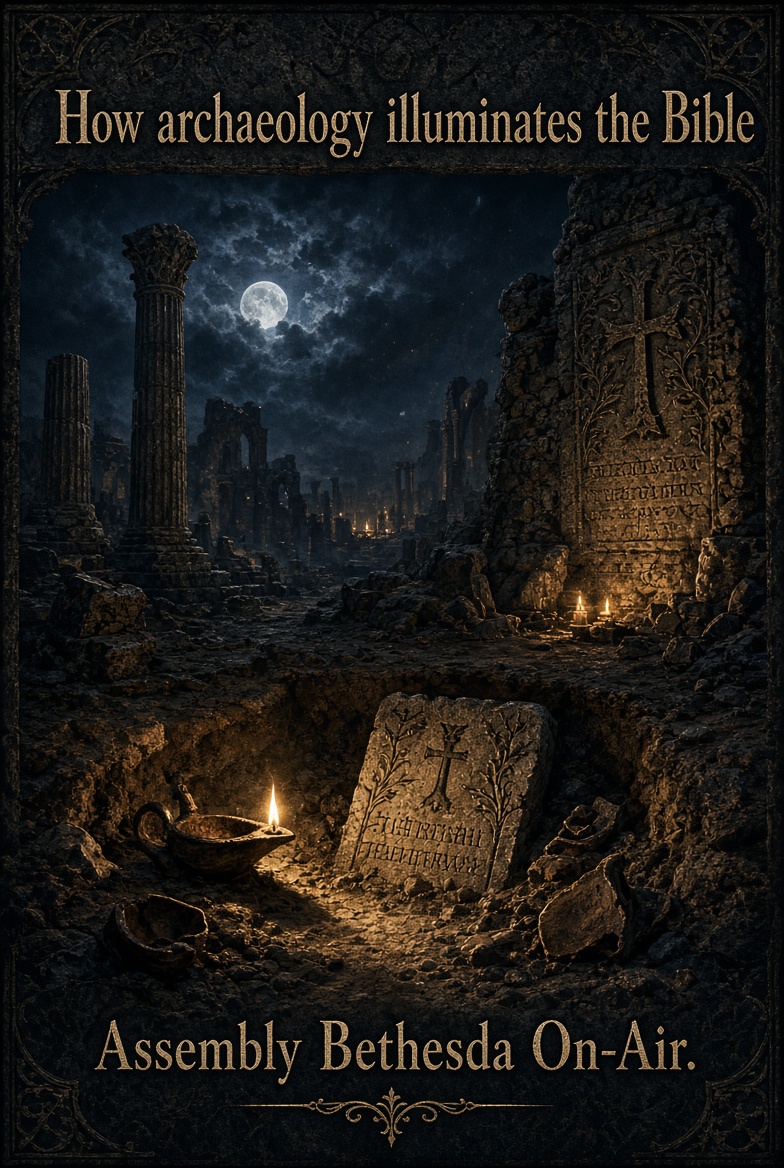
There’s something remarkable about dust settled over forgotten walls and broken pottery half buried in the quiet corners of the earth. Archaeology doesn’t invent the Bible, it doesn’t rewrite it. It doesn’t speak loudly, but in gentle whispers that reach across centuries. It lets the light of discovery fall on the same paths the prophets walked and the same cities the apostles knew, opening up the world the Bible describes.
Imagine an ancient city gate rising from the soil after a long period of silence. The stones are worn and the arches are cracked, but the layout matches the description in Scripture. A simple clay tablet with names in the Old Testament genealogies and royal lists doesn’t grab your attention. They just stand there, solid and silent, confirming that the events recorded in the sacred text happened in real time, among real people, in real places.
The Christian Gothic sensibility finds a natural home in these discoveries. There’s something beautiful about ruins that once held God’s presence. All that’s left behind are broken columns under a gray sky, faded frescoes in dim chambers, the faint outline of a temple courtyard. In the physical world, the same God who spoke through prophets and kings left traces. The purpose of archaeology is to gather those traces and display them so that faith can rest on both the written word and the tangible remains of the world described.
A cooking pot, a lamp, a seal bearing a name mentioned in the chronicles of the kings are some of the best ways archaeology illuminates Scripture. These humble items remind us that the Bible’s people lived ordinary lives with the same needs and habits as we do. Cooked meals, sealed documents, and lit their houses in the dark. Objects like these that surface in the right soil layers place the biblical story firmly in the flow of human history.
City walls that once stood against invading armies now lie in carefully measured rubble. In the historical books, there are stories of sieges and victories that match the thickness of the stones, the gates, the evidence that they were burned or collapsed suddenly. Those remains don’t argue. They just exist, and that makes the biblical record feel real and real.
It’s a special thing when Scripture appears on a stone stele or pottery fragment. When a name, a title, or a phrase shows up on a stone stele or pottery fragment, it’s personal. When a Bible reader looks at that ancient lettering, they know that those same words once passed through the minds and mouths of people who lived in those days.
For example, the Dead Sea Scrolls brought entire sections of the Hebrew Scriptures into modern study, showing how carefully the sacred words had been preserved. Gothic hearts are awed by such finds. Here are the actual pages, or at least the closest ones, to the Word that has guided the church for two thousand years.
Archaeology also helps clarify biblical events’ cultural context. When digs uncover temples, trade goods, and royal correspondence, we find out more about the customs of neighboring peoples, the styles of worship in surrounding lands, and the political pressures that pressed on Israel and Judah. It’s easier to understand God’s people if you know the world around them. The Bible doesn’t float above history. Archaeology helps us see how it’s woven into it.
If a city is said to have been destroyed and left desolate, and the excavation confirms a long period of not being occupied, the text gets quiet credibility. The narrative gets textured when a people group is described as living in a certain region, and the pottery and tools match the description. They don’t prove every detail in Scripture in a lab, but they do something better. Archaeology shows that the Bible is at home in the real world, that its authors wrote from within the same stream of time and place.
In the end, these discoveries are beautiful because they often come from years of hard work under the sun and wind with brushes and trowels, rather than dramatic machinery. It’s almost like a liturgical process. As each new discovery is catalogued, measured, photographed, and studied, the result is not spectacle, but steady illumination. Gothic imaginations appreciate this patience. Some truths don’t come in flashes of lightning. Some come slowly, like a cathedral built stone by stone.
For the believer, these illuminations serve a pastoral purpose. They steady the heart against the claim that the Bible is merely legend or late invention. They remind us that the God of Scripture acted in public history, leaving marks that can still be found. The stones don’t rely on archaeology, but they can help strengthen our confidence when it comes to faith. When they speak, as Jesus said they would, they speak in support of the Word already spoken.
In these sites, time itself is layered, giving the Christian Gothic mood a deeper resonance. Digging through Roman remains, Hellenistic layers, king-era layers, and even more into the days of the judges or patriarchs will show you how long history has been, how generations rise and fall, and how God moves through it all steadily. Standing among them, one feels the weight of continuity. It’s the same Lord who called Abraham and delivered Israel who watches over His people. The ruins don’t mock it, they confirm it.
It’s also fun to see art and architecture from biblical lands. The text is filled with details like carvings of the dress and weapons of the time, mosaics of plants and animals, and building techniques that match descriptions of Solomon’s temple and Jerusalem walls. It’s almost like the scenes are more clear to the reader. These recovered forms reflect the material culture of a people who knew both glory and exile, both temples and wilderness, with their love of solemn beauty and shadowed grandeur.
Archaeology doesn’t answer everything. Some sites are still being debated, some finds are still being interpreted, and the work continues year after year. The ongoing nature keeps the conversation going. Each generation of believers is invited to re-evaluate the ancient world and see how the light of discovery keeps falling across Scripture. The archaeology helps us notice details we might otherwise miss.
There’s no need to reinvent faith. The God who inspired the writers of Scripture also ordered the events they wrote about. Stones, seals, walls, scrolls, all of them stand as quiet witnesses to His action. Despite the fact that He left it in such a state that careful study can still point to His actions, faith doesn’t have to be replaced. Faith goes hand in hand with it.
In the half light of ancient chambers and the open air of excavated courtyards, the believer finds a deeper sense of the biblical story. The past isn’t lost. When it’s uncovered, it shines with the same light that has always guided God’s people.
That’s what archaeology brings to the church. It doesn’t ask for attention. It just offers what it’s found. And what it’s found is a world that matches the Bible’s description. That’s where faith meets a steady companion, and the Gothic heart finds a landscape of solemn wonder where beauty and truth meet.