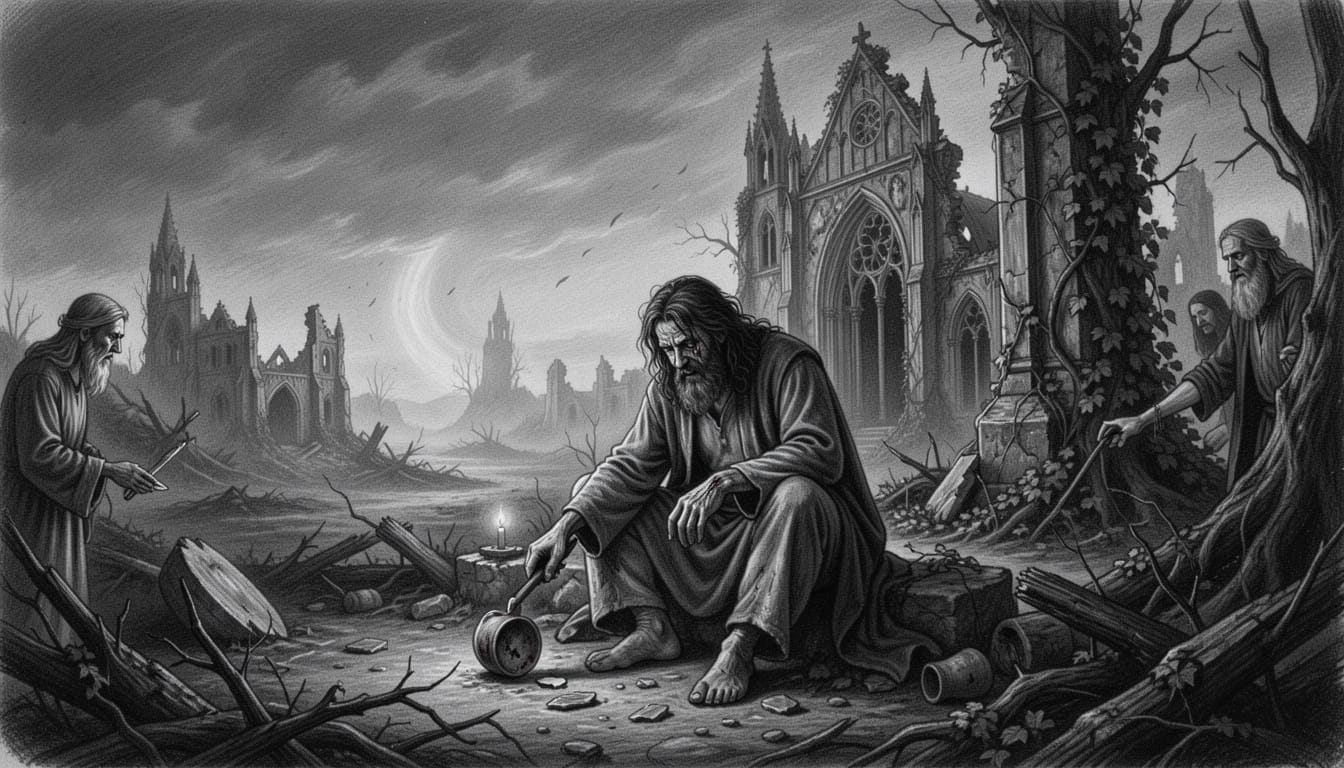
It’s hard to know what to do when life crumbles and you’re left in the dust. The story of Job takes us into a shadowy place where everything familiar vanishes. There’s no quick fix here. In this Gothic Christian reflection, Job holds on when depression wraps around you like thick fog and God feels close and far. As he sat among the ashes, Job scraped his sores with broken pottery. Still, he stayed with God in the middle of it all.
Imagine the scene. The once-great man is now reduced to silence in the gray dust. The wind howls around him like an ancient lament. Friends come, but their words cut deeper than the pain. When depression hits hard, we find ourselves here. The world feels heavy and colorless, like a crumbling cathedral overrun by ivy and shadow. Everything you depended on is gone. Everything you rely on is gone, health, relationships, security, etc. That’s where Job shows us it’s okay to sit with God and not pretend everything’s fine.
As with gothic stories that walk through haunted halls and forgotten graves, the Bible doesn’t skip over the darkness. Job’s pain was real. He cursed the day he was born. He questioned why God allowed such suffering to occur. His cries echo through the chapters like thunder rolling over empty fields. But he never walked away. He sat in the ashes and kept talking to God, the One who allowed the storm. Wow. Modern life is full of quick distractions and happy filters, so we forget how honest faith can look when everything is lost.
When you’re depressed, you feel like it’s a long night that never ends. You sit there, tired, your thoughts heavy like wet stone. Job knew this. He described his life as a shadow, slipping away without hope. In Christian Gothic, God doesn’t always remove the ashes right away. Sometimes He’ll meet you right there in them. He’ll let you pour out your heart, your anger, your confusion. Job’s honest lament mattered more to God than his friends’ tidy theology. His friends tried explaining it all away with neat religious answers, but God said they were wrong.
When you’re in the ruins, casual faith gets tested. You might wonder if God sees your sorrow. Job certainly does. He feels abandoned, but he declares that his Savior lives. In the gothic darkness, the cross stands tall amid the graves as the anchor. He understands the depression, the loss, the silence that follows disaster, because He hung on the cross and cried out, “Why have you forsaken me?”. Your pain isn’t foreign to Him.
The beauty of sitting with God in depression is that faith endures decay, it grows through the cracks in the broken walls of your life, and you don’t have to fix it all today. Like Job, you scrape through the hard questions. Why me? How long? How now? God’s presence isn’t always loud cheers or bright lights. Sometimes it’s the quiet companionship in the ash heap, the still small voice after the whirlwind.
In Job’s story, we see that restoration comes, but it sometimes takes a long time. God spoke in the storm, not with easy answers, but with majesty that put everything in perspective. As the Creator of the universe reminded Job of His vastness, beauty in the wild things, order in the chaos, we, too, can listen for that voice in our depression. In the ruins, we aren’t alone, but it reminds us we’re not alone.
It’s cold and gritty out there. Every movement stirs up dust. The sky hangs low and gray. Sounds feel muffled, like the world is mourning. Job sat there for days. His story is so real because he didn’t jump up with positive declarations right away. He wrestled. He complained. He stayed connected to God even when it hurt. His casual honesty makes it so relatable for anyone struggling with depression today.
Many times in life we want the happy ending first. We want the resurrection without the tomb. But gothic Christian faith teaches us to sit in the in-between. A place where crosses cast long shadows and hope shines like a faint candle in an empty hall. At first, Job’s friends sat in silence for seven days. It was a holy silence that didn’t put pressure on him. Eventually their words became burdensome, but the initial act of just being there shows how we can help people too, by not rushing to fix things that only God can fix.
The dialogue gets more intense as Job’s words get more intense. He compares his suffering to being hunted by God, like a target in the night. Even in those raw moments, he still holds on to the hope that one day he will see God for himself. It’s not that the future hope erases the present pain, but it keeps him grounded. It’s hard to think about eternity when you’re depressed. Even if you don’t feel the truth fully, Job shows us it’s enough to whisper it.
The gothic atmosphere of the book builds with each chapter. Storms gather. Winds blow. The ash pile becomes a kind of altar where honest prayers rise like smoke. God doesn’t get offended by the questions. He listens. Then when He speaks, it comes from the whirlwind, a dramatic entrance that shakes the ruins. God doesn’t explain why Job is suffering, He just shows His glory through creation. There’s the wild donkey, the eagle, the mighty sea creatures all under His care.
You don’t lose control, even if it looks like that from your ash heap, because God says, “I’m not lost control.” It’s a gentle but firm shift. Depression clouds our view, but God’s majesty cuts through it all. We’re still scarred, but we’re more aware of who God is. Job got twice what he lost at the end, but the real treasure was knowing God better.
This Christian gothic walk through Job’s ashes calls us to stay honest. If you need to cry, don’t feel ashamed. Sit in the dust and know that God loves you. Darkness doesn’t win. Light breaks through even the thickest fog eventually. Hang on. Your Redeemer lives, and He’s familiar with your grief. Keep showing up in the ruins. Let’s keep talking. Restoration is coming, but for now, the ashes serve as a sacred place for faith.