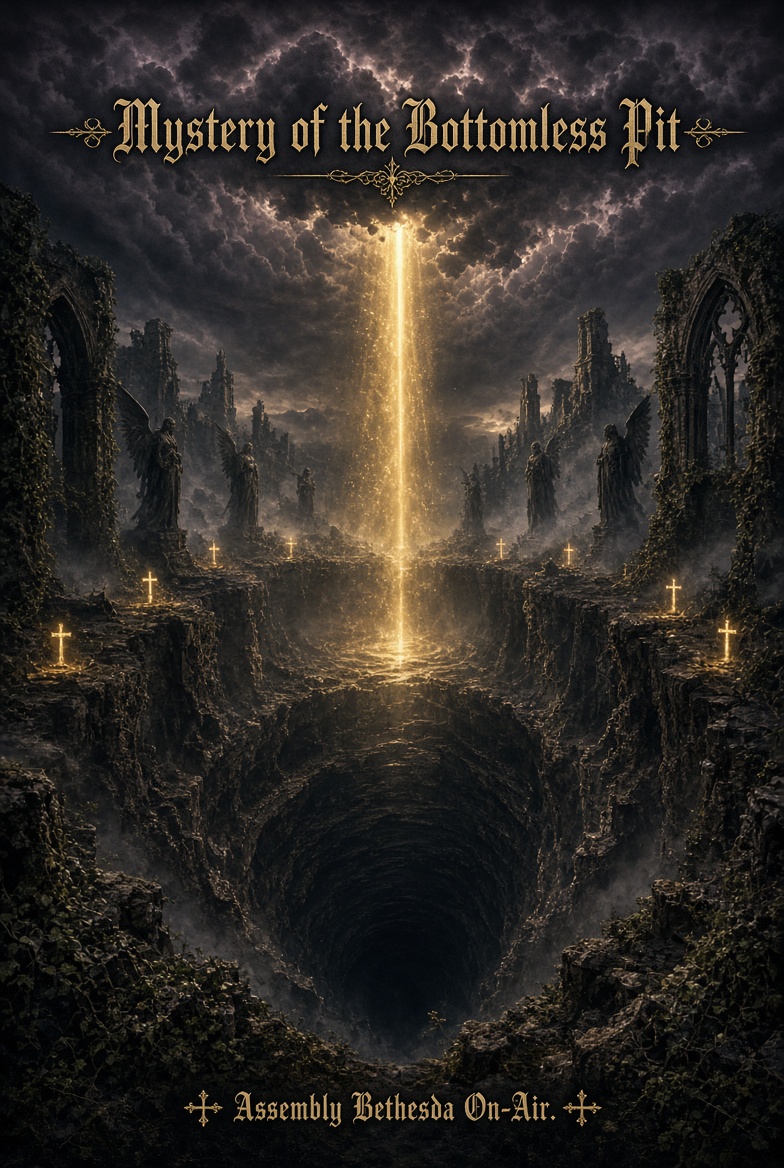
It’s called the bottomless pit, the abyss, the deep in Scripture, not a metaphor we invented to describe our dark moods. It’s a reality the Bible names with sober clarity, a place of restraint and judgment under God’s sovereign hand. There’s no need to get curious about this mystery just for its own sake in the gothic imagination of faith. This is a call to holy fear, to a deeper trust in Christ, and to a clearer vision of the victory already won.
A star falls and gets authority to open the bottomless pit in the book of Revelation. An angel comes down from heaven and opens it. The smoke pours out like smoke from a furnace, darkening the sky and the sun. From that smoke come locust-like beings with power to torment, but they can’t kill, and they can’t touch those sealed by God. The beast rises from the abyss later. This pit is real in the vision. It’s purposeful. Nothing escapes the control of the One who sits on the throne. Later, the dragon, that ancient serpent, is thrown into it for a thousand years.
This is the heart of the mystery. The bottomless pit isn’t a chaotic free-for-all. It’s not the final home of the redeemed. It’s a place of divine restraint. Evil is real. Spiritual forces of darkness are real. The struggle is real. However, none of it works without God’s permission and timing. In the pit, there’s a key. The enemy is thrown in it. He’s sealed in it. The enemy will be freed only for a short time at the end, and then the final judgment will come. Every limitation, every delay, every boundary will be set by the same Lord who walked out of the tomb.
Christian gothic light gives this truth a special meaning. We live in a world that loves decorating darkness, making it stylish, turning the abyss into a mood board. Scripture won’t let us do that. The bottomless pit isn’t aesthetic. It’s dreadful. The smoke, the torment, the binding, the sealing, these are images of judgment and holy order. But it’s not ultimate. The throne stands above the smoke, while the Lamb is above it. The same book that shows the abyss shows us the New Jerusalem coming down, the river of the water of life, the tree whose leaves are for the healing of the nations. The Gothic note in Christian faith is never the last note. It’s the minor key that makes the major resolution more piercing.
There’s something about holy fear that grows naturally from this mystery. Not the fear that makes us want to run away, but the fear that draws us closer to Him. When we see that God alone holds the key to the abyss, that He alone limits the forces that hate His people, something settles in the soul. There’s nothing out of hand in the world. Spiritual battles aren’t fair fights. That knowledge does not make the present darkness pleasant. It makes it temporary. It makes it bound. It makes it accountable.
The sealed ones in Revelation 9 are given power, but they can’t touch them. The bottomless pit opens, the smoke rises, the air darkens, and yet God marks and protects His children. It’s not a promise of ease. It’s a promise of belonging. The same God that opens the pit also seals His own. The same hand that lets evil loose is the same hand that writes names in the Lamb’s book of life. Darkness and smoke fill the vision, torment is permitted for a time, but still the sealed walk through it under a higher covering.
This mystery also guards us against two equal and opposite errors. One error is to treat spiritual evil as if it were nothing, just a psychological leftover. The bottomless pit won’t let us dismiss it that way. There’s another error: treating spiritual evil as if it’s the ultimate thing, as if the abyss had the final say, as if the dragon’s binding was temporary and his freedom permanent. Scripture reverses that order. The binding is real. The sealing is real. It’s real. The pit is a holding place under divine decree, not a rival kingdom.
The bottomless pit is a call to steady trust for the believer going through ordinary days. We don’t need to know every spiritual current or name every influence. We just need to know the one who holds the key. We have to live as sealed people who belong to the Lamb, marked by the Spirit. When the air feels thick with opposition, when the spiritual climate darkens, when the sense of restraint on evil seems thin, remember that the pit has limits. We don’t lose the key. Christ, who descended into the lower parts of the earth, ascended far above all the heavens and fills all things.
The gothic imagination helps us feel the weight of this without softening it. Imagine stone steps descending into shadowed depths, iron gates that will only open at an angel’s command, smoke that rises but can’t block the light above. These images aren’t meant to scare the kids. Just think about the silence after the dragon’s sealed, God’s patience, the certainty that every rebellion will end. Their purpose is to sober us up, to take away our casual confidence, and replace it with a deeper confidence in the God who judges and saves.
Restraint has a note of mercy too. The fact that evil is bound is mercy. The fact that the torment is limited is mercy. The fact that the sealed are protected is mercy. The bottomless pit isn’t God’s heart. In the Lamb who was slain from the foundation of the world, in the open invitation of the gospel, and in the Spirit who seals and keeps, God’s heart is revealed. As part of the larger story, the pit is about a God who won’t let evil run unchecked forever, nor will He abandon His people to it.
So we look at it without flinching and without despair. It’s true what Scripture says about the abyss. We admit there’s spiritual conflict. We refuse both denial and obsession. We rest in the knowledge that the One who holds the key holds us too. In God’s will, the bottomless pit has an end. Beyond that end there’s a city that doesn’t need a sun because God’s glory gives it light, and the Lamb lights it up.
In that light the gothic shadows find their place. They’re real. They’re temporary. They’re under authority. And they can’t separate us from God’s love in Christ Jesus. It’s still a mystery, but it’s a mystery that’s held inside a greater certainty. God’s on the throne. Christ is the last word. The pit doesn’t have the last word. Christ is.