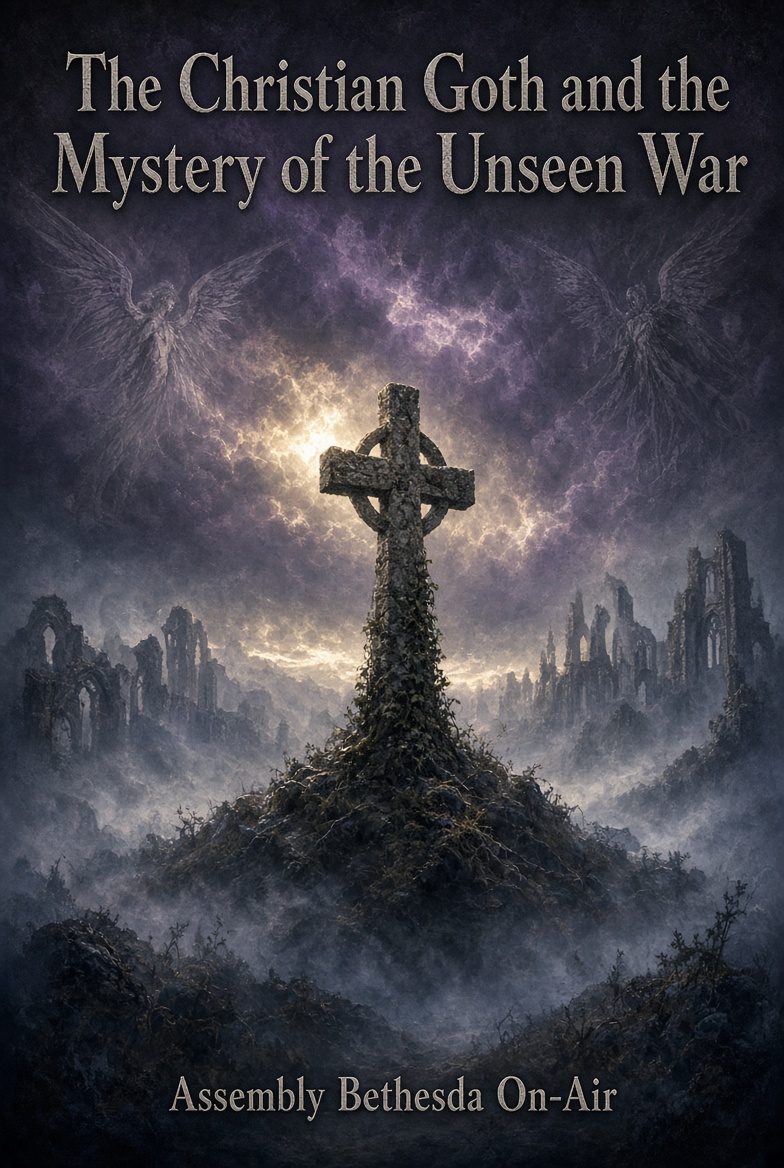
A certain kind of believer is one who sees both the beauty and the weight of things most people brush past, a Christian Goth isn’t someone who chases darkness for its own sake. The Christian Goth is someone who has noticed that the light of Christ shines more clearly against the backdrop of shadow, that mystery doesn’t kill faith, and that spiritual life is lived in the middle of a conflict we can’t see fully. There’s an unseen war going on, and it’s as real as the ground.
It doesn’t pretend there’s only sunshine and easy paths in the world. We’re not fighting flesh and blood, we’re fighting rulers, authorities, powers of this dark world, and spiritual forces of evil in the heavenly realms, Paul writes to the Ephesians. It’s not dramatic poetry. It’s a statement of the state we live in.
It makes a lot of sense to the Christian Goth. The Gothic sensibility already leans toward the hidden, the veiled, the places where light and darkness clash. It becomes a way of paying attention to the war just beyond ordinary sight when that sensibility gets baptized in the gospel.
It’s not a metaphor for bad moods or hard times. It’s a constant struggle between powers that hate human beings as God’s image and despise the Kingdom as a whole. It shows up in the quiet erosion of hope, in the sudden weight of accusation, in the way isolation can feel like a physical force, in the strange resistance that rises when someone decides to pray seriously or to forgive what feels unforgivable.
In the way a single act of mercy can push back a darkness that seemed absolute, it also shows up in the beauty that doesn’t die. The Christian Goth learns to watch for both.
There’s a lot of mystery here. We don’t get a full map. We just get enough light to walk, enough armor to stand, and enough promises to keep us going. Gothic imaginations are comfortable with partial information. They don’t need every shadow explained before they can trust the light.
As a gothic image of the faith, the cross is both horror and glory at once, where it defeats the worst that darkness can do. The ruin isn’t the end of the story. The storm doesn’t get the last word. The candle is small, but it’s not nothing. A Christian Goth can look at a ruined abbey, a stormy sky, or a candle flickering in an empty room and feel the same mystery. It’s not the end of the story.
Aware of the unseen war changes the way you live your life. Prayer isn’t just a quiet conversation anymore, it’s a place of engagement. God’s Word isn’t just comfort. It’s a sword. Fellowship isn’t just pleasant company. It’s the gathering of people who share the same beliefs.
Not only does confession provide personal relief, but it also cuts off enemies’ footholds. It doesn’t have to be theatrical. The most important battles are often the ones no one else sees, the choice to say the truth when a lie would be easier, the choice to keep loving when love has grown costly, the refusal to let bitterness take root.
Of course, it’s easy to get caught up in the darkness. If you’re a Gothicist, you might drift into an aesthetic that forgets light. The Christian Goth keeps the order clear. Shadows are real, wars are real, weights are real, but none of it is ultimate. Christ is risen. The tomb is empty.
Christian Goths walk through the valley of the shadow of death with the Shepherd in view, not pretending it’s imaginary. The powers that once controlled the field are now disarmed. Fear is acknowledged, then answered. Sorrow is felt, then carried to the One who can bear it. Mystery is welcomed, and then put into the bigger story.
As a result, we don’t get a shallow optimism that everything’s fine as long as we smile. The unseen war isn’t fine. It hurts people. Faith can feel thin in it. Churches can get cold in it. Christian Goths name those realities without panic or despair. Naming them is part of it.
The Christian Goth refuses to accept the opposite error, that the dark is stronger than the light, because pretending they don’t exist only gives the other side the advantage. The light shines through the darkness, and the darkness hasn’t overcome it. That’s still true, even when it feels like the night is long.
When you know the war is real and mostly unseen, what do you do? Put on the armor. Grab the shield of faith, not as a feeling, but as a decision to trust God over what seems to happen to you at the moment. We wield the sword of the Spirit, which is the Word of God, not as a weapon against people but as the truth that cuts through the fog of accusation and deception. We pray at all times, with all kinds of prayers, because prayer is how we fight the invisible battle. Keeping alert doesn’t mean constant anxiety, but a steady readiness that knows the enemy is real and the Lord is near.
The gothic landscape of the soul, the part that loves the half-light, the ancient stone, the quiet intensity of a solitary walk under a heavy sky, can become a place of deep formation when it’s offered to Christ. In addition to teaching the heart to linger with hard truths instead of rushing past them, it also teaches the eyes to notice the grace that shows up in unlikely places. It keeps the imagination from becoming purely domestic. Faith that can handle mystery, glory, and war is a faith that can last.
Christian Goths keep walking, watching, praying, choosing the light even when they’re moving through shadows until the King returns. The mystery isn’t a problem to fix, it’s the condition in which we’re called to be faithful. It’s in that faithfulness, quiet and often hidden, that the Kingdom grows one stubborn act of trust after another.
The night is real. The war is real. The victory is already yours.