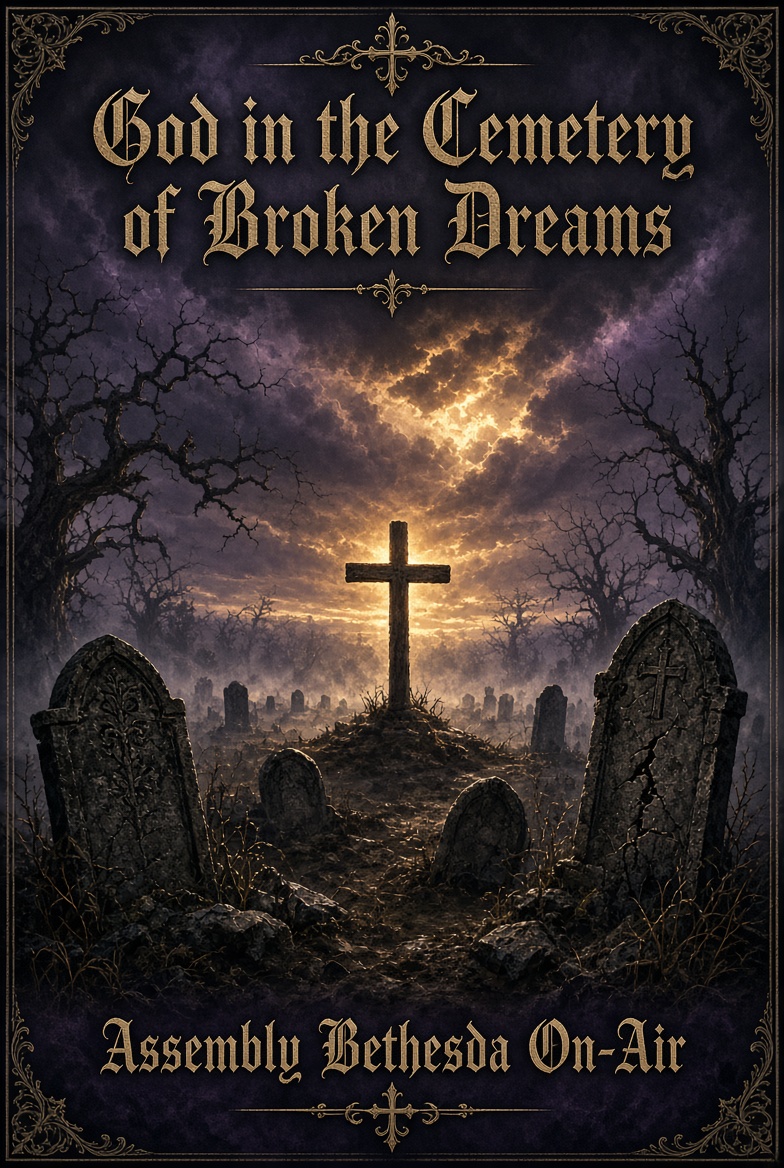
The air feels heavy with things that never came to pass in a quiet place where the light seems thin. The cemetery of broken dreams. Tombstones lean at odd angles and names are worn smooth. Weeds grow from cracked stone. The wind blows through bare branches and makes a sound like soft weeping. Many of us know this place well. It’s a place we’ve walked over and over again.
In the Christian Gothic vision, the cross stands right in the middle of the graves. It’s like the same God who walked among the tombs outside Jerusalem is still walking here. He doesn’t wait for the soil to be neat or the monuments to be polished. He comes into the mist and half-light. He comes for those who’re already buried.
It takes many different kinds of broken dreams. The career that collapsed. The marriage that ended. The child who never got here. The health that failed. The calling that seemed clear until the door slammed shut. They leave a mark. Some of those markers are new. Others have been standing for years. We visit them sometimes at odd hours, when life is quiet. We stand there and feel the weight of what was.
It doesn’t erase the markers. It puts God among them. Scripture tells us that God is familiar with grief. Isaiah says that the Man of Sorrows. The gospels show Jesus crying at a tomb before calling a dead man out. He doesn’t stand at a safe distance. He gets close enough to touch the stone.
Likewise, closeness is offered in the graveyard of broken dreams. Even though the light filtering through the clouds isn’t the full noon of victory yet, it’s that soft, persistent light that won’t let the graveyard get too dark. It falls on the broken headstones and makes even the cracks visible. That’s mercy. The One who sees doesn’t hide anything. Nothing’s too shattered for His attention.
We often want God to clear the cemetery in a single sweeping act. We want every stone removed and the ground leveled into a garden. Sometimes He does that, but more often He walks with us. He lets us point to each marker and tell Him how much it cost. He doesn’t rush the telling, but stays. In this Gothic image, Light is quiet and sure but also dark.
The presence is quiet and strong. It doesn’t yell. It doesn’t tell us to pretend the dreams didn’t exist. It just remains. It says, “Lazarus, come forth,” still over hope’s buried places. The voice is patient. It doesn’t mock the tears. It doesn’t minimize the loss. It just keeps speaking life into the ground.
A stained-glass window is beautiful because it lets light shine through broken colored pieces, so the Christian Gothic faith refuses to split beauty from sorrow. The cathedral stands because its stones were cut and fitted through labor and cost. The presence of God in broken dreams doesn’t deny them, but fills them with something that can’t be broken.
I’m comforted that God doesn’t have to leave the cemetery empty to show up. He doesn’t wait for us to dig up every disappointment and throw it away. He meets us while we’re still standing among the stones. Despite the fact that our feet are still on the same ground, the air is carrying a different weight. Hope isn’t something we have to manufacture anymore. It’s something that has found us.
The broken dreams themselves become places of encounter. The career that ended may open up a quieter obedience. The relationship that ended may teach a deeper reliance on the One who never leaves. The health decline may lead the heart closer to the God who holds every breath. All of these exchanges don’t erase the pain, but they refuse to let it win.
There’s always a cross near the grave in the Gothic landscape. They’re close because the cross represents the ultimate broken dream of human striving and the ultimate faithfulness of God. The cross becomes the doorway to life. That’s still true. In our private cemetery, what looks like a closed chapter may yet become a fertile ground for new life.
The rising doesn’t have to be forced. We just have to stay long enough to see the One already there. We walk slowly through the cemetery. The steps are careful. But every step is taken with company. It’s true that God counts the hairs on our heads as well as the stones we pass. He knows which ones still cut us. He knows what to avoid. He walks with us on the whole thing.
That companionship has a quiet authority. It doesn’t need miracles to prove itself. It just stays when everything else doesn’t. The friends who got tired of hearing the same grief. The plans that couldn’t stretch to include the new reality. The strength that finally ran out. God stays. Gothic night doesn’t have to be lonely.
It’s going to happen. The same sun that rises over thriving gardens also rises over cemeteries. There’s no discrimination in light. It just arrives. It’s not because the names have changed, but because the One who stands among them has claimed the ground. It’s still a cemetery, but it’s also holy ground, because God chose to meet us there.
As a result, we keep walking, naming the losses honestly, listening for the whispers that talk over the stones. We keep believing in the same power that lifted the stone from the garden tomb can still move the weight on our own hearts. There’s a solemn atmosphere. There’s hope. Both can be true at once. That’s the Christian Gothic way of seeing. God is in the cemetery of broken dreams, and He’s still not done.