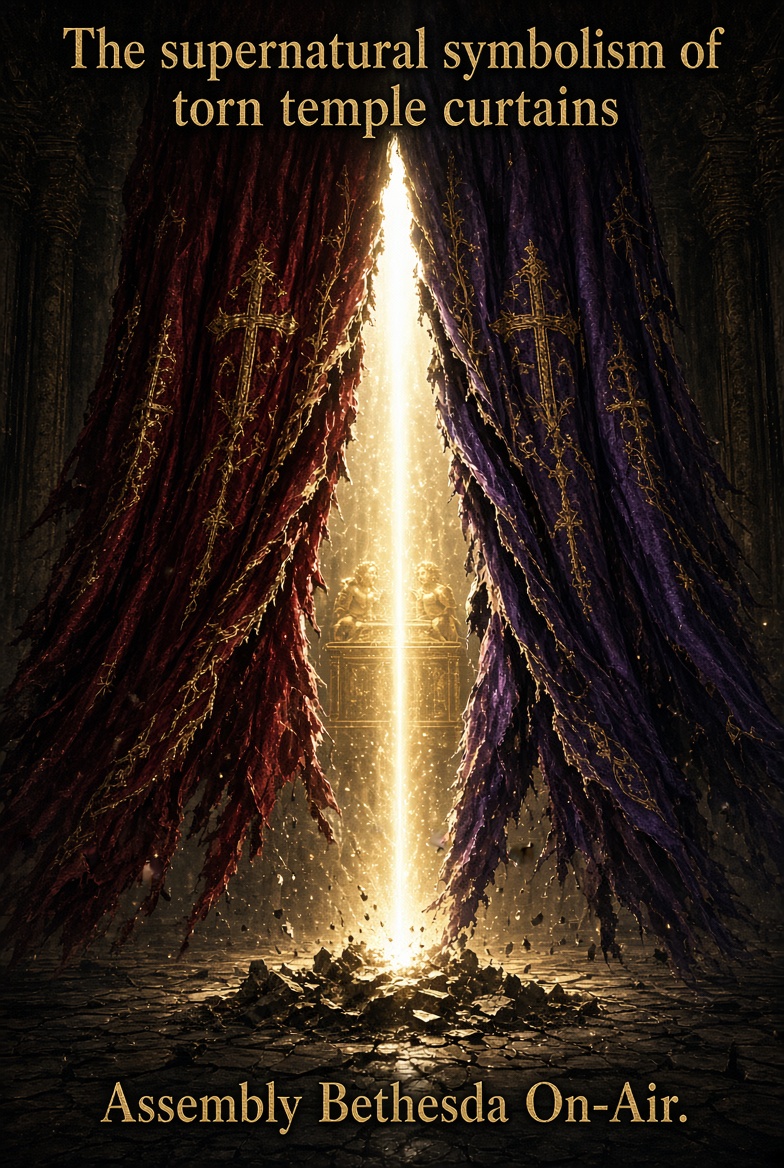
It was like something ancient and heavy cracked open the moment the curtain tore. If you sit still long enough, you can almost hear it. The earth trembled and the sky went dark as thick fabric, woven with care and covered with symbols no ordinary eye could see, ripped from top to bottom. That wasn’t a coincidence. That wasn’t a random act of weather or structural failure. It was a supernatural act of power announcing itself during a public execution.
A temple curtain marked the place where holiness lived and where ordinary people couldn’t go. It was behind it was the ark, the mercy seat, the very presence of God. Only the high priest crossed that line, and only once a year, and only with blood. Everyone else stayed outside. In fabric and thread, the curtain proclaimed there was a big, dangerous gap between God and humanity.
As Jesus breathed His last, the ground trembled. Rocks split. And the curtain, that massive, embroidered wall of separation, tore in two. From the top down. Not from the bottom up. From the top. Heaven started it.
How does that mean in supernatural language? It means the old system of distance ended in a violent moment. There wasn’t a gentle folding aside of the barrier that kept people out. It was destroyed by the same power that kept the stars in place. Access was opened. There was no longer a lock on the holy place.
There was a lot of weight in that fabric. Historians talk about its thickness, its height, the way it took men to move it. It wasn’t delicate. When it tore, the statement reversed. The God who once demanded blood, ritual, and careful approach now invited everyone. The supernatural act of tearing announced God’s presence wouldn’t be hid behind layers of cloth and law anymore.
It’s a dark beauty, that’s for sure. There was already a black sky. The earth was already shaking. Graves were opening. The dead were walking. As if creation could not hold the old order any longer, the curtain ripped. The supernatural broke through the temple and said the rules had changed.
In the truest sense, this is gothic. Shadow and light colliding, death and life overlapping. The sacred and the broken coming together in one torn edge. It was now open, and the pure presence of God stepped out toward the people who had just killed His Son. That curtain that once protected people from the pure presence was now open.
There’s a deeper meaning. The tear was vertical. Top to bottom. That’s important. It wasn’t human effort reaching up. It was divine initiative reaching down. The same hands that formed the universe pulled the fabric apart so that nothing would stand between the Creator and the created. God did the tearing.
The early believers understood this in the years that followed. They didn’t rebuild their hearts’ curtains. They walked through the open space. They prayed without the old intermediaries. They approached the throne of grace with confidence they couldn’t have imagined under the old system. As a result of the torn curtain, a new covenant was sealed in blood and confirmed by a supernatural act that no priest could reverse.
It’s still a weighty image today. The world feels heavy. The distance from God can feel like thick fabric that won’t move. Fear, shame, feeling outside, these can settle over your soul like a second curtain. The torn veil speaks to that heaviness. It says the barrier is already gone. It says the way is already open. At the cross, the supernatural act of opening happened once and for all.
You don’t have to force your way in. You don’t have to earn the right to stand in the holy place. The curtain is already torn and the presence that was once hidden now invites you. In the gothic reality, that invitation came through death, through darkness, through the shaking of the earth, and through the splitting of sacred cloth. Light entered the most restricted room on earth by breaking the restriction.
In addition to access, symbolism also points to identity. When you walk through the torn opening, you’re no longer an outsider looking in. You’re now a temple yourself. It’s a radical claim of the Christian faith that God is moved into human hearts, not a building and curtain. God doesn’t stay behind fabric, he moves in.
Those truths are both comforting and gravityful. The same God who tore the curtain still requires holiness. Comfort because there is no longer distance. Gravity because the presence is real and pure and not to be taken lightly. The invitation is wide open, but the One who invites is still the consuming fire.
In quiet moments, the image of that torn cloth can settle over a person like a dark, sacred weight. It reminds a person that something irreversible happened. A single afternoon outside Jerusalem ended the old way of approaching God through layers of rituals and fear. The new way started with ripping fabric and a declaration that the holy place was now an open ground.
With time, the supernatural symbolism of the torn temple curtains doesn’t fade. It’s still sharp. It’s still strange. That’s the moment heaven decided the separation was over and God was no longer hidden. From top to bottom, the veil gave way, and people still walk through the opening without fear because of the gothic glory of that moment.
There’s no curtain. There’s no wall. The presence waits on the other side.