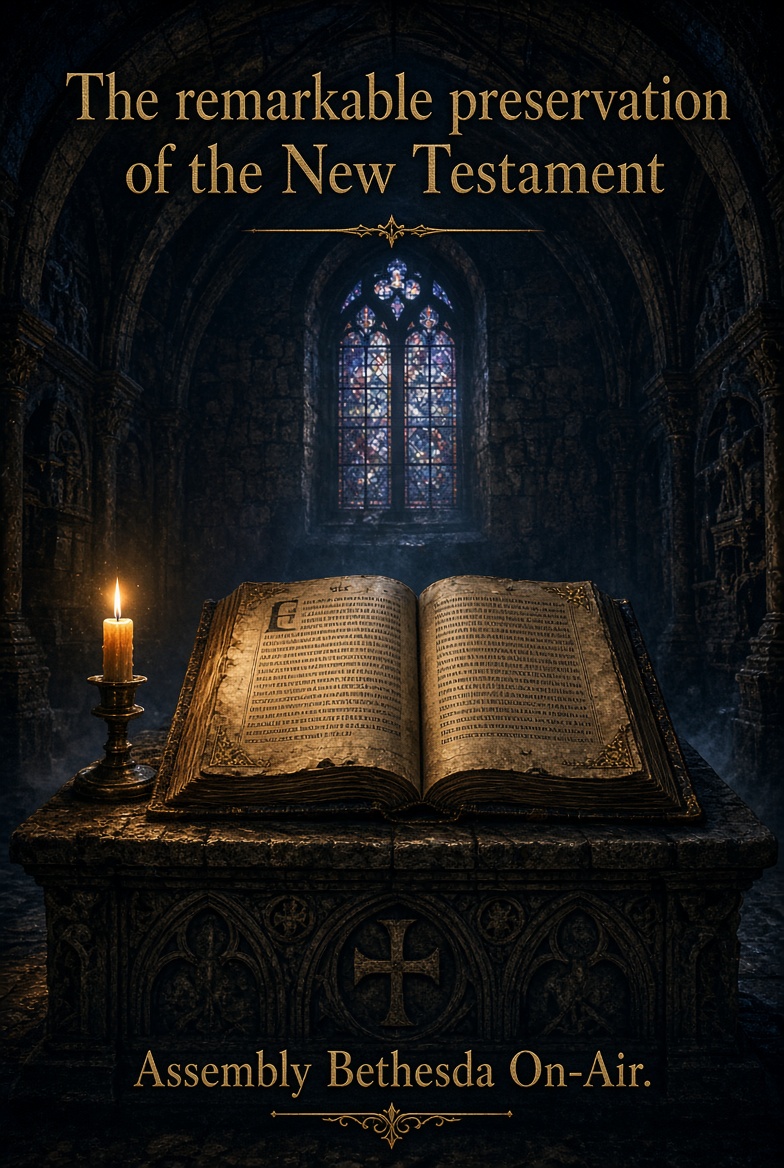
In the deep night of history, when empires crumbled and flames licked at the edges of civilization, a collection of sacred writings endured. Although the New Testament was born in the first century, its words have endured centuries of silence, persecution, and decay. As living testimony, copied by hand under candlelight, transported across borders in secret, and guarded by those who valued the message over their own lives, not as fragile relics.
Imagine the ancient world as a massive, shadowed cathedral. Stone walls rise into darkness. Wind howls through broken arches. In the crypts below, where moisture seeps and time itself seems to rot, fragile papyrus and parchment pages should have turned to dust. However, they didn’t. This is a time when most writings vanished within a generation, like the Gospels, the letters of Paul, and the visions of Revelation. A few works from the classical world survive in a few late copies. There’s nothing like the New Testament, preserved in a density and consistency that’s almost miraculous.
There were times when the words were more than just literature. They were the voice of the rising Christ, the foundation of faith for scattered communities gathering in homes and catacombs. Scribes worked in dim scriptoria, scratching by oil lamps. It was not for fame or scholarly pursuit that they copied, but for the message itself. There were errors, yes, letters misshapen, lines skipped, but the sheer volume created a web of witnesses. Where one manuscript faded, dozens held the same truths.
There were storms that raged against these writings. Roman emperors destroyed Christian books. Temples were destroyed, believers were dragged into arenas, but the texts kept multiplying in secret. Later, barbarians conquered the Mediterranean. Libraries burned. Knowledge fled to monasteries perched on remote cliffs or hidden in misty valleys. Black robed monks bent over desks in cold stone halls, faces pale under hooded cowls. They preserved not only Scripture, but the idea that truth could outlast empires.
The Gothic age itself, with its soaring cathedrals and grim towered fortresses, became an unlikely guardian. Stained glass filtered colored light onto lecterns where the New Testament was read aloud. The words of Christ, framed by dragons and saints, symbols of death and resurrection, were illuminated in gold leaf and deep crimson on illuminated manuscripts. There were treasures in these books, clung to desks or locked in iron-bound chests, but they were also tools for proclaiming. Words aren’t meant to gather dust. They’re meant to be spoken, sung, and lived.
A remarkable aspect of this preservation is not just survival, but fidelity. No matter what continents and centuries you look at, the message stays the same. From the earliest fragments to printed pages, the accounts of the empty tomb, the teachings on the mount, the letters urging love and endurance, they’re all there. As any hand-copied text will tell you, there are variations, but they rarely touch the heart of faith. The crucified and risen Jesus still stands out. Undiminished is the call to repentance and new life.
In the shadowy corners of history, where doubt and decay should have triumphed, the New Testament persisted. It outlasted the parchment it was written on. It outlasted the languages that first carried it. Greek gave way to Latin, Syriac, Coptic, Gothic itself in Ulfilas’ hands, but the message endured. As soon as the printing press arrived, a flood of words could reach every village that was once enclaved in dim scriptoria. The Reformation and the centuries that followed just amplified what providence had already done.
Some of these texts are in museums and libraries today, so old that their edges crumble at a touch. Some are in digital form, easy to access. Even though information is fleeting, where messages vanish with a keystroke, these words from two millennia ago still hold a lot of weight. Despite fire and flood, through devoutness and indifference, through ages of faith and ages of skepticism, they’re still standing.
It’s not an accident of history that the New Testament has survived so long. It’s the quiet testimony that some truths won’t be silenced, even in the Gothic night of the world, where shadows lengthen and certainty seems scarce. Pages turn. The voice that used to speak on dusty roads still calls. And those who listen find that the same Word still has power to change them.
Ink fades. Scrolls get lost. The God who inspired these writings also watched over their transmission. Human hands fail at times. But the collective witness of the manuscripts stretches unbroken from the apostolic age to today. Candle after candle after candle was lit. Copy after copy was made. The message of the cross and the empty tomb continues to shine in the darkness in the crypts of time.
It stands as a testament to the truth, not to human ingenuity alone. It’s the remarkable story not just written on ancient pages, but also across the long night of history. In every age of storm, the Word has found its keepers. In every season of silence, it has found its voice.