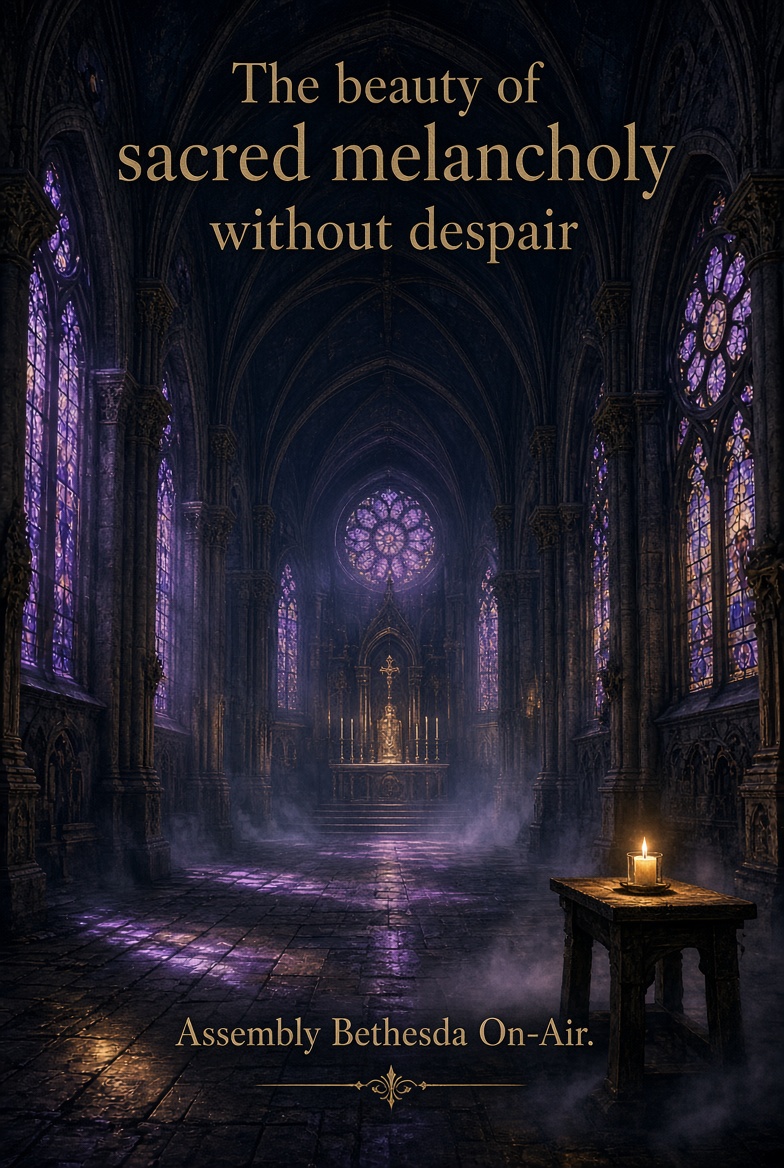
You can find a particular kind of beauty in the shadowy corners of faith, the kind that doesn’t shout or demand attention. It settles in like nightlight through old stained glass, soft and blue and heavy with meaning. Sacred melancholy is that beauty. It’s the ache you get when you realize the weight of the world but still keep looking upward. It’s not despair. Despair closes the door and turns out the lights. Even when the wind is cold, sacred melancholy leaves the door slightly ajar, trusting that the light will find its way in.
We live in a time where sadness is treated like a problem to be fixed or a weakness to be hidden. Scroll long enough and you’ll find endless promises of constant cheer, constant victory, endless upward motion. However, the older language of the church knew better. It’s not a happy symbol. The psalms are full of tears, the prophets are cracking with their words, and the cross isn’t bright either. It’s dark wood, iron, and blood, but somehow it’s also the place where hope is born. It sits with the tension like a believer sitting in an almost empty sanctuary, listening to the silence that still holds the echo of the last hymn.
This melancholy is sacred because it’s honest. It doesn’t pretend that every prayer is answered the way we hoped. It doesn’t insist every loss will be replaced with something shinier. It just says, this hurts, but God is still here. The beauty is in the quiet admission. Something softens when the heart stops fighting the ache and starts holding it gently. The sharp edges of fear lose their power. The soul finds that sorrow doesn’t crush you. Carrying is itself an act of trust.
You know those huge stone forests with pointed arches and high windows in Gothic cathedrals? Standing inside one, you feel the weight of centuries of prayer rising around you. The light that reaches the floor is filtered, colored, incomplete. It’s never the full sun at noon. It’s always tempered, always a little melancholy, and that’s why it’s so holy. They didn’t fill every corner with brightness. They left room for shadow. In the shadow, the light becomes more precious.
There’s nothing like sacred melancholy in the inner life. It doesn’t make every day feel like Easter morning. It lets Good Friday hours, Holy Saturday silence, without deciding that it’s over. In addition, it keeps company with the parts of scripture that don’t tidy themselves up. Lamentations is still in the Bible. Job still cries. Even though He wasn’t about to raise a friend, Jesus wept at his friend’s tomb. Those tears weren’t a failure of faith. They were an honest response to love.
When we let this kind of melancholy, we stop demanding that our spiritual lives look polished at all times. Instead of measuring our closeness to God by how often we feel cheerful, we start noticing the quieter signs of presence. How verses settle differently when you’re in a good place. How a familiar hymn sounds more powerful when it’s soft. How prayer becomes less about performance and more about simply being in the room with the One who already knows.
There’s danger, of course. Melancholy can turn on itself and turn into self-indulgence. It can start to enjoy its own darkness too much. That’s where sacred comes in. Sacred melancholy never ends in itself. It’s always remembering that sadness isn’t the last word. The same psalms that cry out in the night also end with trust. The same prophets who announce judgment also announce restoration. The beauty of melancholy is that it refuses to cut the story short. It stays through the dawn, even if it takes a while.
Weeping wasn’t a sign that something was wrong with the spiritual life to the old monastic traditions. They saw it as a sign that the heart was still soft enough to be moved. It’s true that a heart that can’t feel sorrow is a heart that has closed off from love. Sacred melancholy keeps the heart open. It keeps both grief and joy alive at the same time. It’s the simultaneous holding that makes it beautiful, not just sad.
Basically, we need to learn how to sit with our quieter emotions without immediately trying to talk ourselves out of them. Instead of rushing toward a major-key chorus, let a hymn in a minor key do its job. It means reading the darker passages of scripture without forcing them to resolve into easy encouragement. Those seasons can be slow and low, and they can still be full of God.
Gothic imaginations have always understood this. They love the beauty of ruins, the dignity of weathered stone, the strange glory of a single candle glowing in a vast dark nave. It doesn’t need everything to be restored to newness for it to be holy. Holiness is found in the incompleteness itself, because the incompleteness points towards a completion only God can give. The inner version of that same imagination is sacred melancholy. You can look at the unfinished places in your heart and still call them beloved.
Sacred melancholy says the ache is real, and so is the One who holds it with us. It takes courage to admit the ache is real and still refuse to let it turn into despair. That difference is everything. It’s the difference between an open tomb and an open one, the difference between night that ends and night that claims to be the only thing.
Don’t try to cover the melancholy with forced brightness. Don’t apologize for the softer colors it brings to the inner landscape. Hold it the way old cathedrals hold their shadows, with dignity, patience, and a quiet assurance that light still belongs here. In that holding, the beauty reveals itself. Not a loud beauty, not a triumphant one, but a beauty that knows how to wait, how to weep, and how to keep believing.
A heart that learns this art becomes a kind of living sanctuary where both the bright and the dim can come in without panicking. It can sit with others in their sacred melancholy without feeling the need to fix it. It can pray the darker prayers without losing hope. The melancholy itself has become a kind of worship, a kind of gentle offering of the truth of the human condition to the God who doesn’t mind the dark.