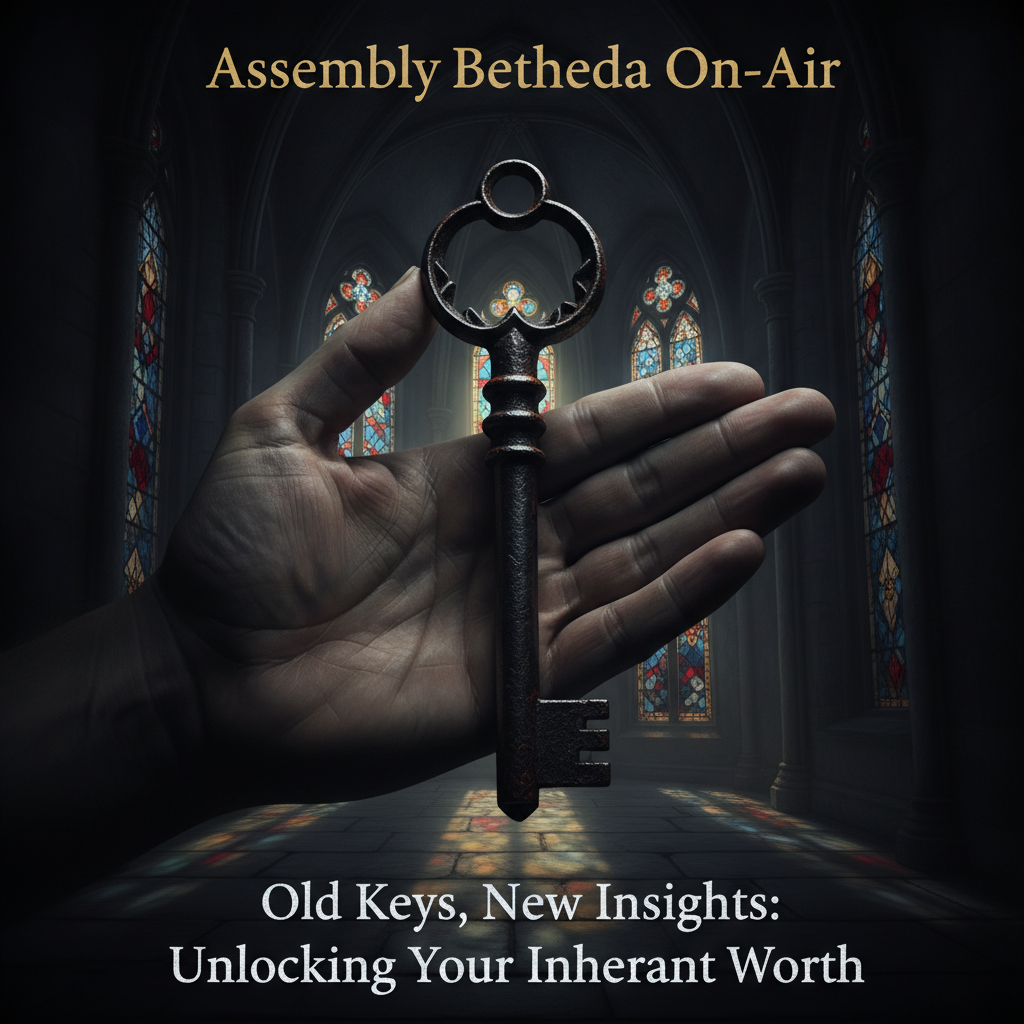
Welcome to Assembly Bethesda On-air. This is Hain Fogarty, and I am glad you are here with me today. The air feels a little cooler this evening, the kind of evening that makes you think of stone walls and quiet corridors, of places where time moves slower and the light falls in long, thin lines. Today we are going to sit with an image that belongs in those places. Old iron keys. Dark metal, heavy in the hand, marked by years, and the way they speak to the inherent worth of every person.
I want to take our time with this. No rush. The Gothic spirit does not hurry. It lets the shadows lengthen and the meaning settle. So settle in. Let the ordinary noise of the day step back for a while.
An old iron key is not pretty in the way new things are pretty. It does not gleam. It carries rust along its edges, a soft reddish bloom that tells of damp air and long waiting. The teeth may be worn. The ring that once held it may be bent. Yet the key still knows its purpose. It was made to open. That purpose does not leave when the surface changes. That is the first quiet truth we hold today. Worth is not a surface matter. Worth lives in the making.
God formed every person with care. The same care that shaped the mountains and set the stars in their places shaped the human soul. The image of God is not a temporary mark. It is the deep structure. When the iron is first poured and hammered, the shape of the key is already decided. Later the rust may come, the scratches may appear, the years may leave their record, but the shape remains. The soul is like that. The years leave their record. Sorrow leaves its marks. Failure leaves its weight. None of these erase the original design.
In the old churches the iron work was never merely decoration. Heavy hinges carried the weight of oak doors. Lock plates guarded the sacred spaces. Keys turned in those locks with a sound that still echoes in memory, a solid click that said the barrier had moved. The key did not create the space behind the door. The space was already there, prepared, waiting. The key only allowed entry. In the same way, the recognition of human worth does not create the worth. The worth is already present because God placed it there. Recognition simply opens the way for that worth to be honored and lived.
Let us stay with the weight of the key for a moment. Iron is dense. It does not float. It settles into the palm with a quiet insistence. The soul also carries weight. The weight of being conscious, of choosing, of loving, of hurting. That weight is not a flaw. It is part of the design. A key that was too light would not turn the heavy lock. A soul without depth would not be able to receive the deep things of God. The iron is heavy for a reason. The soul is substantial for a reason.
The Gothic builders understood that darkness and light belong together. The high windows let the colored light fall across the floor in patterns that move with the sun. The stone keeps the cool of the earth. The iron holds the doors against the wind. Nothing is wasted. Everything has its place. The old key belongs in that order. It is not the most visible piece, yet without it the order is incomplete. Every person belongs in the order of God’s making. Not the most visible, not the most celebrated, yet necessary. The absence of even one would leave a silence that cannot be filled by another.
Scripture speaks of keys with seriousness. The keys of the kingdom are given, not earned by perfection. They are entrusted. Trust is a strong word. It means the Giver believes the receiver can carry the responsibility. God believes that about every person. The capacity to turn toward light, to open the heart, to walk through the door of grace, is already present. The key is already in the hand, even if the hand has forgotten how to use it.
Rust is patient. It does not arrive all at once. It comes with time, with moisture, with the slow chemistry of air and metal. The soul also gathers layers. Habits form. Hurts settle. Doubts take root in the quiet places. Yet the iron beneath the rust is still iron. The original strength is still there. When the key is cleaned, when the surface is tended, the shape that was always present becomes clear again. Grace does that work. Grace does not replace the soul. Grace reveals what was already true.
There is a particular beauty in objects that have lasted. An old iron key has survived the hands that held it, the doors it opened, the years it waited on a ring or in a drawer. Survival is not the same as triumph. It is quieter. It is the simple fact of still being here. Every person who still draws breath carries that same quiet fact. The worth is not measured by how brightly the person shines on a given day. The worth is measured by the fact that God continues to hold the person in existence. The key is still on the ring. The soul is still in the hand of the Maker.
Think of the sound an old key makes when it turns in a well-used lock. There is resistance at first, then a give, then the solid movement of the bolt. The door that seemed fixed begins to move. That is the movement of hope. The soul that has felt locked for a long season discovers that the lock was never permanent. The key was always meant to fit. The resistance is real, but it is not the final word. The final word belongs to the One who designed both the lock and the key.
In the Christian Gothic vision the night is long and the candles are few, yet the few are enough. One candle can show the way to the next. One key can open the door that leads to the next corridor. Worth is like that. It does not need to be loud. It only needs to be true. When a person is treated as valuable, something in the deep structure of the soul recognizes the treatment and responds. The response may be slow. The rust may need time to loosen. But the recognition is there because the worth is there.
The iron key also reminds us that access is a gift. No one forces a door open with a key. The key is used with intention. God does not force the human heart. The invitation is steady, the door is prepared, the key is offered. The turning is left to the person. That respect is part of the worth. To be given the freedom to turn the key or to leave it unused is to be treated as a being of dignity. Dignity is not given after the person chooses well. Dignity is present before the choice.
Let us walk a little further into the image. Imagine a ring of old keys hanging in a stone niche. Some are large, meant for great doors. Some are smaller, meant for chests or side rooms. Each has its own shape. Each fits only the lock it was made for. There is no competition among them. The large key does not make the small key unnecessary. The small key does not envy the large. Each is exact for its purpose. So it is with persons. The variety of gifts, temperaments, histories, does not create a hierarchy of worth. Worth is the common metal. The particular shape is the particular calling. Both are given. Both are held.
The Gothic spirit loves the particular. The carved face on a capital, the slight asymmetry in a window, the unique curve of a certain hinge. These details are not mistakes. They are the record of hands that worked with care. Every person is a particular work. The scars, the strengths, the quiet habits of the heart, all belong to the finished piece. The old iron key is particular too. Its teeth are cut for one lock. Its weight is its own. Its rust pattern is unique. Yet every key on the ring shares the same essential nature. Iron. Formed. Purposed. Valued.
When the world measures people by what they produce or how they appear, the old key stands as a quiet contradiction. Production is good. Appearance has its place. Neither is the foundation. The foundation is the fact of being made and being held. A key that has not opened a door for years is still a key. A person who feels unused or unseen is still a person of inherent worth. The years of waiting do not cancel the design.
There is a tenderness in this truth that the Gothic atmosphere makes room for. The long shadows, the cool stone, the soft sound of distant rain on high roofs, all of these create a space where the hurried measures of the day can fall away. In that space the soul can hear the quieter word. You are worth the iron. You are worth the forging. You are worth the long patience of the One who keeps the key and the lock together until the time of opening.
Grace is the oil that helps the old key turn. Without it the rust can make the movement difficult. With it the resistance eases. Grace does not shame the rust. Grace simply works with what is present. The soul that comes with its layers of difficulty is not turned away. The key is still accepted. The door is still available. The worth is still affirmed.
I want to stay with the idea of waiting. Old keys often wait. They hang unused for seasons, even for generations. The lock they fit may be rarely approached. Yet when the moment comes, the key is ready. The soul also knows seasons of waiting. Seasons when the sense of purpose feels distant, when the door seems permanently closed. The waiting does not mean the key has been discarded. It means the time of turning has not yet arrived. God is not anxious about the timing. The iron is patient. The soul can learn that patience too.
The Christian Gothic heart finds beauty in the unfinished and the weathered. The cracked stone, the faded fresco, the iron that has begun to return to the earth in small flakes of rust, all of these are received as part of the whole. Perfection is not the requirement. Presence is. The person who is present, with all the marks of living, is already enough to be received. The key does not need to be restored to its first brightness before it can be used. It needs only to keep its shape. The soul needs only to remain what it is, a creature held by God.
Let the image of the key rest in the mind a little longer. Feel its weight. Notice the coolness of the metal. See the places where the rust has gathered and the places where the iron still shows dark and strong. That mixture is honest. The soul is also a mixture of strength and wear, of clarity and shadow. Honesty about the mixture is part of walking in the light. The Gothic vision does not demand that the shadows be denied. It places the candle so that both the light and the shadow can be seen together. Worth lives in that honest seeing.
Every person is invited into that seeing. The invitation is not reserved for those who already feel valuable. It is especially for those who have forgotten. The old key that has been overlooked is the one that most needs to be remembered. The soul that has been told, by the world or by its own thoughts, that it no longer matters is the soul that most needs the quiet word of truth. You still matter. The shape is still there. The purpose is still present. The door is still for you.
The iron key also teaches about limits. A key opens only certain doors. It is not a master of every lock. That limitation is not a failure. It is part of the design. Every person has limits. The limits do not reduce the worth. They give the worth a particular place to stand. The person who tries to open every door will break the key or the lock. The person who accepts the particular doors given will find the turning natural and the entry real. Worth includes the freedom to be limited and still complete.
In the long history of faith the keys have been passed from hand to hand. Each generation receives them and must decide how to use them. The responsibility is serious. To hold a key is to hold the possibility of welcome or of exclusion. The Christian call is toward welcome. The doors of grace are meant to open. The worth of the person approaching is not to be weighed in the balance of human judgment. It is already decided by the One who made the person. The key holder’s task is to turn the key in keeping with that prior decision.
The atmosphere of the old stone places helps us remember this. The walls have heard many prayers. The floors have felt many footsteps. The iron has turned for the joyful and the grieving alike. No distinction was made in the metal. The same key served both. The same worth is present in every person who approaches. Joy does not increase it. Grief does not decrease it. The iron remains iron. The image of God remains the image of God.
I am going to return once more to the simple fact of the key’s existence. Before it opens any door, before it is placed in any hand, the key already is. Its being does not depend on its use. In the same way the person already is. The being does not depend on the achievements or the failures. Existence itself is the first gift, and within that gift the worth is already complete. Everything else is secondary. The secondary things matter. They shape the days and the relationships. They do not create or destroy the foundation.
The Gothic spirit loves foundations. The great churches rest on deep stone. The iron is anchored in that stone. The soul rests on the deeper foundation of God’s own life. The worth is anchored there. Storms may come. The upper structure may shake. The foundation holds. The key may be dropped, may be lost for a time, may be found again covered in dust. The foundation remains. The worth remains.
As we prepare to close this time together, let the old iron key stay with you. Let it rest in the imagination as a small, dark, faithful witness. It does not need to explain itself. It simply is what it is, and in being what it is it points beyond itself to the larger truth. Every person is held. Every person is formed. Every person carries a worth that time and rust and sorrow cannot erase. The door is prepared. The key is ready. The turning is possible.
Thank you for joining me today, as always it is a pleasure to spend this time with you. God Bless and until next time. Courage. If you like what I do here, head on over to www.assemblybethesda.com.