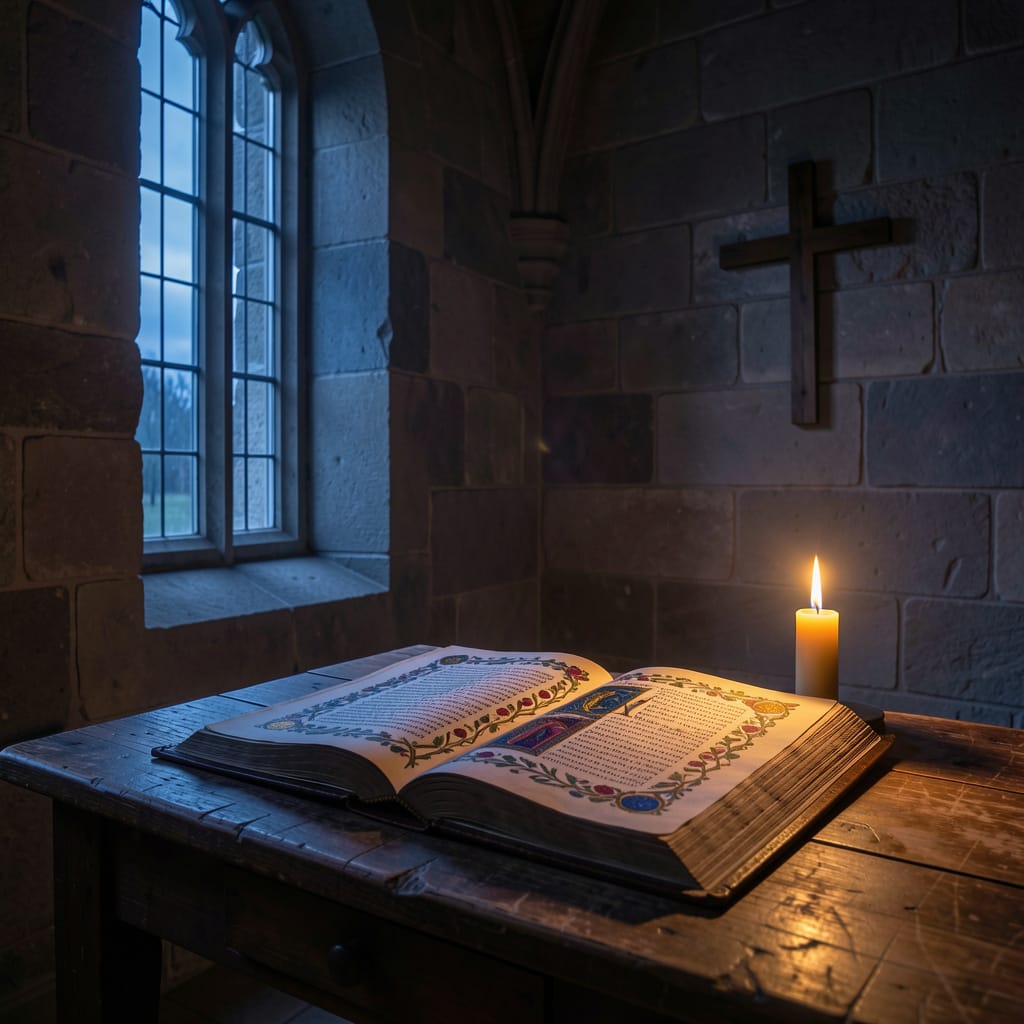
The kind of thing you know about illuminated manuscripts. You know the kind. They’ve got thick pages, letters that seem to breathe, and gold leaf that catches even the tiniest bit of light and turns it into something holy. They’re not meant to sit on a shelf collecting dust. They’re meant to be held, read, prayed over, and passed down. They still invite us to slow down and look closer at the beauty God has always woven into His Word even in a world that often feels gray and rushed.
Those illuminated manuscripts were the result of a love for the Bible. Monks and scribes spent years bent over desks in cold stone rooms, copying every line by hand. They didn’t hurry. Every letter was an act of worship. When they finished the text, they didn’t stop. In addition to vines curled around the margins, tiny scenes from Christ’s life, and gold that glowed like the light of the world, the result was more than just a book. A visual sermon, a reminder that God’s words deserve beauty because they come from Him.
Think about the Book of Kells or the Lindisfarne Gospels. They’re filled with color and pattern. Lions and eagles represent the Gospel writers. Crosses come out of swirling designs. Christ appears in quiet majesty with a calm, strong face. There’s nothing empty or decorative about these images. Every detail points to the story of salvation. The gold leaf isn’t just pretty. It symbolizes God’s glory that no darkness can tame. It was as if the Word was still speaking as a candle flickered across those pages in a dim monastery chapel.
This is where the Christian Gothic spirit finds a natural home. Gothic art has always been about the tension between light and shadow. Tall cathedrals reach toward heaven while their stone floors stay cool and dark. Stained glass turns sunlight into rivers of color. Luminous manuscripts do the same thing on a smaller scale. With parchment and ink, they transform ordinary materials into something that feels almost otherworldly. There’s a visual language here that says faith isn’t soft or vague. Faith is solid, intricate, and full of mystery that still invites us in.
We live in a time when most of our reading happens on screens. Words pop up and disappear with a swipe. Convenience is great. However, something gets lost when we don’t sit down and read a physical page that someone poured years of effort into. Illuminated manuscripts remind us that the Bible is more than just information. It is revelation. It is the living Word who became flesh and dwelt among us. Scribes painted Christ enthroned or the Lamb standing as if slain, not to decorate. They were preaching.
Don’t forget how these books were used. They weren’t just locked away for scholars. Many communities brought them out for feast days, carried them in procesions, and opened them up so everyone could see the pictures. Even if you couldn’t read, you could still hear the story through image and color. Both the powerful and the poor stood under the same light reflected off the gold. That’s how the Gospel works. It’s for everyone. Open eyes and a willing heart are all it takes. It doesn’t require perfect education or perfect circumstances.
Scribes began with prayer while making illuminated manuscripts. They mixed their inks with care. They picked the best sheepskin or calfskin for the pages. They ruled the lines so the text would sit straight and true. Then they wrote. Once the writing was finished, the illuminators took over. They applied the gold first, since gold was precious and had to be handled carefully. After the gold came the colors, layer by layer, until the page looked like a small window into heaven. The books teach us that some things are worth the slow work. They teach us that mistakes can’t be erased easily. Every stroke counts. It sounds radical today. We’re used to undo buttons and instant edits.
God could have given us His Word in plain text only, but He inspired people to surround it with beauty for centuries. The same God who spoke light into darkness also gave us eyes that love color and hands that love to create. Illuminated manuscripts are one way the Church has answered that gift. It’s said that beauty and truth go together. It’s said that the story of Jesus is worth the best materials and the longest hours of labor. People still found a reason to make things that pointed beyond themselves despite plague, war, and uncertainty.
In the margins of many manuscripts, you’ll see more than vines and animals. You’ll see the daily life of faith mixed with the eternal. There’s a monk praying, a bird that might represent the Holy Spirit, and a winding path that leads back to Christ. Those details keep the book from feeling distant. They bring the holy into the ordinary and the ordinary into the sacred. That’s Christian Gothic. The light of Christ doesn’t shy away from the dark corners of human experience. Instead, it puts it right in the middle of them.
In spite of the fact that we never hold an original, we can still learn from these pages. Museums and libraries have digitized lots of them so you can zoom in and study them. Churches still commission new illuminated works for special occasions. Artists keep exploring the old techniques with new eyes. It’s not dead yet. You just have to look slowly and love deeply to find it.
Remember the long line of hands who copied and illuminated the words before you next time you open a Bible, whether it’s a plain modern edition or something more ornate. You remember the gold that once glowed in candlelight? You remember the Christ you see in those paintings is the Christ you see now. The manuscripts weren’t the point. They were the frame. The picture inside the frame has always been the same. We have always had God with us. A beauty that never fades.
Let the quiet glow of those ancient pages settle into your own reading. Let them teach you to approach Scripture with both reverence and delight. Let them remind you that faith can be sturdy and strange, shadowed and shining at the same time. Open the book and let the light find you instead of the quick and the flat in a culture that often prefers the quick and the flat.
Every time a new reader opens the Word with wonder, another page is illuminated. The gold is still there. The light still catches it. And our Savior still steps out of the shadows to meet us.