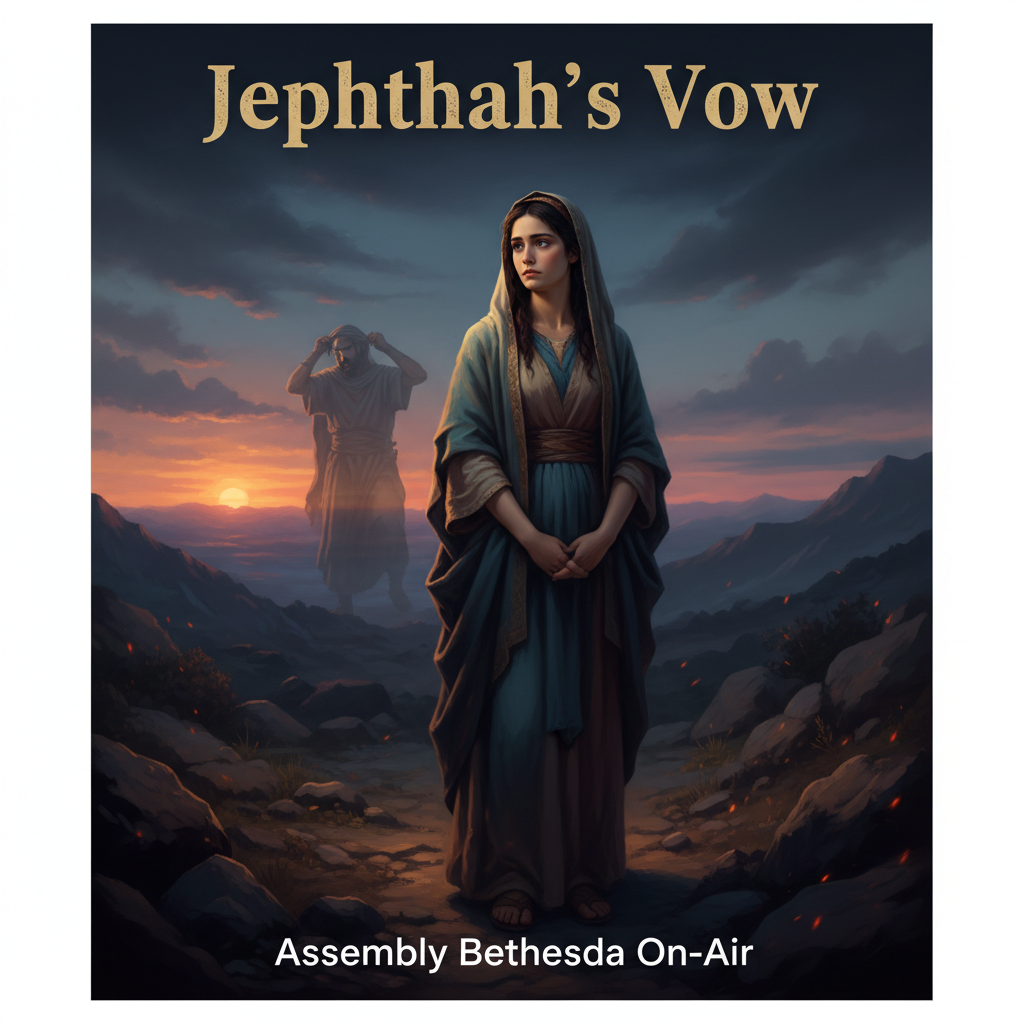
The Shadowed Altar: Jephthah’s Terrible Vow
It’s a tale that chills the soul and stirs the spirit in the dim corridors of ancient Gilead, where winds whispered through rugged hills and shadows of war stretched across the land. It’s from Judges, chapter 11, verses 30 through 40, full of tragedy, rash promises, and a sense of human frailty under a sovereign God. Think of it like a gothic drama played out under stormy skies, where victory tastes like ashes and faith walks a razor’s edge between triumph and heartbreak.
He lived as an outlaw, a mighty warrior who gathered a band of rough men around him, born to a harlot and cast out by his half-brothers. As the Ammonites threatened Israel, the elders came crawling back, asking him to lead them. He reluctantly agreed, but not before turning to the Lord in the heat of war.
The clash of swords loomed, and Jephthah made a vow that would echo through centuries. “If you’re going to give me the Ammonites,” he pleaded, “then whatever comes out of my house to meet me when I return in peace from the Ammonites will be the Lord’s, so I’ll burn it up.”
It’s silly to bargain with the Almighty. God granted victory in the misty battlefields, where blood soaked the ground and the sounds of war filled the air like thunder. Almost like he’s riding home through the gathering dusk, heart pounding with relief, the spoils of war behind him, Jephthah struck down the enemy from Aroer to Minnith, twenty cities falling, the Ammonites subdued in a major blow.
His daughter, his only child, danced out to meet him with tambourines and joyous steps, celebrating her father’s return as he approached his home at Mizpah. He didn’t have sons or other daughters, just this bright girl, the light of his house.
“Oh my gosh, my daughter! You’ve brought me down to a point where I can’t take back my vow.” Jephthah tears his clothes in anguish. His daughter, brave in the face of doom, responds with a quiet strength that pierces the heart. The words hang heavy in the air, thick with regret. “Alas, my daughter! You have brought me down to my knees, and you have become the cause of a lot of trouble for me.”. The queen accepts her fate, asking him to do as he promised since the Lord had avenged their enemies. But she asks for two months, to weep for her virginity, for what will never be.
Those two months must have felt like an eternity in the shadowed valleys. You can imagine the gothic procession, young women climbing rocky paths under brooding skies, lamenting not just a lost life, but the innocence that was taken by the father’s hasty words. As soon as she comes back, Jephthah fulfills his vow. The text says she had never known a man, so daughters lamented her four days a year in Israel. There’s a void where laughter and grandchildren should have been, a deafening silence.
This story, friends, is raw and uncomfortable, far from the neat Sunday school tales we sometimes prefer. It’s Christian gothic at its core, dark with sin and consequence, yet flickering with divine power. In Jephthah’s case, he made a rash vow out of fear and a desire to control things rather than trust God. It was a serious thing to make vows in those ancient times, not to be tossed around lightly, as Ecclesiastes later warns about opening your mouth before God. What about child sacrifice? The Bible elsewhere condemns it fiercely as an abomination, something the pagan nations did to their false gods. Leviticus and Deuteronomy ban it fiercely. So what happened here? It’s hauntingly ambiguous in places, sparking debates throughout history. Some see it as a literal burnt offering, the tragic fulfillment of a broken promise. Some say her virginity and her annual lament suggest that she was dedicated to the Lord’s service, set apart like a perpetual virgin in the tabernacle, with her life sacrificed but not sacrificed.
No matter what, the shadow falls hard. Rather than endorsing the act, God is allowing the painful consequences of a flawed man’s choice to play out in Judges, a book full of imperfect deliverers in a cycle of sin, oppression, cry for help, and flawed salvation. Even though Jephthah is listed among the faithful in Hebrews 11, his vow stains the record as a reminder that faith doesn’t erase foolishness.
Let’s linger in the gothic atmosphere a bit longer. Think about the mist-shrouded mountains where the daughter mourned, the cold stone altars of promise, and the flickering torchlight in Jephthah’s home while he pondered what to say. The gothic style evokes old cathedrals with gargoyles leering from the heights, beauty mixed with terror, holiness mixed with human darkness. In a crisis, how many times have we promised God, “If you just get me through this, I’ll…” only to regret the strings attached when the answer comes?
Even so, grace whispers. The daughter’s submission is filled with quiet dignity, a willingness to honor the vow, which echoes later sacrifices. Her story hints at the ultimate sacrifice, in a way that’s twisted and incomplete. Jephthah’s promise led to loss, but God’s promise in Christ leads to life. The only Son of God willingly went to the cross because he loved him so much that he died. There weren’t mountains of lament for Him alone, but a resurrection dawn broke through the Gothic night. Jephthah’s daughter reminds us of sin’s ripple effects, while Calvary shows our redemption’s full cost.
It’s not a blueprint for vows today, but it hits you differently when you sit with it. It’s not a blueprint for vows today because we’re under grace, not bound by every impulsive prayer like a legal contract. James advises us to be slow to vow, to let our yes be yes. Yet it does make us look at our hearts. Do we bargain with God, or do we trust Him when we fight? Do we promise the moon and then mourn when the price gets paid? It’s the same God who gave Jephthah victory despite the vow.
A haunting beauty is added by the annual lament of the daughters of Israel. Four days a year, they remembered her. Not forgotten in the annals of victory, but mourned in community. In our churches, we also need spaces to lament the hard stories, the unanswered whys, the consequences that linger. Gothic faith isn’t all sunshine, it’s the cross in the storm, the empty tomb after the grave.
In his homecoming, which was once seen as triumphant, Jephthah’s line ended there, no grandchildren to carry his name on. It’s a cautionary tale wrapped in midnight velvet, urging us to be wise. A warrior who subdued nations couldn’t control his tongue. Proverbs says the tongue has the power of life and death. Jephthah spoke death into his future.
Let it sink in as we close this shadowy reflection. Read Judges 11 again by lamplight, and feel the weight. Jephthah kept his vow, and Israel moved on in its turbulent history. But we can do it better. Christ’s sacrifice stands eternal in the ruins of human effort, turning mourning into dancing forever, not just for two months. It’s surrender without strings, trust without tests, obedience born out of love.
The tale from Gilead is much more than ancient history. It’s a mirror, dark and unflinching, showing where zeal without knowledge leads. Yet it also shows God’s mercy, using broken pieces. The altar is real, but thank God, the perfect Lamb has already been. Let’s learn from the shadows, walk in the light, and be careful with our words.