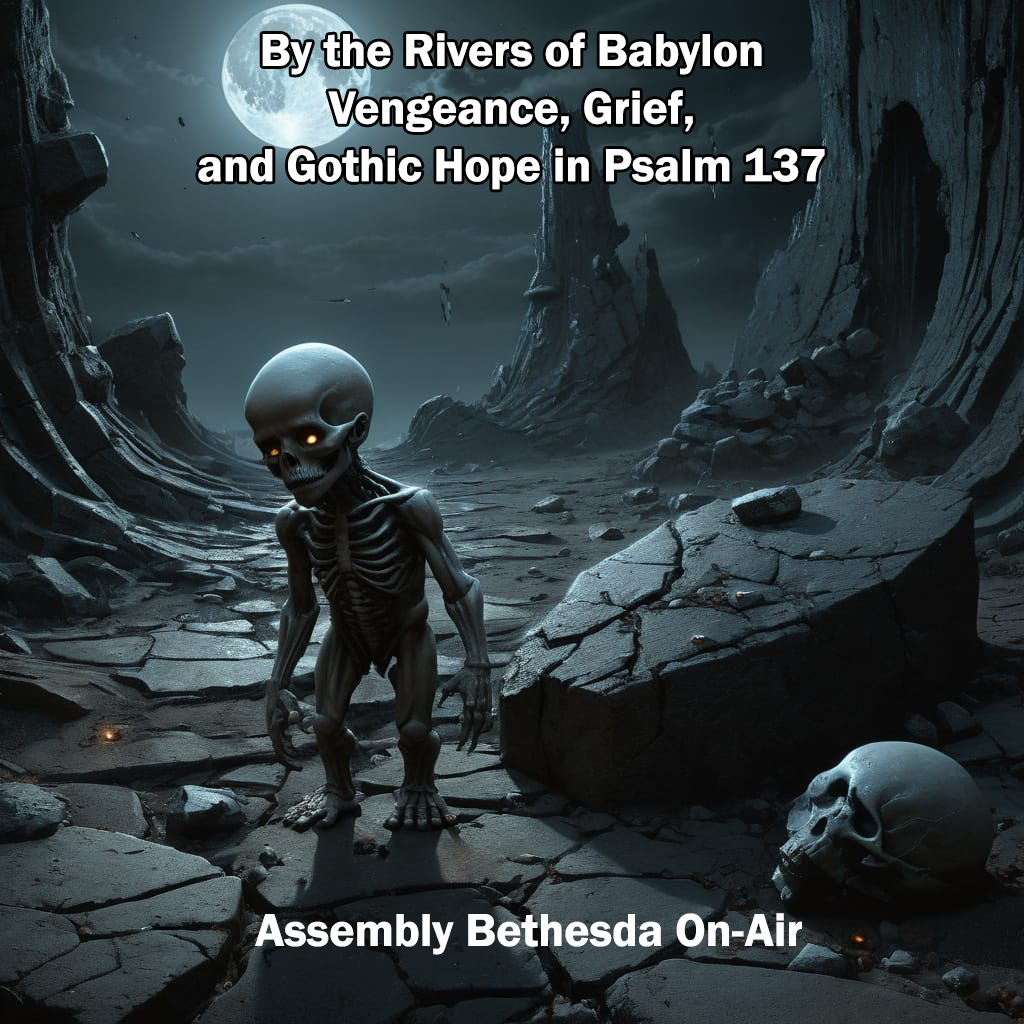
A cold wind blows from a forgotten grave. “Happy is the one who grabs your baby and smashes it against the rocks.” Psalm 137. This is an unfiltered line about vengeance against Babylon, the kind that makes you wonder how it ended up in the Bible next to love and mercy. Yet here it sits, part of a lament that feels more at home in the shadows than in stained glass windows. We don’t run from verses like this when we’re Gothic Christians. Let the darkness press in, and watch how the light still breaks through.
It’s not a sugarcoated scene. Judah’s people were dragged from home, marched across deserts, and dumped in the rivers of Babylon. The city is in ruins, the temple is gone, and the captors are mocking them with happy songs. “Sing us one of Zion’s songs.” The exiles weep and hang their harps on willow trees. While this whole psalm drips with grief, it builds to a fierce call for justice that shocks us today.
It’s not a polite slap on the wrist. It’s a call for the end of Babylon, the empire that destroyed everything he loved. The infants are Babylon’s future, the next generation that would grow up to do the same thing. They’re being smashed against the rocks as a symbol of total, sudden, irreversible judgment. It’s brutal, honest, and scripture.
Whenever we talk about Gothic faith, we feel its weight. Gothic culture has always hung out in places the rest of the world won’t – graveyards, mourning veils, decayed beauty. Psalm 137 belongs there too. It doesn’t pretend suffering is tidy. It doesn’t demand we smile through exile. Instead, it gives voice to what we sometimes feel like Babylon again. Many believers today live in a culture that mocks their faith, pressures them to sing shallow songs, and suggests the old ways of Zion are outdated. The psalm lets us name the pain without being embarrassed.
I love the structure of the poem. The first part is lament, the middle is a vow to never forget Jerusalem, and at the end is a prayer for revenge. I’d call it a Gothic ballad, starting out soft and mournful, then rising to a thunderous end. The writer knows Babylon won’t get away with it forever. The tears by the river have been heard by God, and Babylon’s violence will return one day. The psalmist is just asking God to enforce the ancient law of measure for measure.
Today, readers want to skip this verse or dismiss it as Old Testament anger that Jesus cancelled. But that’s missing the point. Jesus never cancelled honesty. He wept over Jerusalem, he overturned tables in the temple, and he promised final justice would happen. Babylon appears again in Revelation, symbolizing corrupt systems that oppose God, and she falls in one hour.
The same satisfaction the psalmist longed for echoes in the heavenly cry , “Rejoice over her , O heaven.” The desire for evil to be crushed is not ungodly. It is human , and when handed over to God it becomes part of our worship.
As a reminder that light shines brightest against darkness, Gothic Christianity wears the black veil, the skull, the dim candle. The hard stuff isn’t props, they’re signs that we don’t airbrush it. One of those hard parts of faith is in Psalm 137, 9. The rock the infants hit can remind us of the Rock that was struck for us. Christ took the full force of judgment so that we don’t have to suffer from it. As Babylon’s infants represent sin’s future, on the cross that future was cut short for all who believe. The Savior absorbed our vengeance.
Despite Paul’s clear advice that we leave room for God’s wrath, this psalm still has a place in our prayers. When innocent blood is spilled , when persecution rises , when systems crush the weak, we can bring our anger to the Father who understands. He doesn’t flinch at the graphic language. He inspired it. And He answers in His time , sometimes with mercy for the repentant, sometimes with finality.
It’s Gothic and feels real. We gather in the shadows with our black lace and crosses, we sing songs that don’t ignore the night, and we trust that every Babylon will meet its rock. The verse isn’t a cruelty guideline. It’s a window into the hearts of a people who refused to stay silent. Our ministry keeps that window open. Hope and melancholy sit together because they’re both real. Exactly the same God who heard the exiles by the river hears us today. The same God who judged Babylon will judge every power that stands against His people.
In spite of its despair, this passage ends with a blessing for the person who enforces justice, not because violence is beautiful, but because a world without justice would be unbearable. Gothic looks at that tension, the way ruin and redemption kiss. The rocks become a sort of altar , the infants a symbol of everything that dies so something beautiful can live. We don’t celebrate the image. Our honesty drives us closer to the cross, where all vengeance finds its end.
When you read Psalm 137:9 for the next time, don’t rush past it. Feel the shock. Feel the darkness of exile surround you like a heavy cloak. Then listen for the quiet promise underneath. God sees. God hears. Gothic believers in Babylonian worlds need to keep their harps tuned, their veils ready, and their hope rooted in God who turned the darkest hour into a brightest sunrise. This verse is hard, haunting, and holy. That’s why it belongs in every Christian Gothic heart