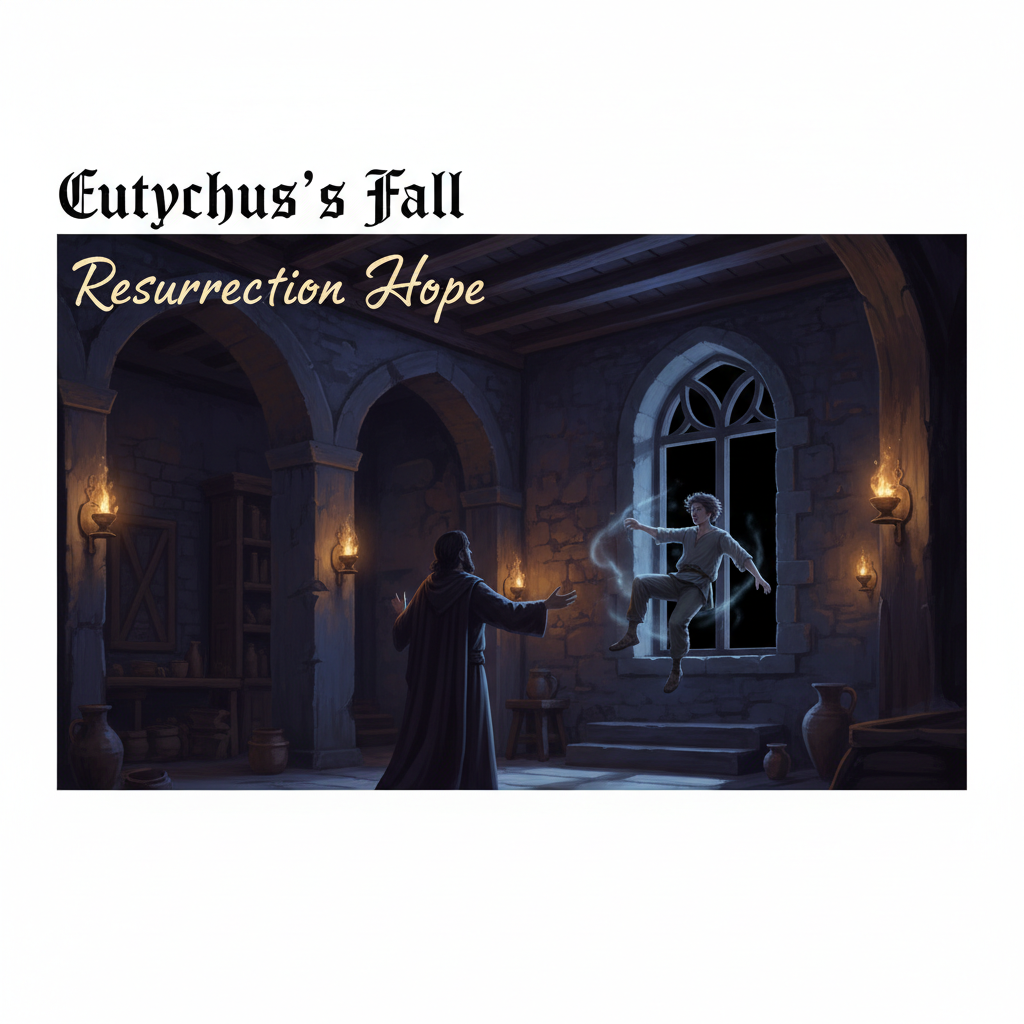
An upper room in Troas was filled with the smell of oil lamps and the low murmur of voices sharing bread and wine at night, when the early believers gathered there. Because he knew morning would take him away on the next ship, Paul stood among them with steady words. There were many lamps in the room, yet outside the window was real darkness, one that pressed close and beckoned the weary to sleep.
As the teaching continued, Eutychus sat right on the edge of that window, listening at first, then drifting, his body giving into sleep. It happened suddenly, the fall silently from the third story into the courtyard below. The thud echoed, people rushed down, and there he was, lifeless.
Acts 20 verses 7-12 captures this moment in its raw gothic beauty, a single heartbeat where death claims a seat at the table of life only to be thrown back by resurrection hope.
Rather than some distant history lesson, think of it as a Gothic painting. The upper room becomes a sanctuary suspended between heaven and earth, with its stone walls holding the flicker of lamps fighting the night pressing in from all sides. Those lamps, so many of them, cast long shadows on tired faces but hungry for truth.
Despite the gloom, Paul keeps talking, his voice a steady anchor. Breaking bread isn’t just a meal, it’s the heartbeat of a community that won’t let darkness win. It’s like watching a figure from an old cathedral carving perched in the window, every soul who’s ever sat on the edge, listening, but slipping, dragged by exhaustion, doubt, or a heavy veil of melancholy all goth hearts know. At that moment, fortune seems to tumble away with him into the black.
In the fall itself, the spirit hovers between worlds, the body hitting cold ground while the spirit plunges from safety into the unknown. People picked him up dead, the text clearly says. In the courtyard, it must have felt like the night was absolute, the lamps from above now distant and mocking in their unreachable light. Still, Paul doesn’t stand frozen at the window.
As he descends, he throws himself on the young man, wraps his arms around the still figure in an embrace that mirrors the love that reaches the graves. The words cut through panic like a blade of pure light cutting through velvet darkness. He tells them he’s alive. Then Paul goes back up, breaks bread again, eats, and talks until daylight bleeds. The believers bring the young man home alive, and every heart is filled with comfort.
This passage pulses with the gothic Christian truth that darkness is never the end, it’s the canvas on which resurrection paints its boldest strokes. It’s like a midnight mass in a forgotten abbey, the lights pushing back just enough to let faith breathe.
As Eutychus falls asleep, we see how easy it is to drift when the hour gets late and the body gets weak. Yet even deep sleep, even actual death, can’t silence the voice that calls us home. The way Paul descends the stairs is like Christ stepping into a tomb, arms wide open, life flooding where decay tried to claim it. Gothic souls find beauty in the broken window, in the fall that should have ended everything, in the embrace that defies logic and raises the dead.
Consider how the lamps play their part , small flames in a vast night, a reminder that the light shines in the darkness and it doesn’t die. The upper room holds both celebration and crisis , bread shared and a body fallen , yet the community doesn’t scatter. They stay , they watch , they get comfort from a young man returned to them breathing and whole.
Gothic faith lived out, not pretty or polished, but real , raw, wrapped in shadows that make the light even more precious. This story whispers to melancholic hearts that feel perched on a ledge that the fall may come but grace will descend faster than gravity. Resurrection isn’t a distant future event, it breaks into the present midnight hour demanding death to let go.
The passage also carries the quiet courage of endurance. Paul had been speaking for hours , the night stretching long , yet he didn’t stop when tragedy struck. He took care of it, then returned to the table and kept feeding souls until dawn. There’s something gothic about that kind of steadfastness, not letting darkness dictate grace’s schedule. The believers leave comforted, not because the fall never happened, but because it was answered with life. In a world that lingers on tragedy, this story focuses on the triumph that follows, the walk home with a living witness.
When the window is layered into the Gothic aesthetic, it becomes a threshold, a way to separate the warm glow of fellowship from the chill of mystery. The shadow claims Eutychus for a moment as he sits there, half in light and half in shadow. But the border proves porous once Paul crosses it with resurrection power. It feels like a veil is lifted just enough to let the hope that awaits on the other side of the border emerge. For those on the Gothic path of faith, this tale becomes a lantern, proof that even when we sink into sleep or fall into darkness, the voice of Christ still calls us fortunate, still calls us alive.
The comfort at the end ripples outward like the first light of dawn creeping across the courtyard. The young man is taken home, breathing, walking, a living sermon. The community carries that comfort into their own nights , into their own upper rooms where lamps burn and bread gets broken and sometimes bodies fall. Alarms don’t matter when grace is there. If we stay at the table, daylight always follows the longest midnight.
Every Gothic believer should linger in this Acts account, to see the beauty in the broken window pane, the poetry in the descent and the ascent, the tension between fall and rise. Not a story of perfection, but a story of presence. A God who meets us in crisis and turns death into a doorway. The lamps keep burning, the bread keeps feeding, the words keep flowing until morning dawns. That’s where the gothic heart finds its truest home, where shadows serve the light, and every fall is a stepping stone.
It’s an invitation to trust in the power that raised Eutychus and raises us still, even if no window, no night, no sleep are too high, too deep for that power. The believers are comforted, alive, and ready for what comes next in the upper room. Gothic gospels shine here in full, dark and luminous at once, beckoning us to sit at the table, watch the lamps, and trust arms that never let the fallen stay that way.