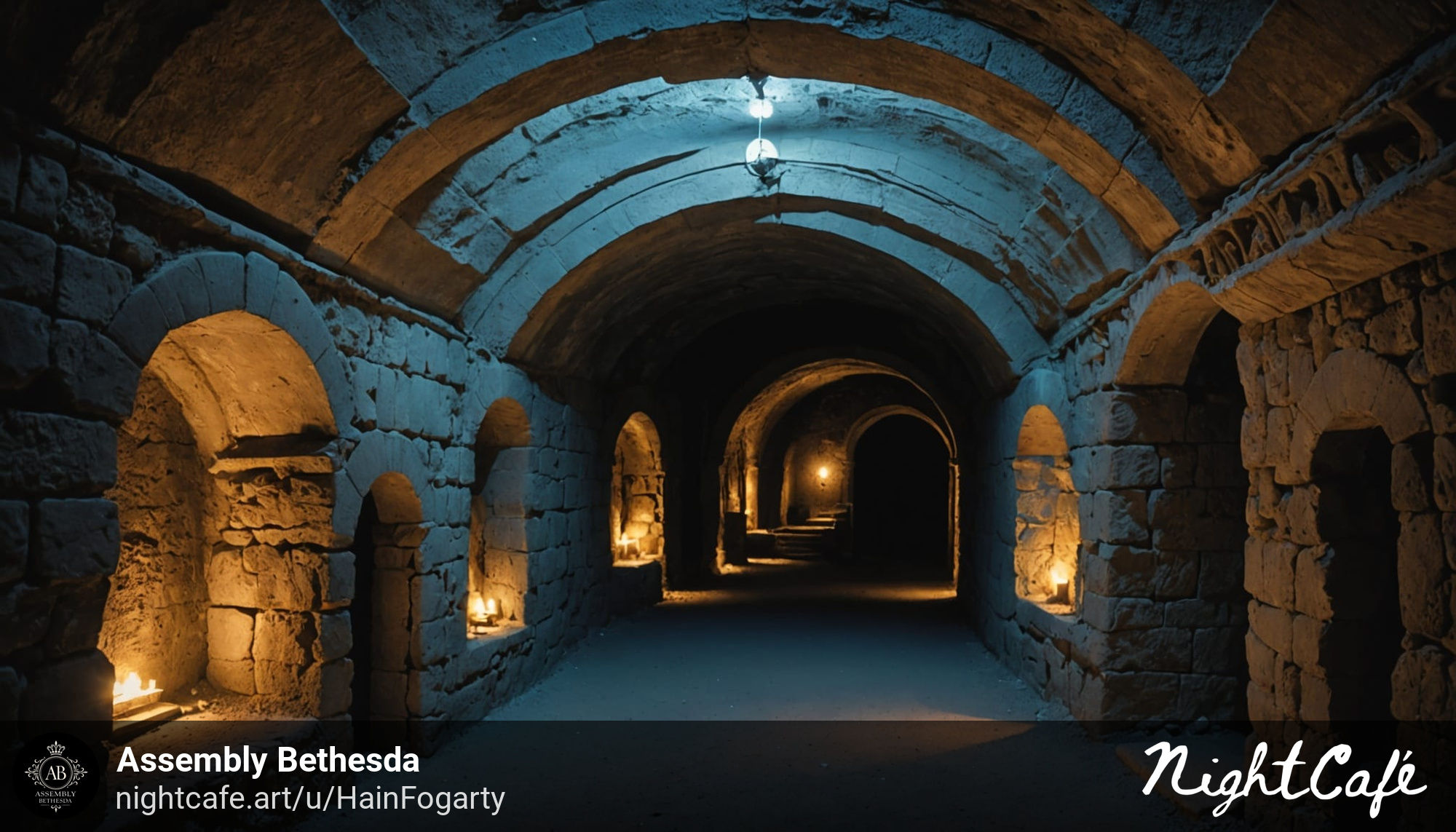
In the shadowy depths beneath ancient Rome stretch the catacombs, vast labyrinthine networks of tunnels carved into soft tufa rock, which served as burial sites for early Christians during centuries of intense persecution. As well as enshrining the remains of the faithful, these cool and perpetually dark underground chambers became sacred spaces where believers could express their beliefs through secretive art.
Christian believers used subtle, coded symbols on damp walls, etched into loculi seals, or carved on sarcophagi to avoid arrest, torture, or execution when displaying overt Christian imagery aboveground. In the midst of overwhelming death, these markings functioned as quiet declarations of faith, passwords for the persecuted, and promises of resurrection.
Modern Christian Goths see the catacombs as a profound intersection of darkness and devotion, where hope endures despite mortality, and macabre surroundings house unbreakable light.
The most widespread and ingenious symbol was the fish, known as Ichthys. Early Christians drew a simple curved outline of a fish because the Greek word ΙΧΘΥΣ formed an acrostic: Iēsous Christos, Theou Yios, Sōtēr, translating to Jesus Christ, Son of God, Savior. In the flickering torchlight of the tunnels, one believer might trace one arc in the dust; a stranger would complete the second arc only if they shared faith.
Catacombs like San Callisto and Domitilla have frescoes depicting fish swimming beside anchors, doves, or vines, often accompanying scenes of baptism or the multiplication of loaves, illustrating spiritual nourishment and eternal life.
Another frequent motif, the anchor, cleverly disguised the cross. Its vertical shaft ended in a curved stock, evoking Hebrews 6:19: “We have this hope as an anchor for the soul, firm and secure.” The anchors dangle from tomb ceilings, paired with dolphins or inscribed with phrases like “peace be with you,” reminding people death would yield to Christ.
In many chambers, the Good Shepherd appears as a young, beardless Christ carrying a lamb across his shoulders, echoing John 10 and Psalm 23. The orante is a stylized female figure with arms raised in prayer that symbolizes the soul at peace or the Church interceding.
Some of the oldest Christian paintings are preserved in the Catacomb of Priscilla, including banquet scenes that scholars interpret as allusions to the Eucharist, and possible early depictions of Mary holding Jesus.
Symbols that aren’t so common but still powerful include the phoenix rising from flames, the peacock, whose flesh is thought to be incorruptible, and the Chi-Rho monogram, the first two letters of Christos superimposed on each other. When Constantine saw this emblem before the battle of Milvian Bridge, it became the standard laboratory.
These ancient motifs reveal a community that embraced paradox: surrounded by skulls, bones, and the stench of decay, they painted symbols of life, deliverance, and victory. Christ’s triumph over death comes from Jonah emerging unharmed from the whale, Lazarus emerging from the tomb, and Daniel standing untouched among lions.
Medieval and Victorian gothic art echoes the veiled hope of the catacombs centuries later. Death units king and peasant in memento mori vanities, transi tombs feature rotting corpses beneath prayerful effigies, and danse macabre frescoes remind us of that. Despite being grotesque and protective, cathedral gargoyles echo horrors and holiness.
Underground secrecy evolved into shadowy cloisters, ruined abbeys, and moonlit graveyards that became Romantic and Gothic Revival staples.
These ancient whispers take on a new life in contemporary Christian Goth expression. Inverted crosses recall Peter’s upside-down crucifixion and humble martyrdom instead of rebellion, skulls entwined with roses or vines symbolize beauty born from suffering, and ornate crucifixes set against black velvet symbolize light shines brightest in deepest night. Faith doesn’t have to flee darkness; it carves eternal truth into the tomb’s walls instead.
The Psalmist’s words echo through those silent tunnels: “Even though I walk through the valley of the shadow of death, I will fear no evil, for you are with me.” In the catacombs, death is ever-present, yet resurrection is promised. The early Church did not deny the grave; they sanctified it, transforming places of ending into galleries of beginning.
Let’s see how the AI does with pronouncing this one. Wish it luck