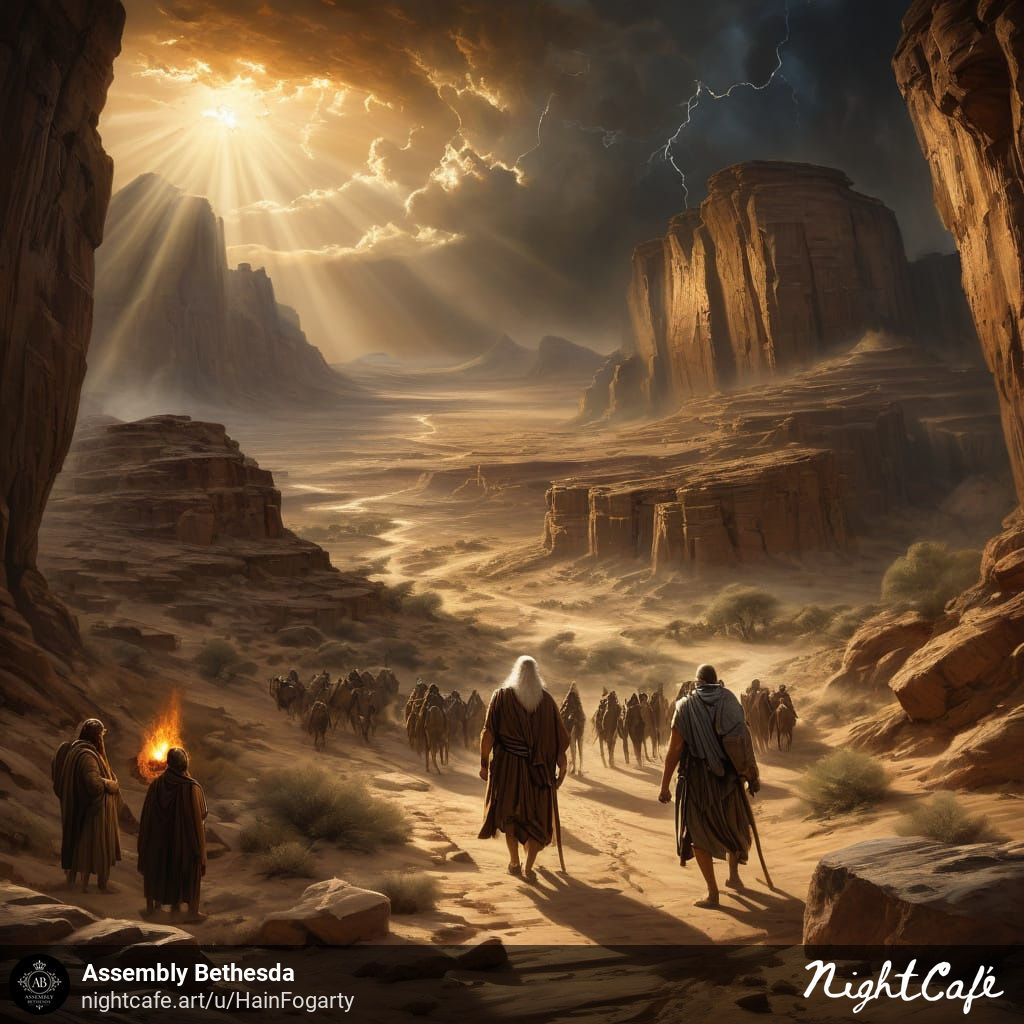
The Rebellion of Korah: A Tale of Defiance and Divine Judgment
As the Israelites wandered in the wilderness after leaving Egypt, a dramatic uprising unfolded, testing their faith and leadership to the core. In an effort to confront Moses and Aaron directly, Korah, a Levite from the Kohath family, allied with Dathan, Abiram, and On from the tribe of Reuben. They rallied 250 influential community leaders, all men of renown.
There was an accusation from their side: “You’ve overstepped your bounds. The entire congregation is holy, and the Lord dwells among us all. Why are you exalting yourself above the rest?”
When Moses heard this challenge, he prostrated himself in prayer and declared, solemnly, that the Lord would reveal who truly belonged to Him and who would be set apart as holy the following day. The rebels were instructed to prepare censers with fire and incense, which they presented alongside Aaron before the Lord.
The Levites were warned by Moses that their ambition for the priesthood was not merely against Aaron but also against God Himself, especially since they already held the position of serving in the tabernacle.
He commanded Dathan and Abiram to appear before the Lord with their censers the following morning, but they refused. They complained that he had led them from a prosperous land into a barren wilderness without delivering the inheritance promised. Despite being enraged yet righteous, Moses prayed to the Lord, affirming his integrity and rejecting the rebels’ offerings.
As dawn broke, the assembly gathered at the tent of meeting. Moses and Aaron were ordered to separate from the people for their impending destruction as the glory of the Lord manifested before all. The Lord relented, ordering the people to distance themselves from Korah’s tent, Dathan’s tent, and Abiram’s tent. Moses and Aaron pleaded for mercy, questioning whether the sins of a few should doom the many.
The elders echoed Moses’ warning, urging the crowd to avoid any contact with the rebels’ possessions to escape their fate. Dathan and Abiram emerged defiantly with their families. It was Moses’ intention to test these men: if they died naturally, he would prove his authority false, but if the earth swallowed them alive, he would prove their contempt for God.
As soon as he spoke, the ground cleaved apart, taking the rebels, their houses, and all their belongings with it. As the earth sealed shut over them, the onlookers fled, fearing the same fate. Fire erupted from the Lord’s presence, consuming the 250 incense-bearers.
Afterwards, Eleazar, Aaron’s son, was instructed to forge the consecrated bronze censers into altar coverings out of the charred remains as a perpetual memorial so that only Aaron’s descendants could offer incense, lest others suffer Korah’s fate.
Although unrest persisted, the congregation began to murmur against Moses and Aaron, blaming them for the deaths. As they gathered, the Lord’s glory returned, threatening annihilation. For the plague that had engulfed the people, Moses urged Aaron to hurry with a censer of altar fire and incense.
After halting the scourge, Aaron rejoined Moses, marking the end of this profound episode of rebellion and redemption. Tragically, 14,700 had perished beyond those lost in the initial judgment.
It serves as a timeless reminder of the dangers of envy, the sanctity of divinely appointed roles, and the swiftness of justice tempered by intercession, as outlined in the book of Numbers. In addition to challenging what is ordained, it encourages reflection on authority, humility, and consequences.
Biblical rebellion, Korah story, Numbers 16, Moses leadership, Divine judgment, Levite uprising, Wilderness drama, Faith challenge, Censer ritual, Earth swallowing, Plague atonement, Biblical warning, Spiritual authority