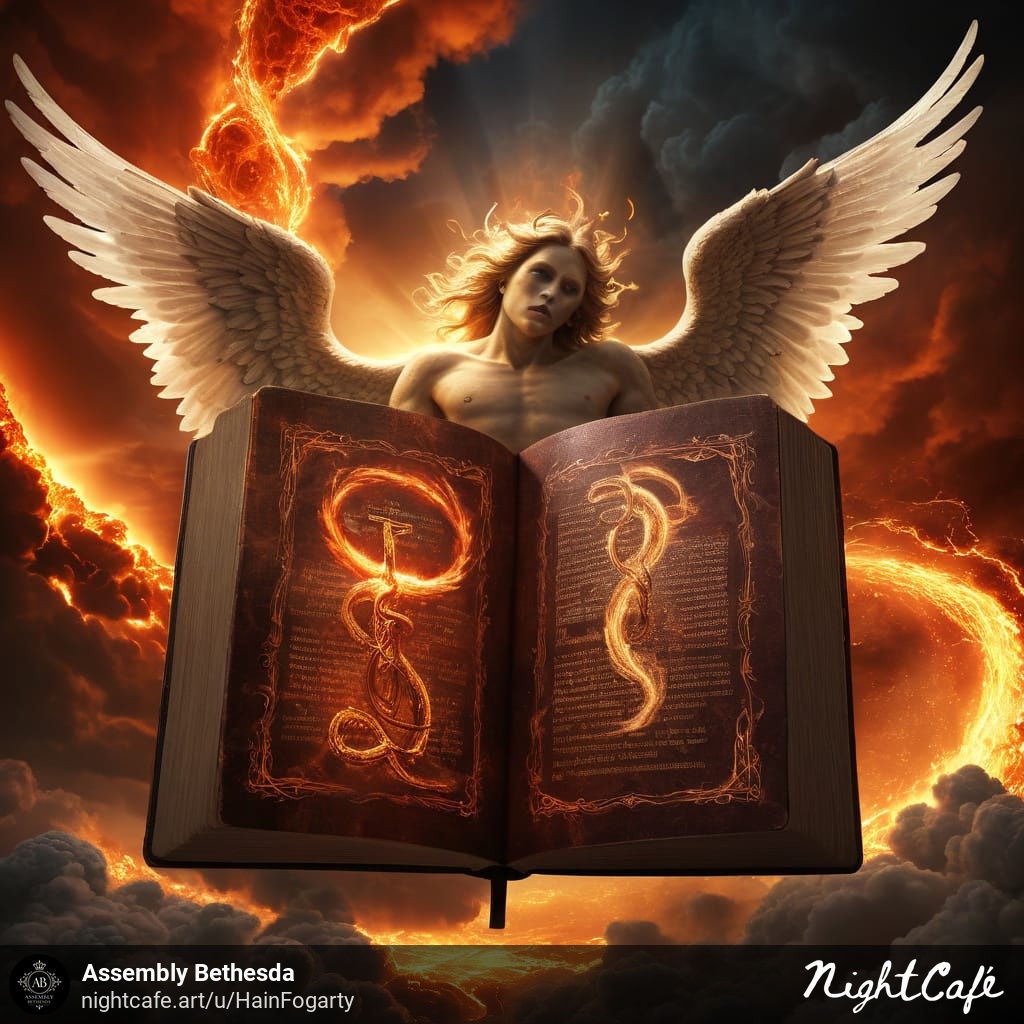
You read the Book of Revelation at midnight when everything else fades away and your mind opens up to what’s going on. As this bold, almost overwhelming display of divine beauty mixed with chaos, the apocalyptic imagery jumps off the page, not as pure terror. Besides warnings about the end, John’s visions are filled with stunning visuals that blend destruction with glory. Usually people focus on the scary parts, the fire and judgment, but there’s real art here, a kind of cosmic poetry that reveals hope.
Let’s start with the throne room. John hears a trumpet ringing through heaven’s open doors. What greets him is stunning: a throne at the center surrounded by a rainbow. A sea of glass stretches in front of the throne, clear as crystal, with 24 elders sitting around it in white robes, golden crowns on their heads. Lightning flashes, thunder crashes, and seven lamps blaze like the seven spirits of God.
It’s not a scene of panic; it’s majestic order, a heavenly headquarters where everything pulses with purpose and light. Just by looking at the colors, emerald greens, sapphire blues, fiery reds, gold everywhere, you’re overwhelmed. This is like the universe’s biggest light show, controlled and radiant, reminding you that God’s presence isn’t distant or cold, it’s alive and glorious.
This is followed by one of the most striking images in the whole book: the Lamb. No one can open the scroll that is sealed with seven seals until he sees it. At first it’s described as the Lion of Judah, but then John sees a Lamb standing as though it had been slain, yet alive, with seven horns for complete power and seven eyes that are the seven spirits of God. It’s awesome.
In worship, the elders play harps and sing about how worthiness comes from sacrifice after the Lamb takes the scroll. At the same time, it’s haunting and beautiful, showing how apparent weakness, a slain Lamb, leads to ultimate victory. Blood marks the path to triumph, transforming suffering into something poetic and redemptive. The image lingers because it captures the core mystery: glory born from apparent defeat.
As soon as the seals start breaking, the imagery ramps up fast. Four horsemen ride out, one on a white horse, one on a red, one on a black horse, one on a pale horse. Each one unleashes waves of trouble, but there’s a rhythm to everything here. It’s intense, cinematic chaos, but it’s never random. Souls cry out for justice under the altar, a great earthquake shakes everything, the sky rolls up like a scroll, stars fall like figs from a tree in a storm. Visions build tension deliberately, showing evil’s reach while keeping it bounded. God sets the limits; judgments unfold gradually.
Every trumpet brings a new disaster. Hail and fire mixed with blood torch a third of the earth, a burning mountain crashes into the sea, turning a third to blood. Wormwood poisons rivers and springs. Then the locust plague: creatures from the abyss that look like battle horses, but have human faces, women’s hair, lion teeth, iron breastplates, and scorpion tails that sting. They’re limited to five months, and don’t kill. A nightmare fuel, sure, but the details feel like dark art. The locusts represent tormenting forces, demonic powers unleashed yet restrained. God’s sovereignty is underscored by the horror.
The bowls of wrath pour out next, escalating everything. Painful sores hit people with the beast’s mark. Seas and rivers turn blood. The sun scorches people with fire. Darkness covers the kingdom of the beast. The Euphrates dries up, preparing for kings from the east. Demons gather for Armageddon. It’s heavy stuff, but the language keeps this poetic edge, echoing old prophecies while painting fresh, urgent pictures.
The beasts rise, one from the sea with ten horns and blasphemous names, another from the earth that makes fire come down and forces worship of the first. The dragon, that ancient serpent, wage war against the saints. Even in this darkness, beauty shines through in the faithfulness of the marked ones, the 144,000 sealed, the multitude in white robes holding palm branches singing redemption songs beside the sea of glass mixed with fire.
It’s dramatic: merchants weep over lost luxury, smoke rises forever when Babylon falls. Heaven rejoices, the Lamb’s marriage arrives, the bride is dressed in white linen, bright and clean, and she’s beautiful. The white horse appears, the rider Faithful and True, eyes like flames, robe dipped in blood, and he’s called Word of God, King of Kings. With the sword from his mouth, he kills nations and throws the beast and false prophet into the fire. During the final battle, Satan is bound for a thousand years, then released briefly.
In the end, we get a new heaven and a new earth. There won’t be any seas, no chaos. The holy city, the new Jerusalem, descends from heaven like a bride adorned for her husband. God dwells with people, wiping away every tear. Death, mourning, crying, and pain will stop. God’s glory shines through the city, with walls that are like jasper, gates that are as pearly as a pearl, and streets that are as clear as glass.
The foundations are full of precious stones: jasper, sapphire, chalcedony, emerald, carnelian, chrysolite, beryl, topaz, chrysoprase, jacinth. On either side of the throne is the tree of life, which bears twelve kinds of fruit, leaves that heal nations. There’s no night, no curse, God’s servants see his face, his name on their foreheads, reigning forever.
Apocalyptic imagery doesn’t scare people into submission; it’s about stirring awe at God’s plan in the closing vision. All the fire, smoke, and battle finally settles into radiant peace and beauty. It’s powerful because of its contrasts: darkness amplifies light, judgment leads to renewal, beasts fall to the Lamb. Symbols are everywhere, seven for perfection, twelve for God’s people, colors carrying layers of meaning, hybrid creatures showing spiritual realities words can’t express.
The midnight visions in Revelation remind us the world’s mess isn’t the end. Behind the chaos stands a Creator who paints with bold strokes, turning destruction into something eternally magnificent. It’s not fear that lingers after reading; it’s wonder, a quiet wonder at a God whose endgame is beauty beyond human imagination.