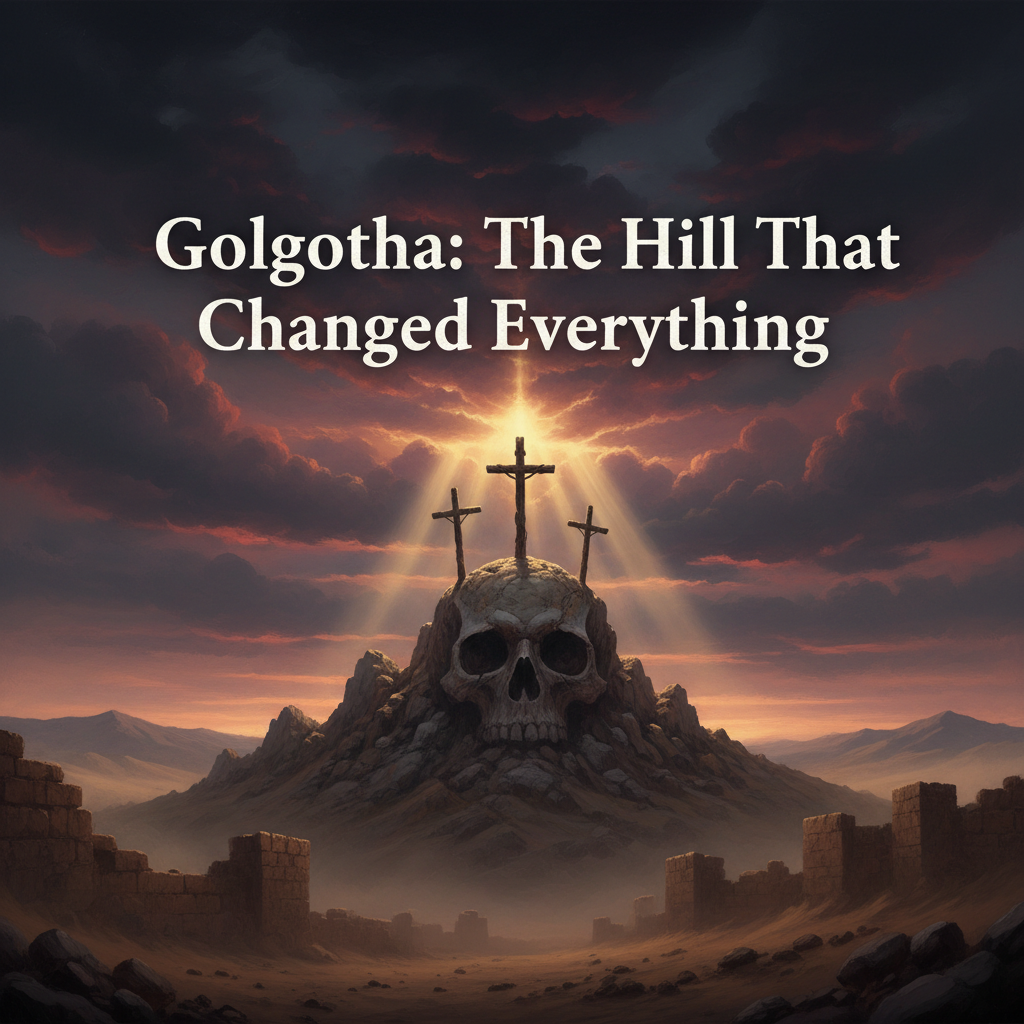
Almost two millennia ago, there was a hill outside Jerusalem that changed everything. Not gradually, not quietly, but with the force of an earthquake and the finality of tearing a curtain. Golgotha, the place of the skull, is the most significant site in human history. For two millennia, its shadow has darkened and illuminated the world.
The Romans had execution sites throughout their empire. Crucifixion was their preferred method for dealing with rebels, thieves, and anyone who threatened the Pax Romana. But on that particular Friday, a cross stood against the sky on this particular Friday, and only one of them split history in half.
Golgotha isn’t just about what happened there, it’s about what it represents. It wasn’t a palace or temple or some gleaming monument to human achievement. It was a garbage dump, a place of shame, where society disposed of its condemned. Those trash heaps were where humanity found redemption.
We can tell something from the physical location. Golgotha likely sat just outside the city walls, visible to travelers entering Jerusalem. Roman executions were public spectacles, meant to terrorize and control people. But in this case, their intimidation tactic became the most witnessed moment of divine intervention in history. The oppressor’s theater became God’s stage.
It’s told in the gospels that darkness fell from noon till 3 in the afternoon. Not a cloud passing over, not an eclipse, but darkness. It’s like the sun’s turning away. Whether metaphorical or literal, it’s the perfect image. Ancient historians outside the biblical text reported unusual darkness around this time, suggesting something atmospheric, something cosmic was happening. Creation itself recoiled as the Light of the World went out.
That hill became a cosmic battlefield. Every theological concept we wrestle with, sin, sacrifice, atonement, grace, mercy, justice, they all converged on Golgotha. That’s where human rebellion got paid for. That day, there wasn’t just the darkened sky; it was the shadow of sin meeting the light of holiness.
Romans thought they were keeping order. Religious leaders thought they were protecting orthodoxy. Pilate thought he was navigating political pressure. But something infinitely bigger was happening. Crosses meant to silence became megaphones for the gospel. Graves they intended to be final became launch pads for resurrections.
For those struggling with guilt, it’s the shadow of relief, proof that no sin is beyond forgiveness. For those seeking justice, it’s complicated, watching innocence suffer for the guilty challenges our sense of fairness. It’s the ultimate answer to those who are wondering if God loves you, love doesn’t send a card or make a speech, it bleeds.
The hill itself probably wasn’t impressive. Calvary wasn’t Everest. But spiritual geography doesn’t work like physical geography. Some places become thin spaces where heaven and earth almost touch. At Golgotha, deity met humanity in blood and tears, it became the thinnest place on earth.
When Jesus died, the temple curtain ripped from top to bottom from the massive tapestry that separated the Holy of Holies from the rest of the temple, the barrier between God and humanity. That wasn’t human hands at work. That was God saying the distance was closed, the separation ended, the way is open. Golgotha made it happen.
The early church understood this hill’s significance. They didn’t build monuments to Jesus’s teaching ministry or his miracles. They built their entire theology around his death and resurrection. Later on, Paul wrote he preached Christ crucified only. Not Christ the philosopher, not Christ the healer, but Christ crucified. Golgotha became the center.
There’s more to it than just history. Every church steeple points skyward and every communion table reminds us of that hill. The cross is so familiar that we sometimes don’t realize how scandalous it was. Romans humiliated people with the crucifixion, so Christians turned it into their symbol.
It’s amazing how Golgotha’s meaning changed. From execution to salvation. From apparent defeat to ultimate victory. From Rome’s trash heap to God’s treasure. A hill that was supposed to end a movement became a foundation for the biggest religion in the world.
In history, crucifixions have been painted, sculpted, dramatized, and contemplated more than any other moment. There’s something about that hill that grabs the human imagination and won’t let go. Maybe it’s the injustice, maybe it’s the love, maybe it’s the cosmic drama of it all.
God’s methods don’t always match what we expect. We wanted a conquering king, He gave us a suffering servant. We wanted power displays, He gave us weakness that proved stronger than any army. We wanted revolution, He gave us redemption. The hill that darkened the world became its greatest source of light.
The churches around the world remember this hill every Good Friday. They dim the lights, read the passion narratives, and sit in the darkness created by Golgotha. Then comes Sunday, when the light of the empty tomb always follows the shadow of the cross. It was one hill, one Friday, and everything changed.
The skull-shaped hill outside Jerusalem still exists. Pilgrims go there, historians debate the exact location, archaeologists dig. But the spiritual reality of Golgotha doesn’t need GPS coordinates. The shadow reaches that far, covers that much ground, transforms that completely. It’s everywhere someone realizes their need for grace and discovers it’s already been provided.
God can turn humanity’s worst moment into His greatest victory. The hill meant for ending became the place of beginning. The shadow that fell still covers us, not in darkness, but in sacrificial love.