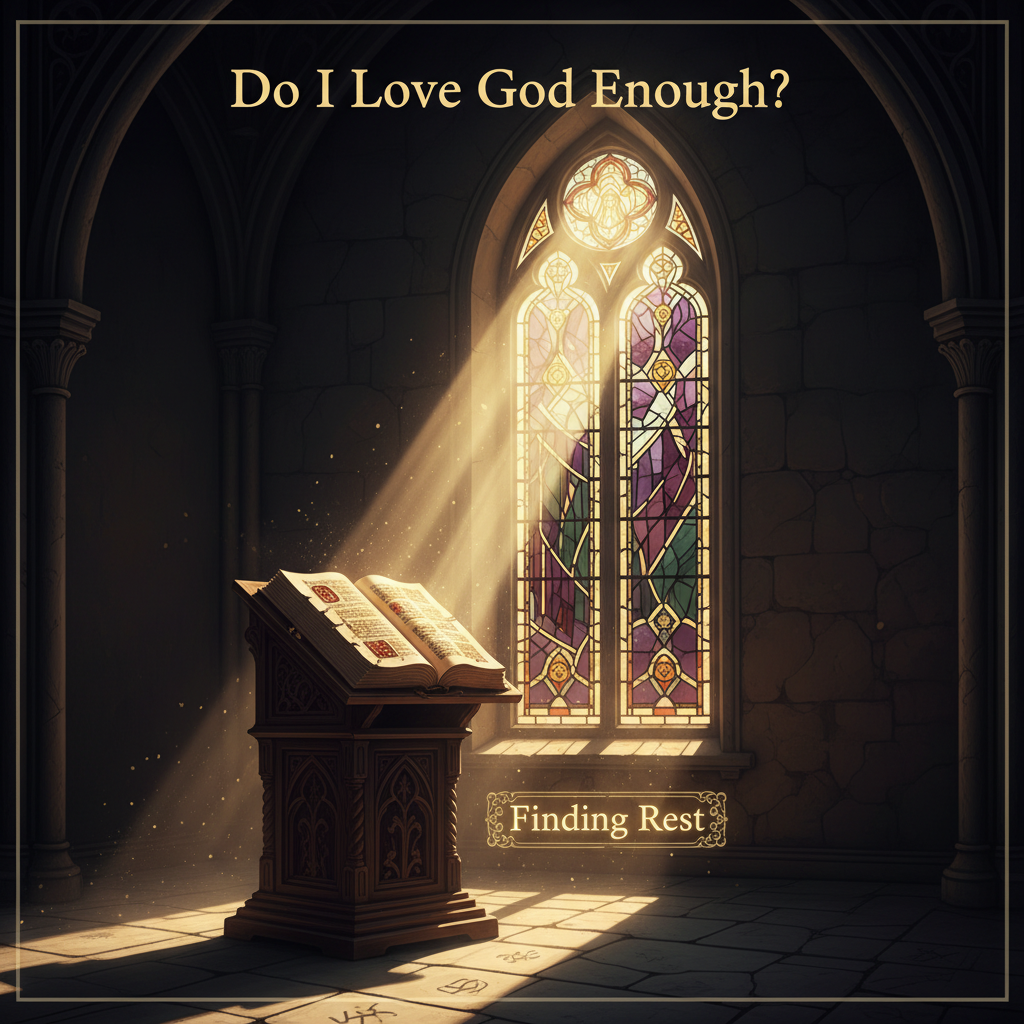
The question “Do I love God enough?” haunts many believers, especially those drawn to the shadowy corners of faith where doubt lingers like mist in a cathedral at midnight. Self-examination whispers accusations: Does my devotion go deep enough? Does my heart burn sufficiently for the Eternal? Does my love reach the level that such infinite worthiness demands?
These questions can feel crushing, especially for those whose spiritual sensibilities lean toward melancholy and introspection-souls that find resonance in the gothic atmosphere of ancient stone, flickering candles, and the solemn hush of vespers. The Christian commentators over the centuries have said that this anxiety doesn’t come from a lack of love, but from its genuine presence.
It’s only when a heart is awakened to God’s majesty that the fear of not loving Him enough arises. It’s a quiet testament to the grace already stirring in us.
There’s no human effort involved in loving God, only divine initiative. The apostle John writes plainly in 1 John 4:19: “We love because he first loved us.” This single sentence defies any notion that our love for God must reach a certain level before it becomes acceptable. We respond to God’s love, but God’s love is the originating cause.
When we were still in rebellion, He poured out love freely, even while He waited for us to prove our devotion.
Romans 5:8 emphasizes this: “But God demonstrates his love for us by this: Christ died for us when we were still sinners.” Throughout history, commentators like Augustine and John Piper have pointed out that this precedence of divine love liberates us from self-measurement.
In particular, Piper argues that genuine love for God is more about delighting in Him, finding our greatest joy in His character, glory, and presence than making feelings intense enough.
This delight-oriented love finds its clearest expression in the Shema, restated by Jesus as the greatest commandment: “Love the Lord your God with all your heart, soul and mind” (Matthew 22:37; cf. Deuteronomy 6:5). Initially, it seems like an impossibly high bar—absolute, undivided devotion across all dimensions.
Although biblical interpreters keep saying this command is given because humanity is broken and fragmented; it’s not a checklist to earn acceptance, but a description of God’s restoration of humanity. Instead of demanding sinless execution, the “all” here refers to direction rather than degree of perfection. It encourages the believer to orient every faculty—affection, will, intellect—toward the Lord.
It reminds me of the image of a soul standing in a vast, shadowed nave, turning slowly to face the altar where the eternal light burns, illuminating every shadowed recess of the heart.
In John 14:15, Jesus connects love to obedience: “If you love me, keep my commands.” The link between love and obedience isn’t contractual-obey to earn love-but relational: love naturally expresses itself through alignment with the Beloved’s wishes.
1 John 5:3 reiterates this: “In fact, keeping God’s commands is love. And his commands aren’t burdensome.” The regenerate heart finds God’s law written inwardly (Jeremiah 31:33; Hebrews 8:10), turning obedience into a pleasure. Often when commands feel heavy or burdensome, it’s not because there’s no love, but because there’s still fleshly resistance that needs to be mortified and renewed.
True love for God grows through struggles and surrender, not in spite of them, say commentators like Matthew Henry and John Owen.
It’s easy to not feel inadequacy when you read Romans 8:38-39: “For I am convinced that neither death nor life, angels nor demons, the present nor the future, any power, height or depth, or anything else in all creation, can separate us from God’s love that is in Christ Jesus our Lord.” There’s no room for personal shortcomings to cause separation with this exhaustive list.
Our fluctuating sense of devotion doesn’t override the objective, unbreakable bond forged in Christ’s blood. Paul’s confidence doesn’t depend on his own spiritual temperature, but on God’s faithfulness. When our love feels cold or insufficient, this passage calls us to shift our gaze—from ourselves to the Savior. Our love isn’t what counts most, but His love for us.
The tormenting question “Do I love God enough?” often carries an undercurrent of punitive dread—as though inadequate affection might result in divine rejection. But perfect love drives out fear, because fear is associated with punishment. The cross reveals God’s love perfectly, so such fear goes away.
The punishment we deserved has already been borne by Christ; therefore, our imperfect responses do not invite wrath, but invite further grace. Fear-casting love works progressively: as we dwell on His mercies and abide in Him, anxiety diminishes and genuine affection deepens.
Psalm 119 celebrates delight in God’s Word as evidence of love; the psalmist meditates on precepts day and night because they reveal his character.
Trust is love in trials—Lamentations 3:22-23 tells us that “the steadfast love of the Lord never ceases; his mercy never comes to an end.” Love for God also shows up horizontally: “If you claim to love God, but hate your brother or sister, you’re a liar!” (1 John 4:20). There’s an implicit question in James 4 about whether love is strong enough to relinquish control, which challenges believers to submit their desires to God. They’re not exhaustive proofs to silence every doubt, but organic fruits that come from abiding in the vine (John 15:5).
The worried believer should take heart in this: questioning reveals a heart that hungers for more of God. Indifference never asks such questions; only awakened love agonizes over its own perceived shortcomings. Let the Spirit fan the flame already kindled. Confess openly, like the father in Mark 9:24 did.
The Bible promises completion: “He who began a good work in you will carry it on to completion until Christ Jesus returns.” Growth in love is not a solitary effort but a cooperative one.
It’s hard not to be loved in the quiet gothic beauty of surrendered faith. The love of God initiated everything; your response, though imperfect and shadowed at times, is precious to Him. The cathedral may seem huge and echoing, the candles low, but the eternal Light never flickers. Turn toward it again, and let His perfect love cast out the fear that you’re not enough.