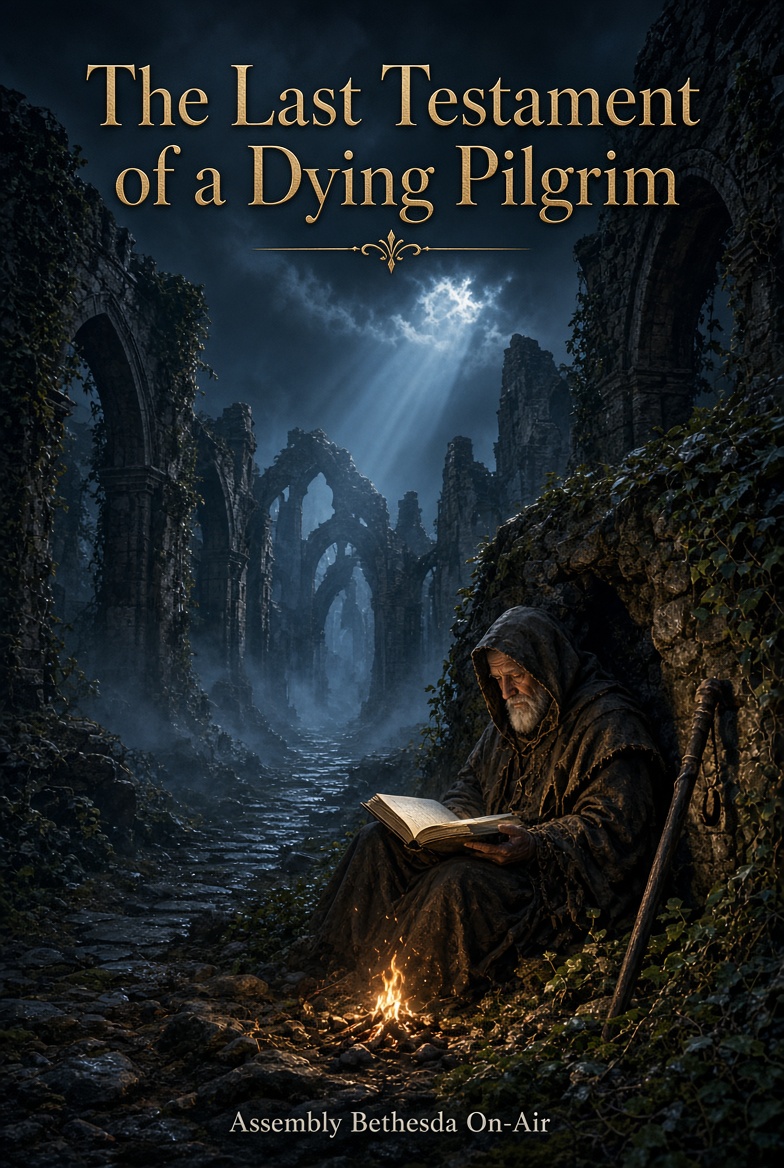
One last pilgrim walks the path through fog that clings to the stones like wet wool. Boots worn thin, staff scored with notches from every hard mile, heart still burning with the same quiet fire that started the journey years ago. It’s not a story of sudden glory, this is the final reckoning of someone who has seen the ruins, felt the cold, but still wants to tell someone else something.
Sometimes we talk about the peak moments, the clear revelations, the days when God feels thick enough to lean on. But most of the Christian life is walked in the valleys and the half-light. A pilgrim knows this. His last testament isn’t polished. It’s scratched with firelight in a leaky shelter, the voice getting thinner with every line. Despite that, every word is meaningful because it comes from a man who has already given everything and still discovered that God is enough.
It describes the places where the road disappeared, the nights when he could only hear his own breathing and a distant cry. He describes the temptation to turn back, to make a little house of comfort and call it faithfulness. Each idol had to be laid down on the stones. Some he set down gently, others he had to pry from his fingers while they still bled. The idols he tried to carry: reputation, certainty, the need to feel useful.
It shows off the gothic heart of the faith here. We’re not called to pretty faith. We’re called to walk through the broken arches of our own failures and still look up. On the pilgrim’s last pages, he looks up all the time. It’s not just decoration for him, it’s the only thing that doesn’t move when the fog swallows the trail markers. The One who hung there still held him, even when his strength failed.
In these final words, there’s sorrow. Of course there is. It’s time for him to stop pretending otherwise. His body is shutting down room by room. The friends who started the road with him are mostly gone. The prayers he prayed with fire now come out as whispers. But the sorrow isn’t the end of the sentence. There’s mercy even here, especially here. A stranger shares bread. A verse long forgotten rises unbidden. Like rain after a long drought, the wind shifts and carries a faint scent of something clean.
You don’t have to wait for the feeling of victory before you take the next step. He leaves instructions that are almost embarrassingly simple. Keep walking. When you can’t walk, crawl. When you can’t crawl, just rest in the knowledge that the road itself is held. The victory was already won in a place of skulls and darkness. The only thing you’ve got to do is keep moving towards the light that still leaks through the cracks of this world.
The pilgrim’s testament isn’t a map with every turn marked. Instead, it’s a hand reaching back through the mist, offering the same staff that carried him. Take it if you need it. The wood is worn smooth by other hands.
He writes about the Church not as a polished building but as a company of limping. We huddle in rooms that sometimes feel like the pilgrim’s shelter. We sing off-key, forget the words. We wound one another and then, by grace, bandage those wounds. Yet the pilgrim insists this broken fellowship is still the body. Love it even when it disappoints you. Especially then. The Head hasn’t abandoned the body, so shouldn’t we.
There are pages about the enemy. The pilgrim has learned to answer those whispers with older words. The real one who whispers the journey is a waste, the silence is absence, the dying is the final word. Scripture spoken into the dark until the darkness itself seems to thin. The blood of the Lamb. The words of testimony. Refusing to love life so much that it becomes an idol. These are the weapons that still work when the body is failing.
Toward the end, the writing gets slower, the letters get bigger. He knows the ink will run out soon, so he spends his last strength on Jesus. Not the idea of Jesus, not the songs about Jesus. The living Christ who still walks the road with the weary, who still breaks bread for the hungry, who still calls the dying by name, and who still promises that death has already been conquered.
It says simply, “He is enough. Even now. Especially now.”
As the pilgrim closes his eyes, the fog outside the shelter continues to dance around the stones. Somewhere beyond Human sight, the same road continues, and the same Companion keeps walking it with every soul still on the journey.
This is the last testament. Not a triumph song. Not a tidy ending. Just the honest word of one who finished it, still believing the One who started it with him would also finish it. It’ll keep you going when the staff gets heavy. It’ll remind you that the gothic beauty isn’t in the unbroken arches, but in the light that still falls through the ruins, and in the pilgrims who keep walking toward it until the end.