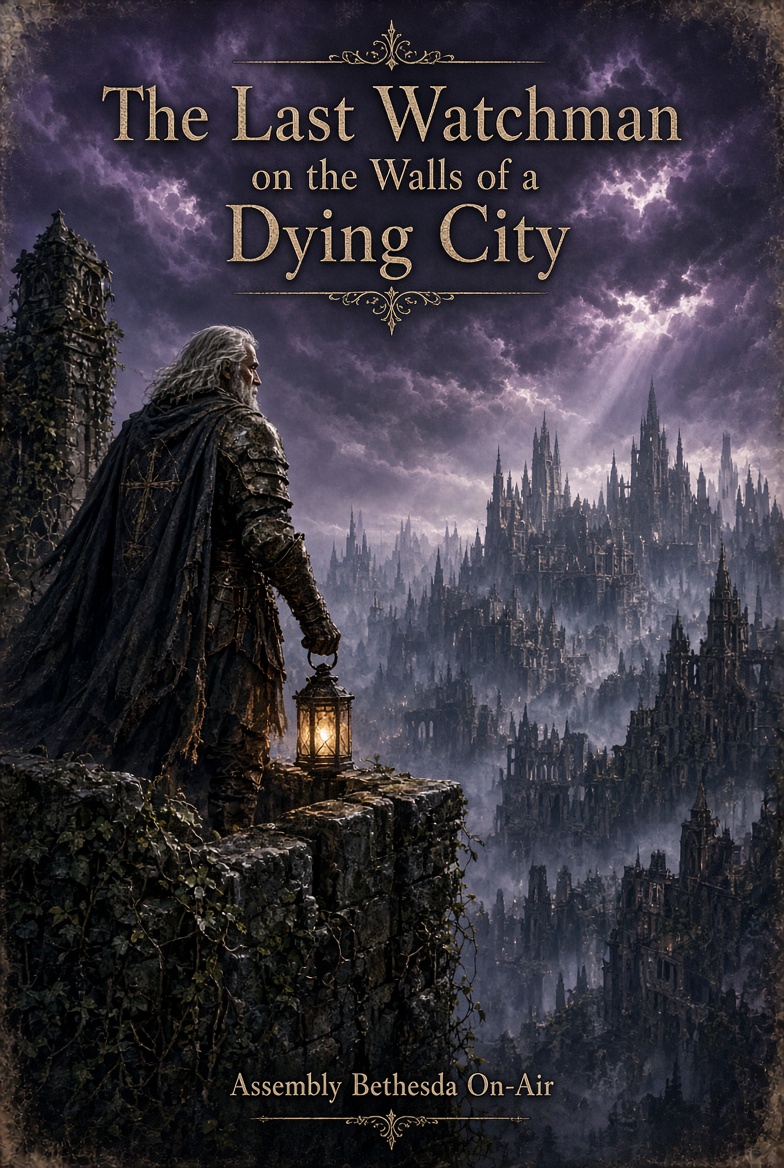
The stones still hold the cold of a hundred winters. They remember every footstep that once hurried along these battlements, every torch that once threw light into the dark. There are fewer torches and footsteps now, and the city beneath has gotten quiet in a way that’s not peace. It’s the silence of people who don’t look up.
This is the kind of city I mean, not just bricks and streets, but a place where people once called on the Lord with one voice. Then, somewhere along the way, the voice grew thin. Gates that used to swing open for the weary and stranger now hang half open or half closed, no one knows which. The market still fills, the lights still burn, but something essential has gone missing. Watchtowers stand, but the eyes that used to scan the horizon have turned inward or closed.
There’s still one figure on the wall.
The years have settled into his shoulders like moss settles into old stone. He’s watched this stretch of land for so long that it feels like a single, long night. He knows every sound the wind makes when it comes from the north, every shift in the distant tree line that means nothing, and every shift that might mean everything. It’s time he learned the difference between ordinary dark and the dark that watches.
This isn’t a glamorous post. No one brings him warm bread at midnight anymore. The relief that used to climb the stairs with a smile and a joke has stopped. Some nights he wonders if the people below even remember there’s a wall, or if the man still walks it. It’s not because the city has earned his loyalty, but because the One who put him here hasn’t released him yet.
Ezekiel was told to be a watchman for the house of Israel, to warn when the sword was near. There’s always been talk about watchmen. It was never about comfort. It was about faithfulness when the city slept, when the city forgot, when they no longer wanted to hear. The last watchman knows that call in his bones. He’s spoken the warnings. Some listened for a while. The city kept its own counsel, followed its own lights, and slowly the lights went out.
Still, he’s there.
Whenever the walls he guards belong to dying places, what does he do? He keeps walking. He keeps looking. He keeps naming what he sees, even when no one asks him to. He prays over the gates that no longer feel sacred. He intercedes for houses that have forgotten how to let the stranger in or to let the Spirit in. Despite the city being healthy, the King still claims it. So he holds the line.
With such faithfulness, there’s a loneliness. It’s not the loneliness of being alone in a room, but the loneliness of seeing clearly while others don’t. It’s in the quiet hours, when the wind blows through empty towers and all he hears is the creak of his boots against stone. It’s only through the One who walks the walls with him that he can overcome it. What could have become bitterness becomes intercession, what could have become despair becomes a quiet, stubborn hope when the Lord is present.
Optimism looks at a dying city and thinks it’s not really dying. Hope looks at the same streets and still believes the King can raise what has fallen. Last watchman carries hope like a lantern, but it doesn’t need to light the whole city. It just needs to keep him walking until the morning.
He remembers those nights when the walls were crowded with men who shared the watch, when the sound of many voices rose during the night watches, when it felt like God owned the city below. Those memories can cut. They can also steady him. They remind him that the work was never about the size of the company. It was about the One who called. The call hasn’t changed, even if the company has.
It’s rarely dramatic when a city dies. It’s the silent decision to stop gathering. The gradual silence where praise used to rise. The careful avoidance of hard words that once kept people honest. The preference for comfort over conviction. As the spiritual walls thin, people walk the streets as if nothing’s wrong. The only one who sees how far the foundation has shifted is the watchman on the high places.
But the gospel still holds. The same Lord who put the watchman on the wall can breathe life into dry bones. The same voice that created the city can bring it back. It’s not up to the last watchman to revive what’s dying. He’s just gotta stay, speak, pray, keep the lamp going until the King comes back.
That ordinary faithfulness has a kind of glory. From the street, it doesn’t look like glory. It looks like an old man pacing cold stone under a sky that feels too big. But heaven sees differently. Heaven records the prayers whispered into the wind. Heaven value the stubborn decision to keep watch even when it doesn’t feel useful.
It’s not beyond mercy that the dying city can be reached. That’s the quiet conviction that keeps the last watchman’s feet moving. He’s seen too much of the Lord’s patience to think that anything can be lost while breath remains. Seeing too many slow awakenings, he stays. He walks. He watches. He warns when he has to, comforts when he can, and prays always, always.
If you feel like that man tonight, if the walls you stand on feel empty than they used to, if the city you love has grown quiet in the wrong ways, take heart. Keeping a lonely watch isn’t new. It won’t be the end of the era. The King still walks the battlements. His eyes are still on the gates. His purpose still holds true despite the people getting tired.
The morning is coming, and the One who appointed the watchman hasn’t forgotten the walls. Keep the watch. Speak the truth in love. Pray without ceasing.
In the morning, the stones will still be cold. The wind will still find every crack in the masonry. But the watchman will be there, because the call remains, and the Caller is faithful.
Until the King says the watch is over, and the city either rises or falls into the hands of the One who built it in the first place, that’s enough for one more night.
Stay on the wall. The night is long, but it’s not endless. The same Lord who set you there will keep you.