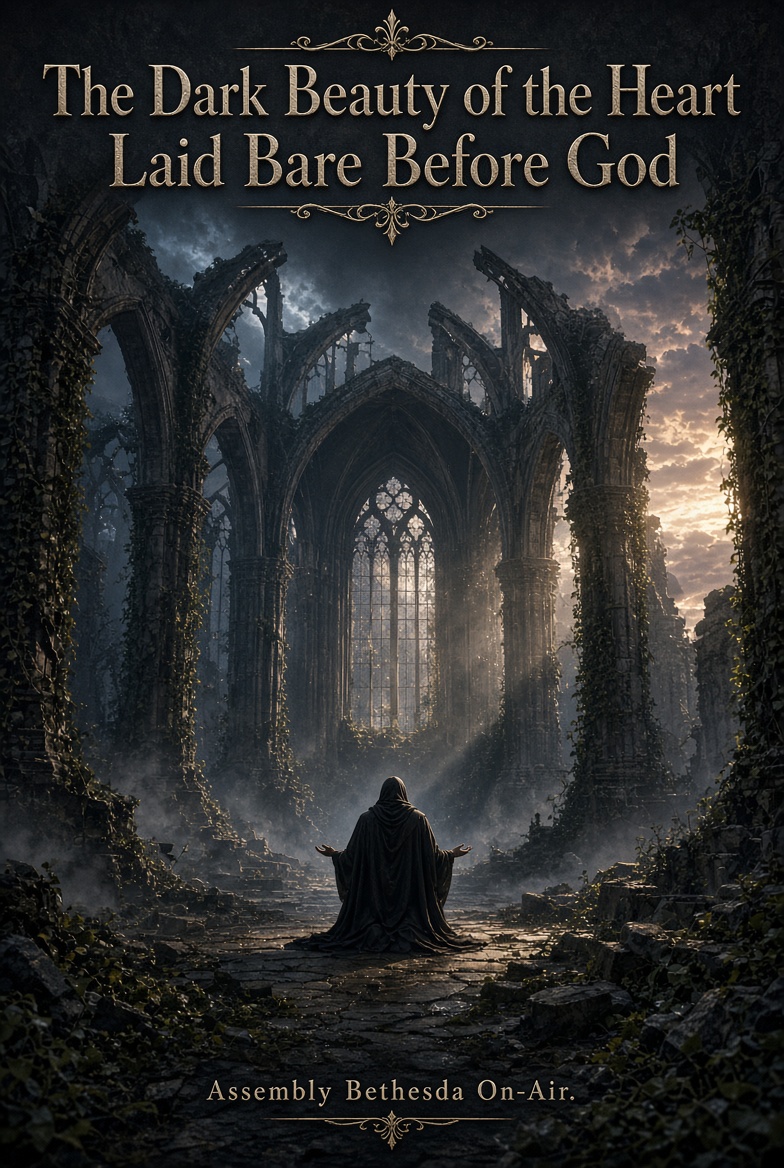
There’s a strange and holy beauty in coming undone before the One who already sees everything. Not the polished version we show at church or online, but the trembling heart that knows its own cracks. It’s the moment when the ruined cathedral of the soul stands open under a storm-lit sky, every broken arch and ivy-covered pillar visible, and yet the light still gets through.
Many of us live our lives behind carefully constructed walls. We make those walls out of good intentions, fear of judgment, and quiet exhaustion. From the outside, they can look like faith, but God doesn’t care. At night, He walks the corridors of the heart, knowing where the plaster has crumbled, where old wounds still bleed, where bitterness has taken root like moss on stone, and He doesn’t flinch.
It’s dark beauty because honesty before God isn’t just clinical. It’s intimacy. A Gothic sense of mystery helps us feel the weight of it, because it’s the soul that steps into His presence with nothing left to hide. The air itself feels heavy with old prayers and unspoken regrets. Imagine the vast, shadowy nave, lit only by high windows and the flicker of a candle. Dust motes hang in the air. That’s what the heart feels like when it finally stops performing. And into that space steps the living God, not as a distant critic but as the One who already bled for everything hidden.
This kind of exposure is all over scripture. David’s psalms don’t scrub up the despair. Job doesn’t sanitize his questions. The prophets cry out from the wreckage of their own hearts. Even Jesus lets his sorrow show in the garden. We don’t have to show up cleanly. The invitation is to come as we are, shadows and all, and let His presence do its slow, patient work.
The beauty is dark because it comes with the cost. When we lay our hearts bare, we have to face the stuff we’d rather keep hidden. The pride that still clings. The fear that still drives. The quiet resentment that has found a place in some corner of the spirit. That admits we’ve grown cold and half-hearted towards God, that we’ve preferred shadows over full light, and that admission hurts. Even though it feels like standing in a ruined chapel with the rain pouring through its broken roof, God’s presence is tangible even there. He doesn’t stand at a distance and lecture. He draws close. He sits with the brokenness and begins the work that only He can do.
This isn’t a one-time event. The Christian life is a series of these unveilings. Every season brings new layers, new walls to come down again. Sometimes it’s sudden, a sharp word of conviction that cuts through the noise. Sometimes it’s gradual, a quiet dawning that something in us has been closed off for too long. God wants it all: come out and let the heart be seen. You can trust that the One who sees it already loves it.
The other side of honesty is freedom. When we stop pretending, we also stop carrying the exhausting weight of the performance. The Gothic image helps again here. A sealed tomb is dark and airless. Even if the stone is still heavy nearby, an open tomb lets the air flow. The heart that’s been laid bare starts breathing differently. Prayer becomes less about managing appearances and more about real conversation. Worship becomes less about sounding right and more about offering what’s really there. Community becomes less about impressing and more about sharing.
It’s no secret that the enemy of our souls hates openness. He prefers locked rooms, carefully curated versions of ourselves, isolation because we feel like we’re the only ones who struggle. He whispers that if the real heart were seen, love would withdraw. But the cross stands as a permanent answer to that lie. The heart of God was exposed on that hill outside the city. Every wound, every cry, every drop of blood was public. From that vulnerability came the greatest act of love the world has ever seen. If God was willing to be that vulnerable for us, we can trust Him with our vulnerability.
It’s dark beauty is that it doesn’t end in despair. What used to choke the stone becomes the soft green of new life. Cracks that used to let in just the cold can now be channels for light. The ruined places become the sites of new growth. The heart that’s been honest before God discovers that honesty leads to deeper intimacy. He doesn’t just tolerate shadows. He enters them, and He transforms them.
This is both simple and expensive at the same time. Get out of your hiding place. Let the light reach where it’s been dark for a long time. Trust that the God who sees the ruins also sees the beauty that can emerge from them. There’s a strange and holy beauty in a heart that has nothing left to prove and everything left to offer. That’s what it’s like to be bare in front of God. Every soul who steps into the light can have it.