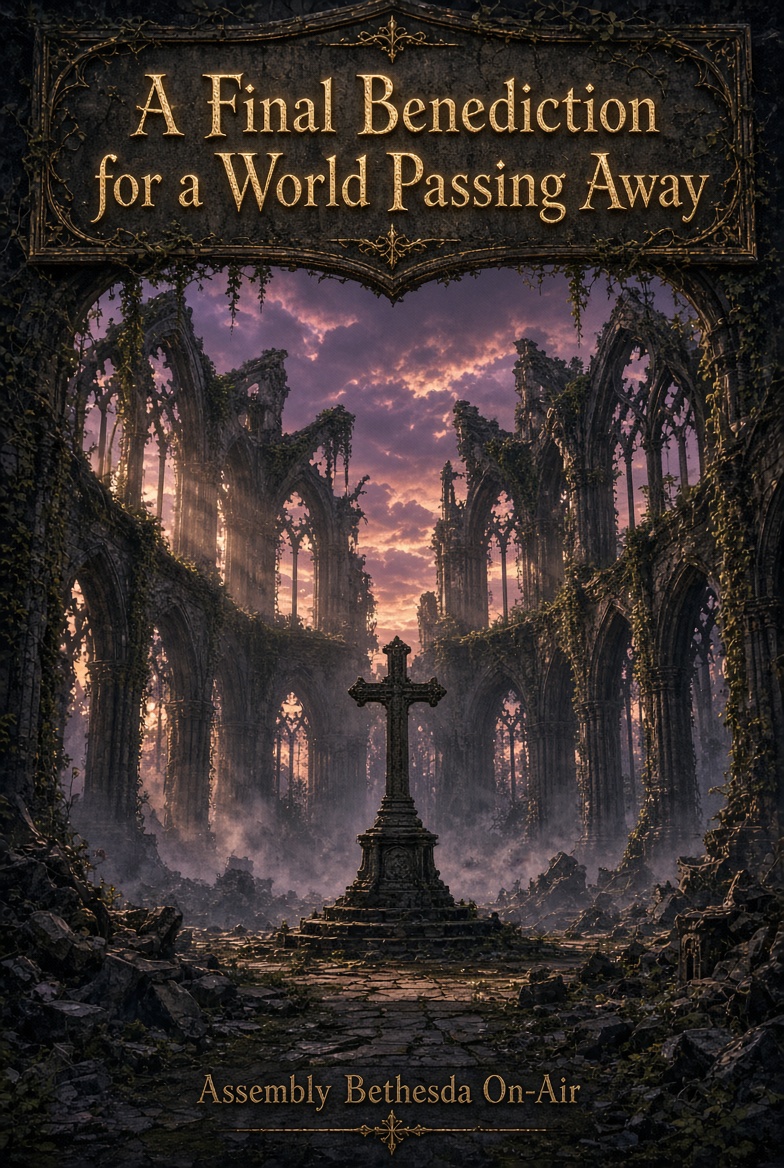
A certain kind of quiet settles over certain evenings, a kind that feels older than the houses around us and older than the roads we walk. We notice it in the thinning of old certainties, in the way familiar landmarks of faith and culture seem a bit more alone against the wind. Our world is dying, not suddenly, but slowly, like a cathedral whose stones are finally giving way to time and weather.
This isn’t a cry of despair. It’s a recognition. Scripture has always told us that this world is temporary. The grass withers, the flowers fade, the kingdoms rise and fall. This isn’t an exception. The story continues right now. And in the middle of that continuing story, God invites us to say a final blessing over what’s leaving, even while we lean towards what’s still to come.
Benedictions aren’t just polite closures. They’re blessings spoken into the gap between what was and what will be. It’s the priestly act of placing both hands on a fading world and saying in the name of the Father and the Son and the Holy Spirit that even this ending is held. Despite this unraveling, mercy is not far from us.
Our moment is like this. Institutions that once felt immovable now creak. Moral language that once carried weight now floats, thin and uncertain. Communities that gathered around a shared conviction are now scattered across competing narratives. For many, the old maps don’t match the ground beneath our feet. We feel the passing, but we can’t describe it without sounding naive or bitter.
Christian Gothic imagination gives us a language for this season. It doesn’t flinch at the ruins. It walks among them. Seeing the ivy climbing the broken walls, the light still shining on the stained glass, the way the wind blows through empty arches, the place still breathes, it notices the ruins aren’t just failures. They’re places where the sacred still speaks, even after the roof falls in.
So we walk the ruins of a passing age. We don’t pretend the stones are still whole. We don’t demand that the old forms return unchanged. Instead, we gather what still holds true and we bless the rest. To the fading world, we say: you’re not the last word. Your beauty was real, your failures were real, and now we get to work together.
The finality in this benediction isn’t the finality of extinction. It’s the finality of completion. A chapter is closing to let another one open. What remains, what cannot pass away, is the kingdom that does not shake. It is the world organized around its own survival, its own power, its own temporary arrangements. A benediction, then, is spoken from an unshakable place into a shaking one.
We bless the friendships that formed under the old sky. We bless the prayers prayed in buildings now emptied or sold. We bless the songs that once filled rooms now silent. Our blessings go out to those who kept faith when the wind of culture was behind them, and to those who still keep it now that the wind is backwards. Throughout decades of ordinary days, we’re blessed by the quiet faithfulness of ordinary people who don’t make headlines and don’t seek them out.
The next generation will inherit both the ruins and the treasure, so we bless them. They won’t rebuild exactly what we did. They aren’t meant to. They’ll find ways to bring light through different buildings. Our blessing isn’t a set of instructions. It’s a release. Go, with the blessing of those who came before you. We’ll sustain you with the same Spirit that sustains us. We’ll walk with the same Christ as you will walk with us. You’ll be held by the same Father who held us.
The moment calls for a particular kind of tenderness. Bitterness is easy. Nostalgia is easy. Both are forms of refusal. But the harder work is looking clearly at what’s ending, grieving what deserves grief, and then talking blessings instead of curses. The world that is passing away doesn’t need our anger to finish its work. It needs our intercession. It needs the steady presence of people who know that God’s purpose doesn’t end with one form.
In the Gothic sensibility, beauty and sorrow are never far apart. The broken arch still looks good. The faded fresco still holds color. The overgrown cloister still holds the shape of prayer. The earth is still in transition, and even though the forms are cracking, the presence that once filled them hasn’t left it. God who met His people in stone temples meets them now in a field, a rented room, a kitchen table at midnight. The presence hasn’t changed.
We’re not saying goodbye to God. We’re saying goodbye to an arrangement of the world that once seemed permanent. We release it with open hands. We don’t cling. We don’t rage. We bless, and then we turn.
Living as a person of the final benediction looks like resisting both despair and denial. It looks like planting gardens even when the landscape is shifting. It looks like telling the old stories with honesty about their limits and gratitude for their gifts. It looks like making space for lament without making lament the only song. Practicing small, daily acts of faithfulness has always been the true substance of the church, regardless of the culture.
The blessing looks like speaking it out loud. Bless the world that’s leaving. Bless the people confused. Bless the people who’re angry. Bless the ones who’re grieving. Bless the artists who’ll give the next generation new images of hope. Bless the pastors who’ll help them get through unfamiliar terrain. Bless the parents raising kids in a world where moral maps are constantly redrawn. Make the blessing your atmosphere.
It’s not a scandal that the world is passing away. It’s a fact that’s as old as creation itself. The only thing new is the speed and visibility of the passing in our generation. The invitation is not to panic. The invitation is to bless. We’re being shown the temporary nature of nearly everything we once took for granted.
As we stand in the long shadow of what is coming to an end, we raise our hands and say the ancient words with new urgency. The Lord bless you and keep you. The Lord make His face shine upon you and be gracious to you. The Lord lift His countenance over you and give you peace. We speak them over the ruins. We speak them over the people who still live among the ruins.
In the end, this is the final blessing for a dying world: not a curse, not a resignation, but a release in the hands of the One who remains. The world fades and forms. But the Word endures, so those who belong to it can bless what is leaving, because they already belong to something that can’t be taken.
May the God of endings and beginnings hold us steady in the in-between. May we learn the art of holy release. May our last words over this passing age be blessings, not bitterness. I hope the light in the darkness will keep shining, even when all the old lamps go out.