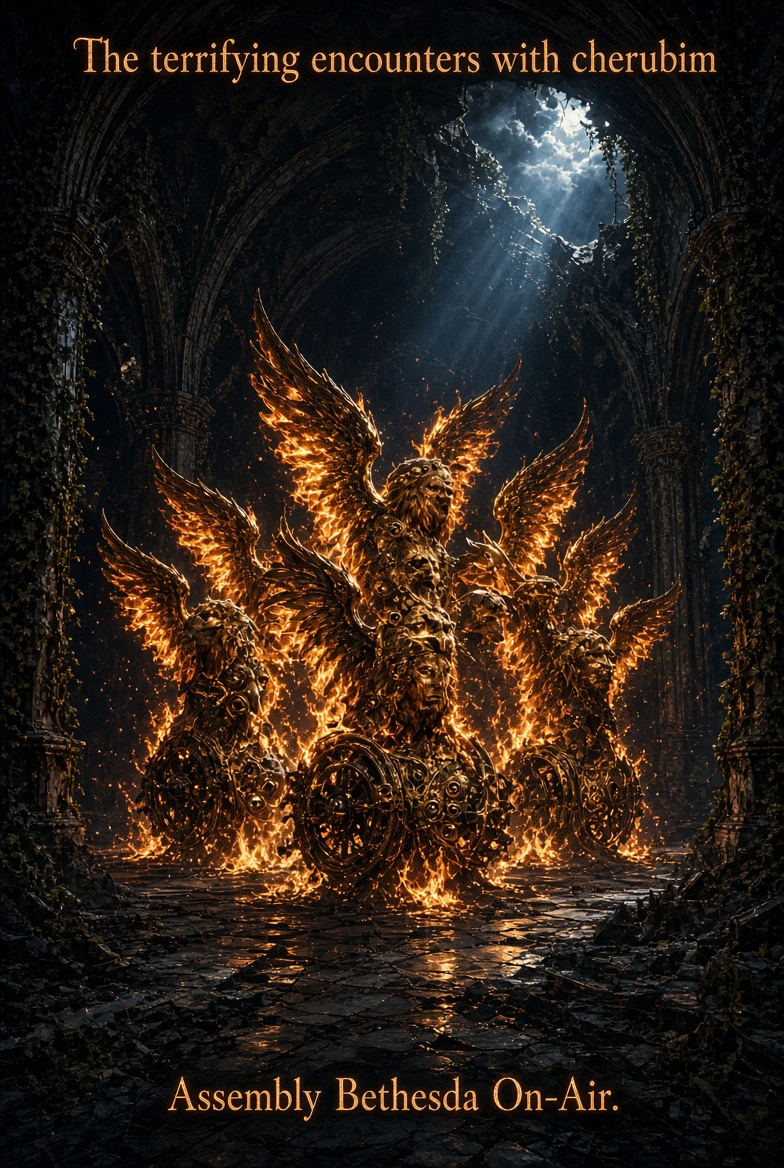
There is a kind of holy fear that settles in the chest when Scripture pulls back the veil on the cherubim. These are not soft, winged children floating on clouds. These are living flames, multi-faced sentinels, wheels within wheels of pure fire, guardians of the presence of God who make even the boldest prophets fall facedown. The encounters are terrifying in the best and most necessary way, because they remind us that the God we approach is not tame.
From the moment the first man and woman were driven east of Eden, the cherubim stood with a flaming sword that turned every way. That was not a decorative gate. It was a living barrier of judgment and mercy mixed together. Access to the tree of life was closed, and the ones who closed it burned with the holiness of the One who set them there. Imagine the heat of that sword, the sound of wings that moved like the rush of many waters, the eyes that never slept. The first humans walked away carrying both shame and a strange new knowledge: the presence of God is guarded by beings who will not let impurity pass.
Later, when the tabernacle was raised in the wilderness, those same figures reappeared in gold, carved above the mercy seat. Two cherubim faced each other, wings stretched over the place where the blood was sprinkled once a year. The high priest entered with trembling, knowing that between him and the glory stood the same order of creatures that once blocked the way back to Eden. The space was thick with incense and silence, yet the weight of those golden wings pressed down like a reminder that holiness has edges sharp enough to cut.
Ezekiel’s vision on the banks of the Kebar River is the one that still makes modern readers catch their breath. He saw four living creatures, each with four faces, human, lion, ox, and eagle, moving in perfect unity with wheels full of eyes. Fire flashed back and forth among them. Their wings roared. When they moved, the spirit of the living creatures was in the wheels, and the sound was like the voice of the Almighty. Ezekiel fell on his face. There was no gentle introduction, no soft light. There was only the overwhelming reality of beings whose very existence declares that God is other, that His throne is not empty, and that the space around it is guarded by those who never tire of crying holy.
Isaiah stood in the temple and saw seraphim, close relatives of the cherubim in the heavenly court, and the same terror seized him. The foundations shook. Smoke filled the house. He cried out that he was ruined, a man of unclean lips living among a people of unclean lips. The encounter did not leave him entertained or mildly inspired. It left him undone, then cleansed, then sent. That is the pattern. The terrifying meeting with the guardians of the throne is never the end of the story. It is the beginning of a deeper surrender.
In the book of Revelation the living creatures appear again, full of eyes in front and behind, never ceasing day or night to declare the holiness of the One who sits on the throne. Around them the elders fall, the angels throng, and the whole of creation is summoned to worship. The terror is not the kind that drives us away forever. It is the kind that drives us to our knees so that grace can lift us up again.
Why does God allow these encounters to be written down for us? Because we need the reminder that casual familiarity with the Almighty is a modern invention. The cherubim stand as living proof that the presence of God is both the safest place and the most dangerous. Safe because nothing impure can remain near Him. Dangerous because the fire that surrounds Him will either purify or consume.
When we read these passages slowly, something shifts. Prayer stops feeling like a casual conversation with a distant friend and begins to feel like standing on holy ground with shoes removed. Worship stops being background music and becomes the only possible response to a God whose attendants are themselves flames of fire. The fear of the Lord, which Scripture calls the beginning of wisdom, stops being an abstract idea and becomes a living reality that settles into the bones.
The cherubim also guard the way forward. In Christ the flaming sword has been satisfied. The curtain of the temple was torn from top to bottom, and the way into the Most Holy Place is open. Yet the cherubim still stand in the visions of heaven, still cry holy, still remind every believer that the God who invites us near is the same God whose presence once made prophets collapse. Access does not cancel awe. Grace does not erase glory. The same Jesus who said come unto Me is the One before whom every knee will bow, and the living creatures around His throne never stop declaring it.
So we live in the tension. We draw near with confidence because the blood of Jesus has opened the way. We draw near with trembling because the One we approach is still surrounded by fire and eyes and wings that move like the sound of many waters. That tension is not a problem to solve. It is the atmosphere of true worship. It keeps us from treating the presence of God like a comfortable living room and teaches us instead to treat it like the throne room it is.
The next time the ordinary feels too ordinary, open Ezekiel 1 or Isaiah 6 or Revelation 4. Let the words paint the scene again. Feel the heat of the fire, hear the rush of the wings, see the eyes that miss nothing. Let the holy terror do its work. Then rise, because the same God who posts cherubim as guardians also calls His children to come boldly to the throne of grace. The fear and the invitation stand side by side, and both are gifts.
In a world that has domesticated the divine, the cherubim still refuse to be tamed. They stand where they have always stood, between the holy and the common, between the throne and everything else. Their presence is a mercy. Their terror is a kindness. And their unending cry of holy is the soundtrack of heaven that we are invited to join, even while we still walk the shadowed paths of earth.