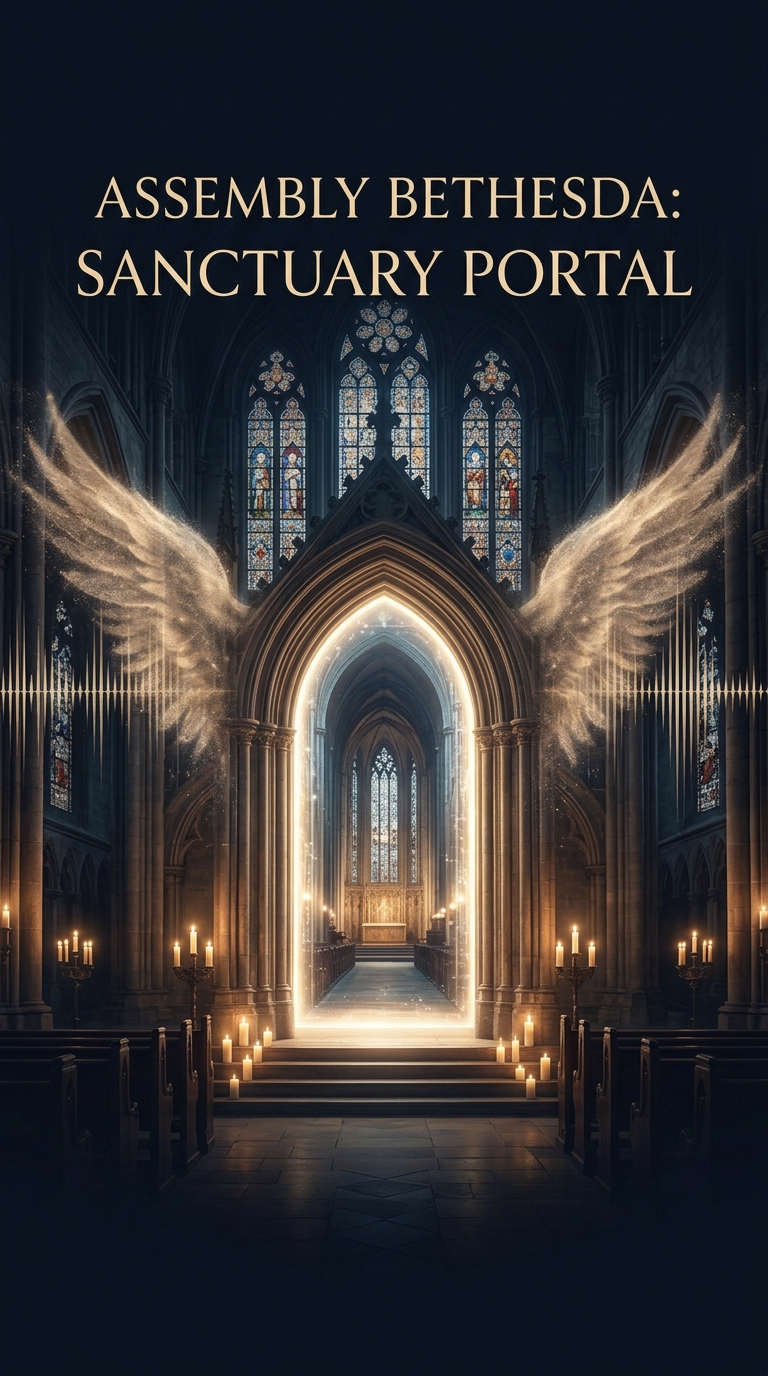
The ministry moves without announcement in a dimly lit sanctuary, where candle flames flicker against ancient stone and old wood smells. God sends guardian angels to walk alongside His people, but they don’t see them. They’re described in Scripture with quiet certainty, not as distant figures of myth, but as active servants who carry out the Lord’s work in ways we don’t see.
The Bible doesn’t present angels as ornaments of religious imagination. According to Psalm 91, He’s going to send angels to guard you in all your ways. Hebrews says they’re ministering spirits sent to serve those who’ll get to heaven. These aren’t vague poetic flourishes. They’re about a real creation order, a pure spirit that exists to serve the Father’s will. They often guide and protect souls.
Christian Gothic sensibilities find something deeply fitting in this reality. Gothic has always been about the thresholds, the places between light and shadow, the sense of something bigger than what can be seen. Cathedrals at dusk, stained glass darkening into deep blues and crimsons, the low murmur of prayer, the atmosphere that feels heavy, all of that is perfect for remembering the unseen. Guardian angels belong there. As the stone pillars that have held up sacred roofs for centuries, they don’t shout. They don’t demand attention. They just remain.
Take a look at the ministry. It’s not flashy. It doesn’t consist of dramatic rescues that make the evening news. Most of the time it’s the inexplicable peace that settles when fear tries to take over, the quiet redirection of steps, the sudden strengthening of resolve during temptation. Sometimes you feel like you’re not alone on a dark road, or that a particular word of Scripture comes at the right time. These are the fingerprints of a ministry that prefers to remain hidden so He can get the glory.
Gothic imagination helps us keep this truth without making it sentimental. Angels aren’t the soft, floating figures of greeting cards. In Scripture, they appear with power that unsettles. They speak and people fall to the ground. Their ministry is marked by authority and purity, not prettiness. They stand between the living and forces that would destroy. It’s good to remember how serious this office is when we look at them watching over the faithful. Their presence carries the order of heaven into the messy, shadowy places of human life.
The guardian angel is a living example of faith. It’s a living illustration that we’re called to walk by faith, not by sight. We don’t see the one assigned to us, yet the promise stands. In a world still marked by the fall, the Lord hasn’t left His children unprotected. There are forces that oppose, but there’s also a counter ministry that moves in silence, steady and faithful. The gothic mood, with its love of mystery and refusal to simplify everything, makes room for this. It doesn’t ask us to explain away the shadows. It just insists that God’s light shines through.
In light of this ministry, how should we live? First, with gratitude that doesn’t require proof. To believe angels are working, we don’t need to count every close call or every unexpected mercy. The Word is enough to believe. Secondly, with a quiet attentiveness. God commands the angels, but he also invites us to pray, read Scripture, do the sacraments, and do the ordinary means of grace. A guardian’s work doesn’t replace our own response. It’s a support. Third, with a sober awareness that spiritual reality isn’t just the material world. The Gothic tradition has always understood that. The veil is thin. The seen and the unseen are inextricably linked. If you just live like there’s only what’s visible, you’re half awake.
Many days feel ordinary, even heavy. The path doesn’t always seem clear. Doubts creep in. Loneliness settles like fog. In those hours, knowing an angel is a guardian can calm the heart. Not because the angel replaces Christ, never that, but because the angel is a servant of Christ, a reminder that the King hasn’t forgotten you. The same Lord who walked dusty roads and knew exhaustion arranged for company that doesn’t get tired.
The church has long held this teaching close, even when it’s quiet about it. In older liturgies and the writings of the fathers, the presence of the holy angels is simply assumed. They join the worship of the congregation. They watch over the baptized. When you die, they’re ready. There’s something in Christian Gothic architecture and art that tries to capture the sense of a bigger group gathered around the altar, the feeling that the stone walls themselves are participating in a conversation that began before we arrived and will continue after we leave.
Our ministry is already given. It is quiet. It is constant. It is ordered under the authority of the Son, so we don’t have to invent new doctrines or chase after private revelations. All we have to do is accept it with the same quiet trust that goes hand in hand with the best of gothic devotion, a trust that lets us sit in the dim light of a candle-lit chapel and know there’s more to it than what can be seen. Guardians keep watch. The Lord keeps His word. The soul that rests in that double faithfulness finds peace that doesn’t depend on perfect understanding.
At the end, the guardian angels’ unseen work points to a bigger and more alive creation than what we can see. It points to the character of God who cares enough to appoint such help. And it points to a final day when the veil will be pulled back and the whole company of heaven will be seen as it has always been, surrounding the throne and serving the redeemed. Until then, we continue in silence, faithful, hidden, and under the hand of the One who never sleeps. We walk, and they walk with us.