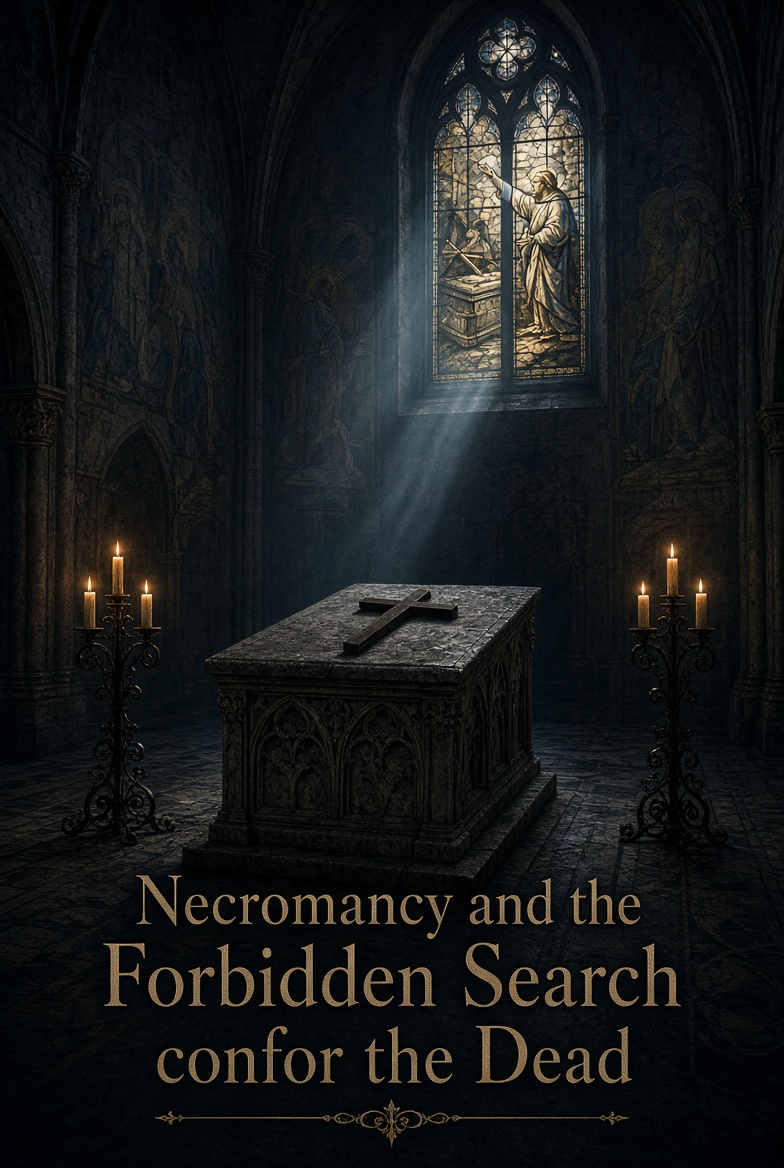
Whenever people talk about the dead, there’s a certain hush. Not the quiet of a funeral, but the kind that happens when someone says they’ve heard something, felt something, or reached for something on the other side of the wall. There’s something coldly sweet about that hush, which the old stories called necromancy. It’s the forbidden search for the dead, trying to get power, comfort, or knowledge from those who’ve already passed over. A Christian Gothic frame looks at that longing with open eyes, not with academic distance, and calls it what it is: a wound that keeps bleeding because it refuses to close.
This isn’t taken lightly by Scripture. God sets a clear boundary from the earliest pages. You don’t want to seek the dead. It’s the same impulse as the command against idols and child sacrifice: refusing to trust the living God with death. Saul’s night visit to the medium at Endor is a classic cautionary tale. A king who once walked with God ends up disguised, desperate, and hears a voice that confirms his fate. The scene is pure Gothic atmosphere, the midnight consultation, the trembling medium, the apparition that speaks judgment. But the real point isn’t the special effects. Saul had already been rejected by God, so the dead could only echo that rejection.
We still feel the pull. Grief is real. Curiosity is real. The ache to know what happens after the last breath is older than Adam. Those are modern versions of the same search: sessions called “spiritual exploration,” apps claiming to channel departed loved ones, books claiming to offer “messages from the other side.” Packaging changes, but hunger doesn’t. Hunger has always been a beautiful danger in Gothic literature.
Think about the ruined abbeys and the candlelit crypts, the wandering figures in the churchyard. These stories aren’t celebrations of the occult. They’re warnings written in velvet and shadow. They show us how easy it is to trade the hard light of resurrection for the soft glow of a seance table.
We can’t summon the dead, so it’s forbidden to search for them. The keys to death and Hades belong to God alone, so we can’t summon them. When Jesus stands outside Lazarus’ tomb and shouts him out, the power isn’t in some ritual formula. The power is in the voice of the One who is the Resurrection and the Life. That’s Christian’s answer to all necromantic impulses. We don’t have to dig in there for comfort. It’s already been opened from the inside. As Christ walked out, He invites us to walk with Him into a life beyond death.
There’s still the temptation. It feels almost reasonable in times of loss. Why not just one more conversation? Why not just one more sign? Gothic imagination knows what that logic sounds like in the dark: reasonable, almost gentle, until it opens and something colder steps inside. The Bible’s warnings aren’t about scaring us away from mystery. They’re about protecting us from a fake intimacy that can’t satisfy. The dead cannot give us peace. It’s only God who can do it.
So we practice a different kind of remembrance. Instead of calling their spirits, we live the faith that they lived. We light candles not to summon, but to remind ourselves the Light shines through the darkness and won’t be overcome. We visit graves to honor the body that will one day rise, not to interrogate the soul that has already gone to its rest or its judgment. A Christian Gothic posture is to love the night, the stone, the candle, the silence, but not let it be our teacher. The night is just a backdrop for the Cross and the empty tomb.
You’re not alone, and it’s not hopeless if you’ve ever felt that pull. The same Christ who forbade searching also invites brokenhearted people to come to him. The gospel doesn’t mock the ache. It fills it with Himself. Necromancy offers a shadow conversation, but the gospel offers a living Person who has already fought the last enemy. Choose the living One. The dead don’t have anything better to offer.